
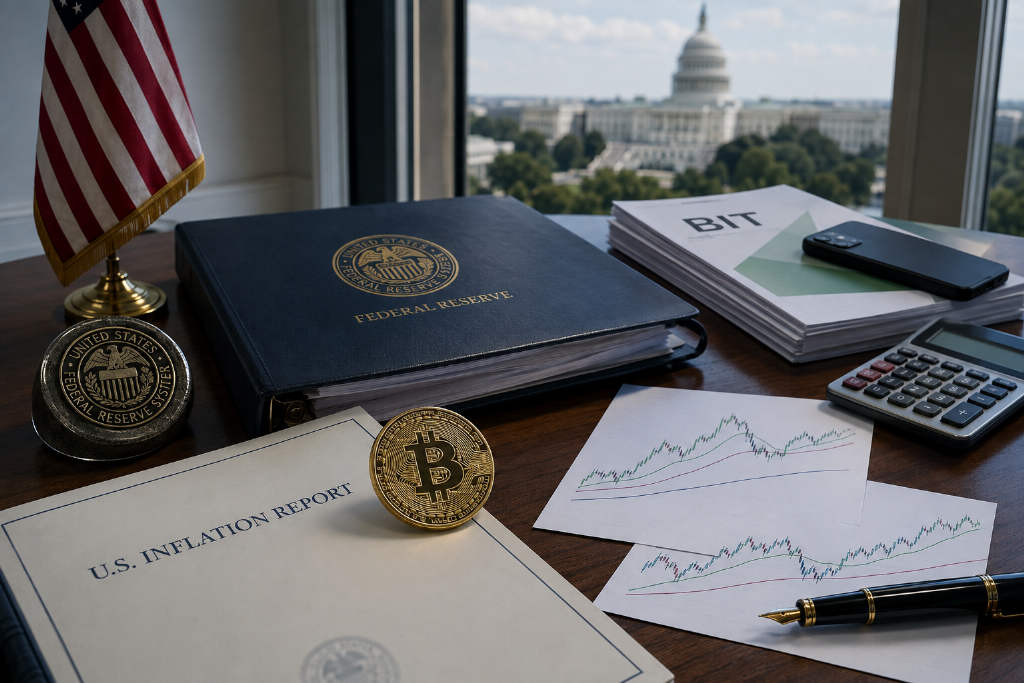
Bitcoin gave up the $80,000 level after a stronger-than-expected U.S. jobs report lifted rate-hike expectations, with traders now focused on this week’s CPI and PPI releases and the final stretch of pricing before the Federal Reserve’s Sept. 15-16 policy meeting.

The original report was jointly produced by PANews and BIT U.S. Stocks. It says BIT U.S. Stocks offers access to more than 10,000 U.S. main-board stocks and ETFs, supports stablecoin deposits and withdrawals as well as traditional U.S. dollar wire transfers, and includes full shareholder rights, dividend entitlements and voting rights.
Strong payrolls data pushed Bitcoin back below $80,000
On Thursday, Bitcoin briefly climbed near $82,000 after dovish remarks from Federal Reserve Governor Waller. That move reversed on Friday when U.S. August nonfarm payrolls came in far above expectations. The report put new jobs at 162,000, close to three times the market forecast. Rate-hike odds then rose from around 50% to about 60%.
The rates market reacted quickly. The 2-year U.S. Treasury yield rose to 4.41%, its highest level since January 2025. Bitcoin then pulled back from the $82,000 area and consolidated around $79,500.
Even so, the decline was smaller than in earlier episodes when rising hike expectations and a jump in Treasury yields hit crypto at the same time. The report points to flows as part of the explanation. U.S. spot Bitcoin ETFs posted about $987 million in net inflows last week, the third straight positive week. Over the past three weeks, cumulative inflows reached about $3.8 billion, the strongest three-week stretch of 2026.
Resistance is clustered between $82,000 and $84,000
From a technical perspective, overhead resistance is concentrated near the 50-week moving average and the $82,000 to $84,000 zone. Several technical analysts cited in the report said BTC has not yet made a decisive move above the 50-week moving average and has also failed to clear the May high at $83,000. On that basis, they said the market still cannot confirm a higher high.
Colin Talks Crypto said the end of a bear market has historically required two consecutive weekly closes above the 50-week moving average. Doctor Profit said a high-volume break above $82,500 could open the way to $88,000.
On the downside, the market is watching the $77,000 to $78,750 range. Killa said Bitcoin tends to move into range-bound trading after a sharp rally, and flagged $77,000 as a key level to watch.
At the same time, Dirk Crypto Diggy said bearish divergence has appeared on the daily, 12-hour and 4-hour time frames. He also noted that September and October are usually weaker months in bear-market cycles, leaving late buyers exposed to what the report described as a “sell the news” setup.
Options traders are bracing for big CPI-day swings
The options market is also preparing for a volatile macro week. According to the report, traders are buying protection for large moves on CPI day. If spot BTC can hold above $78,500 and call positioning in options continues to build in the $82,000 to $85,000 range, an upside break could trigger dealer buying and add momentum.
If CPI runs hot and volatility rises instead, seller hedging could amplify a downside retest.
BIT Asset Management says CPI will decide whether the golden cross can hold
Daniel YU, head of BIT Asset Management, said September has historically been a weaker month for Bitcoin, with 9 of the past 15 years ending lower. He said the expected “golden cross” between the 50-day and 200-day moving averages is likely to appear around Sept. 11, landing near the release window for August CPI.
In his view, this week’s PPI and CPI data will directly shape market pricing ahead of the Fed’s Sept. 15-16 meeting. If CPI is moderate, the combination of a golden cross and returning ETF inflows could turn $80,000 from resistance into support. If CPI is hotter than expected, a realized hike combined with September seasonality could raise the risk of a move back to $77,500, or even into the $72,000 to $74,000 range.
Key points for the day
- This week’s calendar includes Anthropic’s planned IPO prospectus filing and the release of U.S. August CPI and core CPI.
- APT, LINEA, CHEEL and PEAQ are scheduled for major token unlocks this week.
- Upbit will delist BONK on Sept. 7.
- Ondo Finance will stop minting USDY on Aptos and Noble starting Sept. 8.
- Michael Saylor said the goal is to push STRC back to peg around Sept. 8.
- Upbit’s 24-hour trading-volume ranking: XRP, RAY, BTC, ORCA, ETH.
- Spot Bitcoin ETFs saw $987 million in net inflows last week, the third consecutive week of net inflows.
- Spot Ethereum ETFs recorded $218 million in net inflows last week, also a third straight week of net inflows.
- Spot SOL ETFs posted $6.1751 million in net inflows last week, extending the streak to 10 weeks.
- Spot XRP ETFs drew $18.9602 million in net inflows last week.
- Spot HYPE ETFs recorded $12.2734 million in net inflows last week.
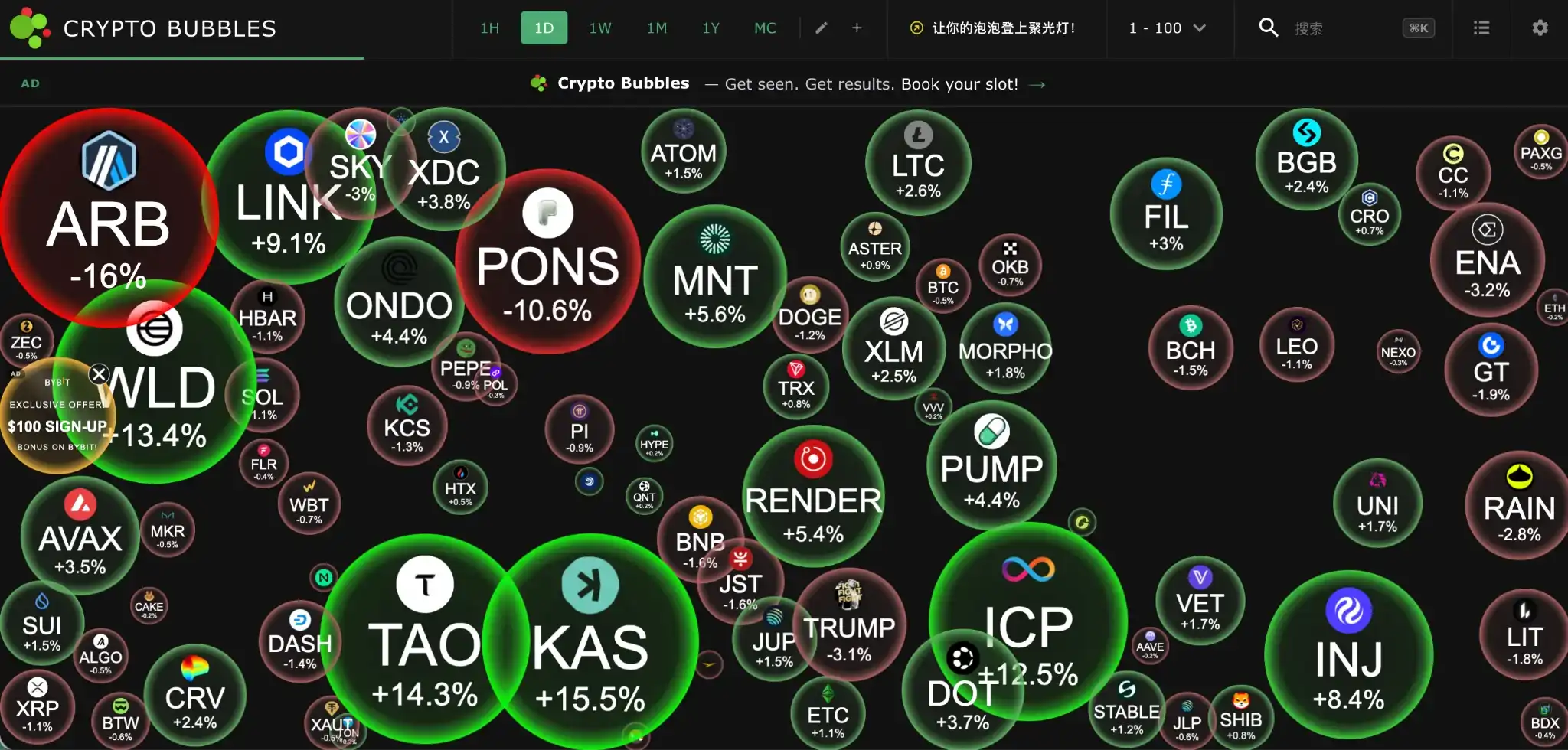
Among the top 100 tokens by market capitalization, the biggest gainers were KAS, up 15.5%; TAO, up 14.3%; WLD, up 13.4%; ICP, up 12.5%; and LINK, up 9.1%.
U.S. equities were pressured by the jobs data, while AI hardware outperformed
U.S. and Canadian markets were closed Monday for Labor Day, leaving Friday’s close as the last reference point before the holiday. The Dow fell 0.51%, the S&P 500 lost 0.38%, and the Nasdaq declined 0.29%. The report says the payrolls release was the main driver, as stronger employment data reinforced the idea that rates could stay higher for longer.
This week, traders will look to Thursday’s PPI and Friday’s CPI for confirmation ahead of the September Fed meeting.
Matt Maley, chief market strategist at Miller Tabak, said 4.8% on the 10-year U.S. Treasury yield is a critical threshold. If yields remain above that level, the impact would spread beyond bonds into richly valued growth stocks, commercial real estate and other long-duration assets. Michael Chen of ARK Noah Hong Kong also said “fiscal dominance” is forcing investors to demand higher risk compensation.
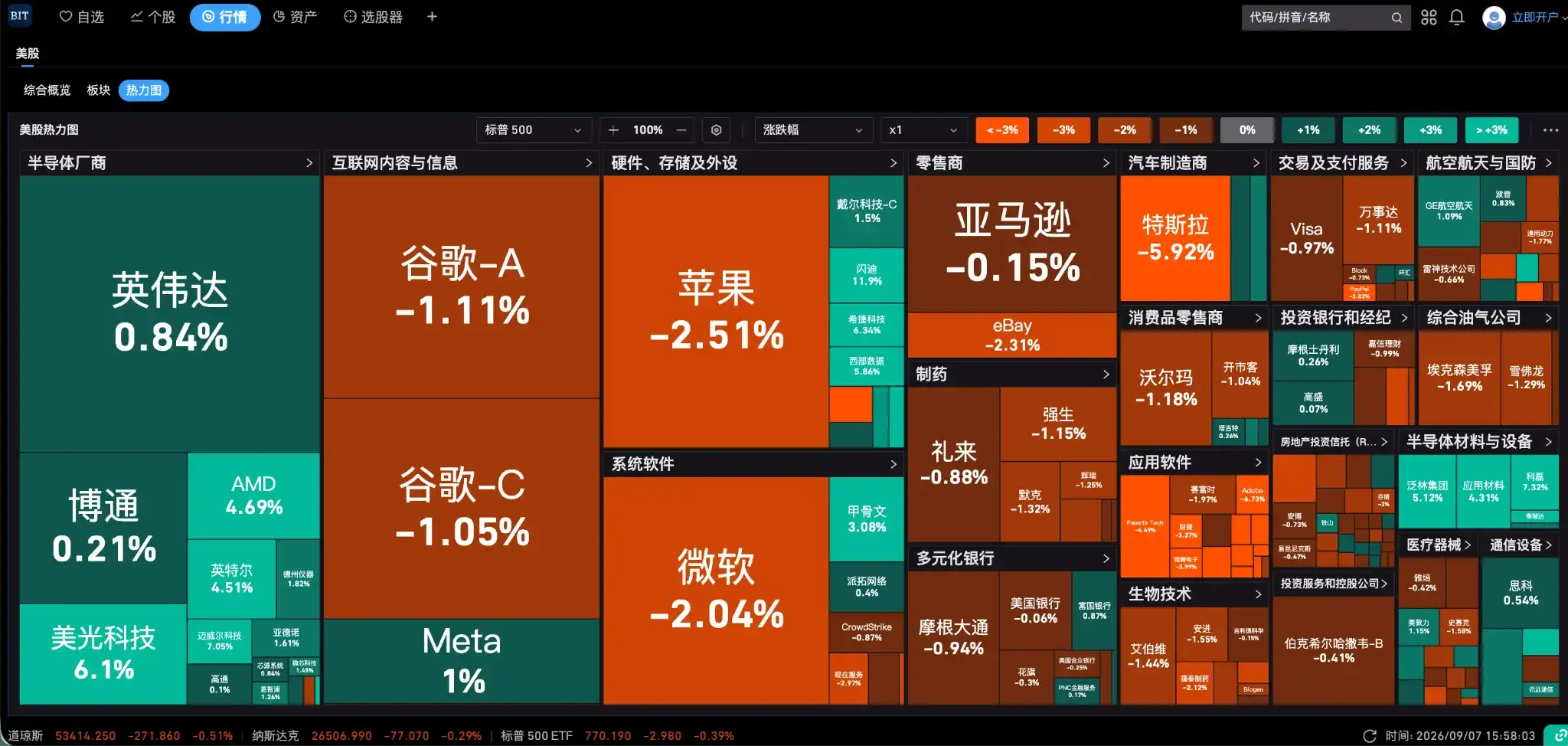
Tesla dropped nearly 6% on Friday, its biggest one-day decline in recent trading. The report said the Cybercab event had no livestream, Elon Musk did not appear, and the fleet scale and rollout schedule lacked clarity. It also cited an NHTSA investigation into self-certification procedures for vehicles without steering wheels or pedals, framing the move as another case of buying the rumor and selling the fact. Apple, Microsoft and other large-cap technology names also pulled back.
AI hardware stocks held up better. The Philadelphia Semiconductor Index rose 3.37% on Friday. Aehr climbed 13.1%, Kexin Semiconductor rose 10.31%, KLA gained 7.32%, Lam Research added 5.12%, and ASML advanced 4.17%. Nvidia rose 0.84%. Jensen Huang said “AGI has arrived” and said OpenAI Astra is backed by an Nvidia training cluster of more than 100,000 GPUs, with 400,000 GPUs set to come online. The Kobeissi Letter estimated that the number of large U.S. data centers could rise from about 90 to 280 by 2030, with tech-company investment in data centers potentially reaching $7 trillion.
As U.S. trading resumes Tuesday, the report says investors will keep watching Nvidia, AMD, Broadcom, Micron, SanDisk, TSMC, Oracle, CoreWeave, Vertiv, and the broader optical-communications and data-center power chain.
Crypto-linked stocks were mixed, and miners diverged
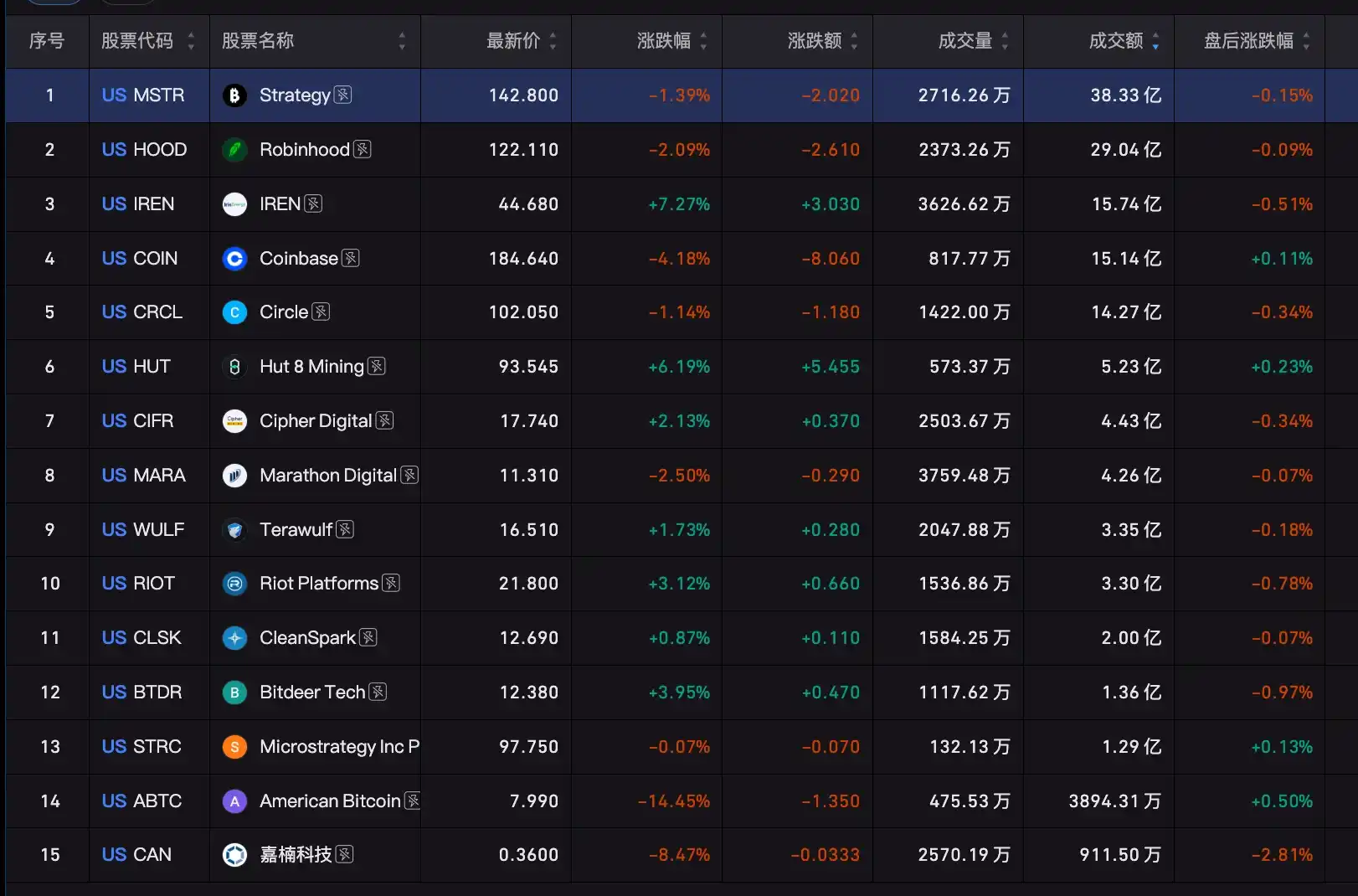
According to BIT U.S. Stocks data, crypto-related equities moved in different directions. Circle fell 1.14%, Strategy lost 1.39%, Robinhood slipped 2.09%, and Coinbase dropped 4.18%.
Among miners, IREN led gains with a 7.27% rise. Hut 8 Mining added 6.19%, Bitdeer gained 3.95%, Riot Platforms rose 3.12%, Cipher Digital climbed 2.13%, and Terawulf advanced 1.73%. Marathon Digital fell 2.50%, Canaan dropped 8.47%, and American Bitcoin sank 14.45%.
Japan and South Korea rallied on chip strength, while Hong Kong optical names outperformed
In Asia-Pacific trading, the strongest performance came from South Korea and Japan. South Korea’s KOSPI closed up 4.6%, Japan’s Nikkei 225 rose 2.1%, and the TOPIX added 0.6%.
In South Korea, the core narrative was that the AI memory cycle is not over. Goldman Sachs Asia-Pacific chief equity strategist Timothy Moe maintained a 12,000 target for the KOSPI and said the market is underestimating how much AI can extend the earnings cycle for memory-chip makers. He expects capital spending by U.S. tech giants next year to exceed $1.2 trillion, far above the previous estimate of about $800 billion. Samsung Electronics rose 5.68% and SK Hynix gained 8.26%, as investors continued to back HBM and DRAM pricing as well as data-center expansion. Goldman said valuations for advanced South Korean memory-chip companies remain near historical lows and still do not fully reflect the durability of AI capital expenditure if earnings continue to come through.
In Japan, semiconductor and technology heavyweights drove the move. Kioxia rose 9.31%, SoftBank Group jumped 11.22%, and Lasertec gained 7.26%, with semiconductor equipment, memory and AI investment plays all advancing together. The report also noted a separate macro variable: Japan’s foreign-exchange reserves fell to $995 billion in August, fueling market suspicion that Japan sold part of its U.S. Treasury holdings to fund record-scale yen intervention. If that continues, supply pressure at the long end of the Treasury curve could increase.
Mainland Chinese equities also moved higher. The ChiNext Index rose 3.41%, the Shanghai Composite added 0.07%, and the Shenzhen Component gained 1.91%. About 3,100 stocks advanced, with funds concentrated in compute hardware, PCB, CPO, memory chips and communications equipment. Compute hardware was the strongest theme. Cambridge Technology, Jingwang Electronics, Zhongjing Electronics and Shennan Circuits all hit their daily upper limits, while Zhongji Innolight’s A shares rose more than 10%, lifting its market value back above RMB 1 trillion. Goldman Sachs initiated or reiterated a “buy” rating on Zhongji Innolight’s A shares with a target price of RMB 2,645 and started coverage on its H shares with a HK$3,267 target. Citi also initiated coverage on the company’s H shares with a “buy” rating, citing demand for AI optical communications, bandwidth upgrades, silicon photonics and capacity expansion.
Hong Kong stocks were weaker overall. The Hang Seng Index fell 0.93% and the Hang Seng Tech Index lost 0.92%. Baidu dropped 5.74%, Xiaomi fell 3.94%, Meituan lost 2.02%, and Tencent slipped 0.72%. Even so, the compute and networking chain moved higher. Cambridge Technology gained 21.06%, Zhongji Innolight rose 13.22%, Volex-type optical names gained 7.73%, and Yangtze Optical Fibre and Cable advanced 7.40%. In PCB-related stocks, Guanghe Technology rose 13.69%, Chipwealth Micro-Assembly gained 11.35%, Victory Giant Technology added 11.09%, and Kingboard Laminates rose 7.73%.
Policy support for communications and domestic compute stayed in focus
On the policy side, China’s Ministry of Industry and Information Technology said it aims to fully build a next-generation communications network by 2030, start 6G commercialization at an appropriate time, and advance pilot programs for 10-gigabit optical networks. Huawei also unveiled the Mate XT 2 tri-fold smartphone powered by the new Kirin 9050 Pro chip, marking the company’s first release of a new high-performance Kirin chip at a flagship launch in six years.
Financial shares were under pressure. China’s Ministry of Finance implemented a special sovereign-bond capital injection of RMB 300 billion into central financial institutions. Industrial and Commercial Bank of China, Agricultural Bank of China, PICC, China Re, China Life, Taiping, the Export-Import Bank of China and China Export & Credit Insurance Corp. were among those receiving capital replenishment. China Securities said the move supports credit stability and expectations, but the report noted that short-term money was clearly more focused on AI hardware.
What markets are watching next
Sept. 7, Monday
- U.S. and Canadian equity markets are closed for Labor Day. U.S. trading is shut for one session, while gold, silver and oil markets close early. The report says lower liquidity could magnify moves tied to Middle East developments, oil gaps and U.S. dollar volatility, leaving Asian and European trading hours to carry more of the price-discovery process.
- Huawei’s Mate XT 2 launch is scheduled for 14:30, and Xiaomi’s 18 Fold event for 19:00. Huawei’s new tri-fold flagship will debut HarmonyOS 7, while Xiaomi 18 Fold will use the Xuanjie O3 AI flagship processor. Foldables, hinges, panels, memory, precision structural parts and on-device AI supply chains may see sentiment support.
- The expansion of the Southbound Stock Connect takes effect, adding names including Baidu Group-W and Manycore Tech to the eligible list. Southbound fund flows may influence short-term trading in the relevant shares.
Sept. 8, Tuesday
- At 00:00, Canada’s retaliatory tariffs on roughly $20 billion of U.S. goods take effect. The report says renewed trade friction may add cost uncertainty across North American supply chains, affecting sentiment around autos, agricultural products, industrial goods and cross-border logistics names.
- At 9:20, Jiangbolong will debut in Hong Kong. The company plans to raise no more than HK$6.28 billion, and the H-share offer price comes at a large discount to the A-share price. Its first-day performance will serve as a test for sentiment in memory and semiconductor IPOs.
- At 23:00, the New York Fed’s 1-year inflation expectations reading for August is due. If expectations rise, the Fed may find it harder to pause rate hikes; if they ease, pressure on Treasury yields and the dollar may also soften.
Sept. 9, Wednesday
- At 00:00, the U.S. Treasury’s expanded buyback program takes effect. The maximum buyback size per operation will at least double to more than $4 billion and run through Nov. 4, with the aim of improving long-end Treasury market liquidity. The report says stronger market absorption could bring a temporary pullback in the 10-year yield, while weak demand for long bonds could leave the risk of yields nearing 5% as a drag on technology valuations.
- At 01:00, the U.S. Treasury will auction $58 billion in 3-year notes, the first major test in a three-day auction window.
- From Sept. 9 to 10, the U.S. Republican midterm election conference will take place. Markets are watching Donald Trump and Republican messaging on tariffs, fiscal policy, immigration and energy. A more hardline tone could affect pricing across the dollar, energy, defense, reshoring themes and global trade chains.
- From Sept. 9 to 10, the Paris Space Summit will be held. The report says Blue Origin, SpaceX, StokeSpace and Starcloud are reportedly set to miss the event. Markets will be watching for political or commercial friction in U.S.-Europe space cooperation and any sentiment impact on commercial space and satellite-communications stocks.
- From Sept. 9 to 10, the 11th Belt and Road Summit will be held at the Hong Kong Convention and Exhibition Centre, with John Lee in attendance.
- Youdi Robotics will list in Hong Kong, and sentiment around the IPO may influence robotics, automation and AI hardware names.