
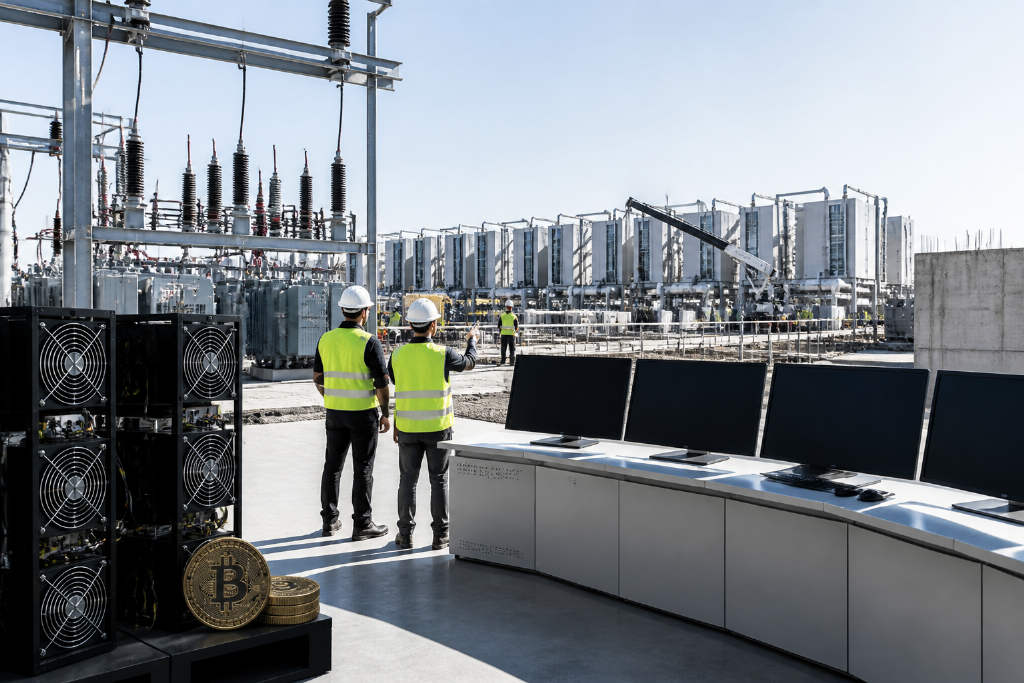
“Power is the most valuable asset” has become more than a slogan for a group of listed Bitcoin miners moving into AI and high-performance computing, or HPC. What the market is rewarding is not headline gigawatts on a slide deck, or cheap electricity in the abstract. It is infrastructure that can be energized on schedule, financed, turned into high-density data centers, and leased over the long term to reliable tenants.
Edited by WuShuo Blockchain.
The valuation model is shifting from EH/s and BTC to MW and GW
Bitcoin mining companies used to be judged mostly on three things: how much hash rate they controlled, how many bitcoins they produced, and how much BTC sat on the balance sheet. For a growing set of public miners moving toward AI and HPC, that formula is losing relevance.
The new unit of value is increasingly measured in megawatts and gigawatts. Investors are asking how much power a company controls that is already energized or has a defined grid interconnection path, how much of that capacity has been contracted to AI customers, and how much has actually been delivered and started billing.
That change reflects two very different industry backdrops. Unit economics in Bitcoin mining remain under pressure, while electricity demand from AI data centers is still rising. In an April 2026 update, the International Energy Agency said global data center power consumption is expected to increase from about 485 TWh in 2025 to roughly 950 TWh by 2030, nearly doubling. The IEA had also previously estimated that U.S. data centers would account for close to half of incremental electricity demand growth between 2024 and 2030.
Power has become the scarce link between the two industries. Land, substations, transmission access, and long-term power purchase arrangements that were built for Bitcoin mining are being repurposed as AI infrastructure. Miners are no longer monetizing electricity only by running computation for BTC production. They are also monetizing capacity, construction capability, and operating expertise through long-duration data center leases.
The old mining formula is breaking down first
The move into AI is not simply a better story for the market. It starts with traditional mining margins getting thinner.
After Bitcoin’s 2024 halving, the block subsidy dropped to 3.125 BTC. At the same time, network hash rate and mining difficulty kept climbing, which spread revenue more thinly across individual machines. VanEck data shows that by mid-July 2026, Bitcoin hashprice had fallen to about $30.6 per PH/s per day. Over the previous 30 days, average daily miner revenue across the network was about $28.5 million, leaving inefficient machines near or below break-even.
For miners, that means earnings can fall even if Bitcoin does not suffer another sharp price decline. Competition alone can compress returns. Machines must be upgraded on a continuing basis, power costs have to remain low, and any outage, difficulty increase, or rise in financing costs can cut into profitability quickly.
More importantly, Bitcoin mining is still a commoditized business. Hash rate from the same generation of machines is not meaningfully differentiated, and miners have limited ability to command a long-term premium through brand alone. Revenue also moves in real time with BTC price, fees, and network difficulty. By contrast, once an AI data center operator signs a long-term lease with a strong-credit tenant, grid access, construction execution, and data center operations can be converted into longer-duration and more predictable cash flow.
That is the starting point for the sector’s asset rethink: the most valuable asset may not be the ASIC machines inside the facility, or even the unsold Bitcoin inventory, but the power interconnection rights behind the site.
Core Scientific’s financials already look different
Core Scientific offers one of the clearest examples of the shift.
In the second quarter of 2026, the company posted total revenue of $164.2 million, up about 109% from a year earlier. High-density colocation revenue reached $136.7 million, accounting for roughly 83% of total revenue, versus just $10.6 million in the same period last year.
Self-mining moved in the opposite direction. Revenue in that segment dropped from $62.42 million a year earlier to $21.54 million, a decline of about 66% year over year. Segment costs were $33.70 million in the quarter, producing a gross loss of about $12.17 million and a gross margin of -56%. High-density colocation, by comparison, generated about $79.98 million in gross profit, with a 59% gross margin.
The same pool of data center assets is now producing very different financial outcomes depending on the business model attached to it. By mid-July 2026, Core Scientific had 437 MW of customer power capacity already billing, equal to roughly $635 million in annualized hosting GAAP revenue. Contracted customer power capacity stood at about 1.1 GW, with potential contract revenue above $24 billion.
That does not mean the transition is finished. Capital expenditures in the second quarter totaled $797.5 million, well above revenue for the same period, and a meaningful share of contracted capacity has not yet begun billing. Even so, the company shows how quickly the revenue mix can change. Lower Bitcoin production does not automatically mean lower company revenue if mining capacity can be rebuilt into billable customer power capacity.
Long-term leases are repricing power capacity into multibillion-dollar contracts
If Core Scientific shows the income statement impact, TeraWulf and Hut 8 show how power capacity, paired with construction and operating capability, is being repriced through long-duration agreements.
In July 2026, TeraWulf signed a 20-year data center lease with Anthropic. The agreement covers the Justified Data campus in Hawesville, Kentucky, and is planned to provide about 401 MW of critical IT capacity for AI workloads. Delivery is expected to begin in the second half of 2027, with full operations starting in early 2028. TeraWulf said the contract is expected to generate about $19 billion of contract revenue over the initial term and is expected to receive investment-grade credit support.
That same month, Hut 8 said it had signed a second 15-year lease at its Beacon Point campus in Texas, valued at $9.8 billion and adding 352 MW of IT capacity. That takes the same customer’s contracted footprint at the campus to 704 MW. The base-term contract value at Beacon Point now stands at $19.6 billion, while the first second-phase data hall is not expected to begin delivery until the second quarter of 2028.
These deals point to a new reality in the sector. For AI customers, the hardest asset to secure may not be GPUs. It may be large-scale power that can come online on a known timeline. Chips can be bought and servers can be installed, but transmission lines, substations, site permits, and grid interconnection often take years.
Bitcoin miners happen to have completed part of that work already. Over the past decade, they searched for sites near generation sources, with large load capacity and room for fast construction, because those attributes supported low-cost mining. What used to keep tens of thousands of ASICs running can now be turned into a different monetization path when AI data centers run into electricity constraints.
The premium in AI does not come from reselling the same electricity at a higher rate
The substance of the transition is not as simple as unplugging miners and installing GPUs.
Bitcoin mining can tolerate a much higher level of interruption. Operators can curtail when power prices rise or the grid tightens, and they can move equipment from one site to another. AI training and inference workloads need much stronger uptime, network bandwidth, cooling performance, and system redundancy. High-density GPU racks impose standards on data center design that are far above those of a conventional mining site.
The premium, then, does not come from marking up the same kilowatt-hour. It comes from converting power capacity into high-reliability critical IT load. What earns the premium is a combination of four capabilities: energized capacity or a clearly defined interconnection path, engineering execution that can deliver on schedule, financing capacity for heavy upfront spending, and customer credit strong enough to support a long lease.
Long-term leases also change the risk profile. Mining revenue depends on BTC price, network difficulty, and transaction fees, all of which can move day to day. AI hosting revenue is tied more to contract duration, delivery progress, and tenant performance. The first looks more like commodity production. The second starts to resemble a data center developer or an infrastructure asset operator.
That is also why the market is paying attention to who is leasing the capacity. A long-term agreement backed by an investment-grade hyperscale cloud tenant can help a miner finance a project more cheaply. The same 100 MW can be valued very differently if the tenant is smaller, the lease shorter, or the credit weaker.
Wall Street is starting to price miners by megawatts, not by Bitcoin alone
In a June 2026 framework for valuing miners’ AI infrastructure, VanEck used Gross Energized Power as the main lens for comparing enterprise value. Based on data through June 4, 2026, the firm said companies that had already signed AI or HPC leases generally traded at valuation multiples above 10x on that measure. Companies with little or no contracted capacity, and mostly forward-looking power inventories, were closer to 2x to 6x. These are not P/E, EV/revenue, or EV/EBITDA multiples.
That framework draws a clear line between stages of capacity. Planned capacity remains in project inventory or development concepts. Locked power capacity has secured power agreements or interconnection arrangements, but may not yet be energized. Energized capacity has actual power availability. Delivered and billing capacity has been handed over to customers and is already generating revenue. The market is no longer treating those categories as interchangeable.
As more projects come online, the valuation yardstick is likely to change again. The market first rewards control of power resources, then rewards signed contracts, and eventually returns to more traditional questions: whether projects are delivered on time and on budget, how much cash flow each megawatt can produce, and whether returns on capital exceed financing costs.
This is also where the listed miners are starting to split. Core Scientific, TeraWulf, Hut 8, and Cipher are moving closer to data center development and operations platforms. MARA and CleanSpark still retain relatively high exposure to Bitcoin mining. The result may be that “mining stocks” no longer fit under one valuation model.
The biggest risk is treating a power blueprint like revenue already on hand
The AI transition lifts the upside for valuations, but it also raises the execution bar well above traditional mining.
VanEck estimated, using data through June 4, 2026, that the companies in question had delivered only about 25% of their leased capacity. It also estimated a near-term funding gap of roughly $50 billion between capital spending needs and cash on hand. That estimate did not include future operating cash flow or funds that might be raised through selling or borrowing against BTC. VanEck also estimated long-term capital expenditure needs at nearly $221 billion, though it did not define that figure as a long-term funding gap. Many of the gigawatts and contract values appearing in company announcements still map to buildouts scheduled for 2027 or even after 2028.
That is why a contract worth billions of dollars cannot be equated directly with current revenue on the same scale. Projects can still be delayed or repriced by grid upgrades, equipment deliveries, construction costs, financing conditions, regulatory permits, and community opposition. For miners without deep experience building high-density data centers, any delay or cost overrun can hurt both cash flow and market value at the same time.
Customer concentration is another risk. Long-term leases improve revenue visibility, but they can also make a single tenant central to the future of a campus or even an entire company. If AI infrastructure spending cools, if tenants cut capital expenditures, or if a new chip generation changes data center design, miners could be left with heavy assets built for a specific customer and not easily repurposed.
The transition itself is capital intensive. Miners can raise funds through equity issuance, convertible bonds, project loans, and customer prepayments, but those tools can also bring dilution, higher leverage, and tighter financing constraints. Control of power resources is only the entry ticket. The return depends on whether those resources can be turned into billable assets at a reasonable cost.
Miners are not disappearing, but some are turning into power infrastructure companies
Bitcoin mining has not lost its value. It can still monetize electricity quickly and provide highly elastic upside when BTC rises. Unlike a traditional data center, a mining site can also curtail load and participate in grid demand response, giving unsold power capacity a temporary source of income.
But for a number of public miners, Bitcoin is moving from being the sole core business to becoming one way to monetize power infrastructure. Machines can be replaced, and mined BTC can be sold. What is much harder to replicate is already-secured land, interconnection rights, transmission facilities, and large-scale power arrangements.
That is why the phrase “power is the most valuable asset” needs a qualifier. It is not gigawatts in a development plan, and not just low-cost electricity by itself. It is power that can be connected to the grid on time, financed, turned into a high-density data center, and leased for years to creditworthy customers.
Miners once searched for cheap electricity to produce more Bitcoin. Now some of them are trying to monetize scarce interconnection and infrastructure time value through data center leases. The sector has reached a new fork. One group may continue to lean into Bitcoin price and hash-rate cycles. Another may end up dropping the “miner” label altogether and operating more like a new class of power real estate company for the AI era.
