
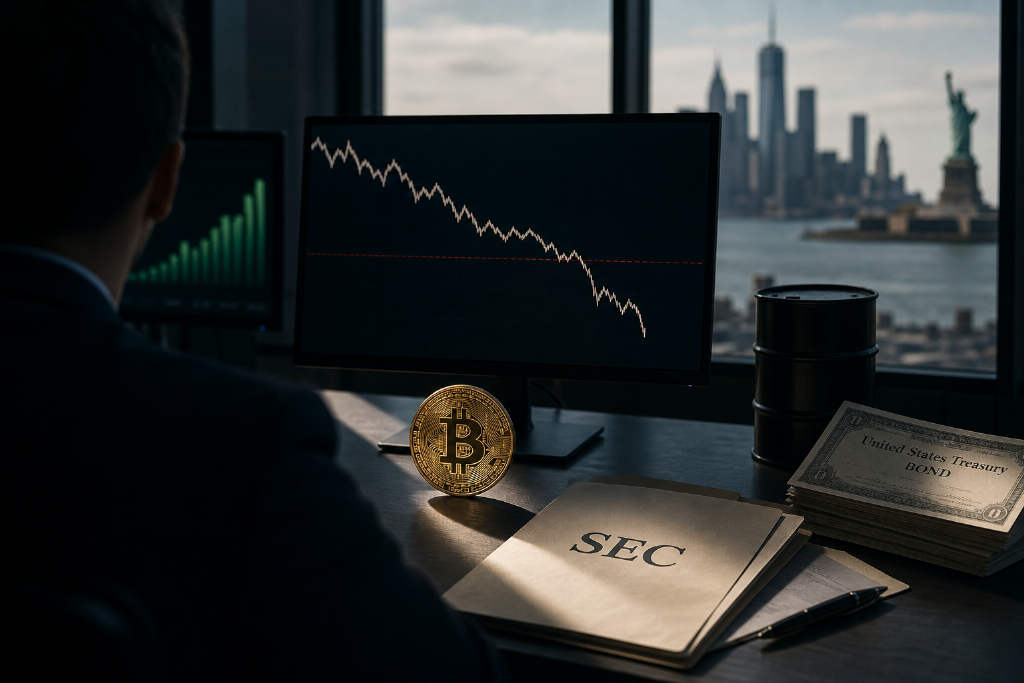
Bitcoin entered September under pressure after a strong August run, with Decrypt’s Morning Minute saying the asset fell below $77,000 after gaining 25% last month. Tyler Warner, who writes the daily newsletter, said that was Bitcoin’s strongest month since November 2024 and its best August rally since 2017.
The newsletter also notes that the analysis and opinions are Warner’s own and do not necessarily reflect Decrypt’s views.
September weakness returns to focus
Warner described the shift as Bitcoin entering “Rektember.” Since 2013, September has been Bitcoin’s worst month on average, with a loss of nearly 3% and only five positive years out of thirteen. Even so, the last three Septembers have all ended in the green for Bitcoin.
He said the market is now facing real headwinds. Fed Chair Kevin Warsh leaned hard on elevated inflation in his Jackson Hole speech on Friday, and the bond market reacted sharply. Sovereign yields moved to new cycle highs, and the U.S. 10-year Treasury reached 4.784%. Markets are now pricing a 66% chance of a 25-basis-point rate hike at the September 16 meeting, with another possible hike before year-end. At the same time, continued U.S. strikes against Iran pushed WTI crude to $88 a barrel, up 2% on the day and the highest level since late July.
The newsletter frames September as a contest between opposing forces: ETF inflows, DAT inflows, and a booming on-chain crypto market on one side, and war, higher oil, inflation, and possible rate hikes on the other. Warner points readers to September 16, the date of the next Federal Open Market Committee meeting and rate decision, as a possible turning point for the rest of the year’s macro tone.
Majors fall as oil and yields rise
Major cryptocurrencies traded lower after a selloff in traditional finance markets. Bitcoin was down 2% at $76.6k, ETH fell 3% to $2,376, SOL dropped 4% to $98, and HYPE slipped 2% to $81.
Among large altcoins, FIL rose 10%, PYTH gained 7%, and UNI added 6%. In broader markets, oil was up 3% at $90 while gold fell 1% to $4,360. Stock futures were also lower as bond yields and oil climbed, with the Dow down 0.1% and the Nasdaq off 0.5%.
The newsletter also highlighted comments from Strategy CEO Phong Le, who defended selling Bitcoin near $60,000 and buying it back at $80,318. Speaking to Bloomberg, Le said those decisions depend on the cost of capital rather than price after the company cut net debt to zero and built $7 billion in dollar reserves.
Saylor and CEO Phong Le also asked MSCI to withdraw a screen that would remove Strategy from its global indexes, calling the move discriminatory and arbitrary. Feedback on that issue closes on September 30.
Stablecoin plans and SEC rule changes
Twenty-one banks and asset managers, including Citi, Goldman, Bank of America, and UBS, are set to form a stablecoin company in the second half of 2026, according to the newsletter. The venture is expected to start with a dollar token due to reach the market in the first half of 2027.
The U.S. Securities and Exchange Commission has proposed modernizing transfer agent rules so blockchains can serve as official ownership records. The SEC also scheduled a September 17 roundtable on 24-hour trading with the New York Stock Exchange, Nasdaq, DTCC, Citadel Securities, and Robinhood.
Robinhood Chain fee revenue helped push ARB up more than 30% as traders priced in the Orbit stack that underpins the network, the newsletter said.
Hyperliquid Strategies raised the cap on its Chardan equity facility to $2.5 billion from $1 billion. That gives the Nasdaq-listed treasury company room to issue new shares for general corporate purposes, including additional HYPE purchases.
ETF flows and treasury activity
Spot Bitcoin ETFs recorded $237 million in net outflows on Tuesday. Ethereum ETFs, by contrast, posted $8.6 million in inflows and extended their green streak.
DeFi Development Corp launched a preferred stock offering that could raise $19.8 million to buy more SOL. The company is proposing to price 2.2 million shares at $9 under the ticker CHAD.
Meme coins and Robinhood Chain movers
Meme coin leaders were broadly lower. DOGE fell 2%, SHIB was flat, PEPE dropped 2%, PENGU lost 5%, TRUMP declined 7%, and SPX fell 6%.
Leaders on Robinhood Chain were mixed. PONS fell 14%, Cashcat gained 22%, AI rose 10%, Boner dropped 35%, and Microduck jumped 130%. Tendies, Moo, Orbio, Ubik, and Optimus were also listed among the bigger runners.
The newsletter added that Robinhood CEO Vlad Tenev was replying to meme coin posters on X as he continues to lean into the ecosystem.
On Solana, Tuesday’s broadly red tape produced few sustained runners. Ansem fell 17% to a $240 million market cap.
Tokens, apps, and protocol activity
Robinhood Chain set new records in fee revenue and decentralized exchange volume, reaching $3.38 million in revenue and $1.3 billion in DEX volume.
Pumpfun’s terminal hit a new all-time high in volume at $162 million. Pump also continued to out-earn Hyperliquid, with $2.14 million in revenue versus $1.98 million.
Ethena launched Ethena Pay on the App Store, describing it as a neobank app that pays 6% on dollar savings and 5% card cashback, with Avalanche serving as the exclusive settlement layer. ENA rose 9% after the launch.
The newsletter said more than $1.5 billion in token unlocks are due this month across XPL, Cards, H, ZRO, Ena, and other projects.
NFT market check
NFT leaders were slightly lower overall. CryptoPunks rose 1% to 32 ETH, Bored Ape Yacht Club fell 1% to 7.55 ETH, and Pudgy dropped 3% to 3.87 ETH.
Top NFT movers included NetNet Gear, up 180%, Normies, up 20%, and Stock Miners, up 350%.