
Crypto assets are no longer moving inside a single market logic, according to a Foresight article that breaks the sector into five distinct segments: Bitcoin, stablecoins, real-world assets, meme coins and infrastructure plays.

The piece, written by Zeuspace contributor Yaokun, says the label 「crypto market」 has become less precise as different assets are increasingly funded, used and valued in different ways. Bitcoin is being pulled into a macro asset framework, stablecoins are turning into the capital base of on-chain finance, RWA products are serving existing real-world allocation demand, and meme coins are still being driven by attention and risk appetite.
The old unified-market view is losing traction
For a long time, investors treated crypto as one market. If Bitcoin rose, higher-beta assets usually followed. If a fresh narrative appeared, capital rotated from one sector to another. The article says that framework made sense in the industry’s earlier stage, when there were fewer asset categories, a narrower participant base and one main pool of liquidity behind most moves.
That setup is no longer holding. ETF products, stablecoins, RWAs, infrastructure projects and meme coins are gradually forming separate funding sources, use cases and valuation methods. In that environment, Bitcoin is no longer just the sector’s lead token, stablecoins are no longer mainly speculative instruments priced on narrative alone, RWAs resemble real-world allocation products more closely, and meme coins still function as high-elasticity expressions of market risk appetite.
The article argues that the old idea of one new story lifting the whole market is fading at the margin. Different assets now have to answer different questions. Some need to prove they belong in a macro portfolio. Some need to show they function as financial infrastructure. Some need to demonstrate they can absorb real demand. Others still rely on bursts of attention and liquidity to stay relevant.
Each segment is being priced on its own terms
The article says misreads become more likely when every crypto asset is forced into the same valuation framework. A segmented view is more useful.
Bitcoin
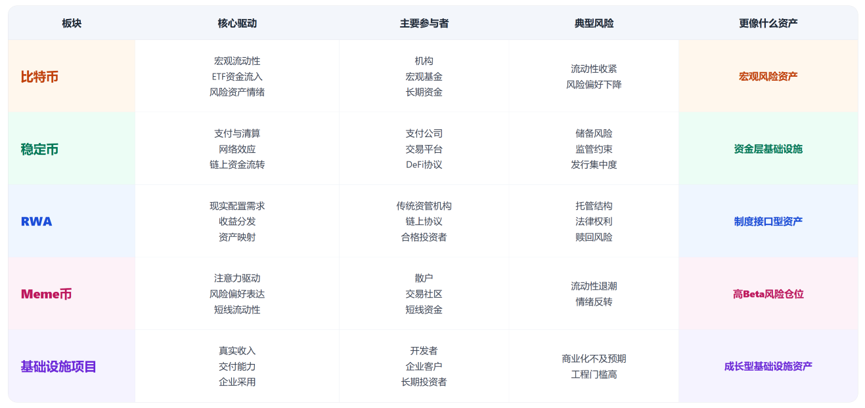
Bitcoin is increasingly being discussed as part of the global macro asset universe. Its price swings are being shaped more by ETF inflows, dollar liquidity, interest-rate expectations and sentiment across risk assets. For institutions, the article says, Bitcoin looks more like a macro risk asset with high volatility characteristics. That is one reason its price action no longer serves as a simple stand-in for the entire crypto sector.
Stablecoins
Stablecoins sit in a very different category. Their core is not price direction but usage frequency, settlement efficiency and distribution reach. The article describes them as the funding-layer infrastructure of crypto, supporting on-chain payments, settlement, collateral, cross-border transfers and capital parking. Their growth logic comes from network effects and penetration into financial interfaces rather than narrative premium.
RWA
On RWAs, the article says the demand they serve already exists outside crypto. Whether the product is U.S. Treasuries, money market funds or tokenized equities, the point is not to invent a new story but to redistribute existing yield and exposure from off-chain markets through on-chain rails. In that reading, demand is not created natively on-chain. It is established in the traditional financial system first and then carried into crypto form.
Meme coins
Meme coins, the piece says, are still driven mainly by attention, risk appetite and short-term liquidity. They act as the clearest expression of market sentiment and look more like high-beta risk positions. Their main role is to provide price elasticity, room for narrative imagination and a venue for short-cycle trading.
Infrastructure projects
Infrastructure names occupy another layer again. The article points to DePIN, AI compute networks, middleware and data protocols, saying the market is no longer satisfied with technical feasibility alone. What matters more now is whether projects can show real revenue, deliver consistently and present a path to enterprise-grade adoption. In that sense, the segment is shifting from concept assets toward revenue-validated assets.
All five segments share the same technical foundation, but their asset properties are diverging. Some are moving closer to macro assets. Some function as capital-layer infrastructure. Some act as institutional interfaces. Some retain high-beta speculative characteristics. Others are converging toward growth-style assets. The article’s point is simple: one analytical lens is no longer enough.
Why the split is becoming clearer
The article links the change to structural evolution in the market itself.
First, institutional capital is not applying the same logic to Bitcoin, stablecoins, RWAs and meme coins. Different pools of capital come with different purposes, target exposures and holding objectives.
Second, on-chain products are taking on more specialized functions. Stablecoins serve the funding layer. RWAs sit closer to the asset layer. Bitcoin is being absorbed into a macro framework. Meme coins express risk appetite. Infrastructure projects are moving into a phase where commercial delivery is being tested. Once functions split, a unified valuation model becomes harder to defend.

Third, regulation and institutional frameworks are making asset categories clearer. The article notes that there is still debate over which assets look more like commodities, which resemble securities, and which serve payment and settlement roles. Even so, the boundaries are no longer completely blurred.
There is also less chance that one narrative will lift everything at once. In the past, a new concept could drive a broad rally across the industry. Now the same narrative may only move one small corner of the market. The article says that does not mean the sector has run out of imagination. It means different assets are being asked different questions: where the money comes from, whether demand is real, how value accrues and who ultimately carries the risk.
A stitched-together market, not one uniform trade
If this trend continues, the article says the most important skill in reading crypto may no longer be picking the next all-market narrative. The more practical starting point is to identify where an asset sits inside this layered structure.
Its framework is clear. Bitcoin will keep moving in a macro direction. Stablecoins will keep becoming infrastructure. RWAs will keep developing as institutional interfaces. Meme coins will retain high-beta characteristics. Infrastructure projects will keep facing revenue validation. All of them still sit under the broad crypto label, but they are no longer driven by the same logic.
The article says this does not mean the market has lost all internal coherence. It means the structure inside crypto is becoming more complex, more mature and closer to the kind of asset layering seen in traditional finance. In that setting, calling bull or bear is no longer enough. The first question is which market an asset actually belongs to, and what framework should be used to understand it.
The article closes with a standard disclaimer, saying the market carries risk and the piece does not constitute investment advice. Readers should determine whether any opinions, views or conclusions fit their own circumstances and bear responsibility for any investment decisions made on that basis.