
Bitget CEO Gracy said the exchange’s tokenized U.S. equities product, rToken, crossed $100 million in assets under management about a month after going live in early June. As of July 6, AUM stood at $114 million, while cumulative trading volume had reached $670 million. She said the pace was faster than Bitget expected and showed that crypto users are willing to trade traditional financial assets such as U.S. stocks.

She said demand is visible not only in holdings, but also in trading activity. During a period of changes in the Middle East situation and a weekend when the U.S. stock market was closed, weekend rToken trading volume rose to 10 times the prior week and was about 2.2 times the average weekend level seen in June. Gracy said more users are starting to treat rToken as a tool for allocating across global assets during volatile periods, not just as a long-term holding. She added that weekend trading volume in absolute terms is still at an early stage, but periods of market stress have already highlighted the value of 24/7 trading.
Bitget’s next target is utility after listing
Gracy said the $100 million AUM milestone confirms that users are prepared to trade this type of product, but she described that as only the first step. The bigger question now, she said, is what practical uses Bitget can offer once the asset is listed.
She said Bitget introduced the Universal Exchange, or UEX, concept in September last year and has since added U.S. equities, foreign exchange, commodities, and pre-IPO products. With most core asset classes now in place, she said simply adding more listings is unlikely to create a durable difference over time.
The next stage, in her view, is to bring different assets into one account and improve capital efficiency. That means using rToken as unified margin, letting funds be shared across asset classes, and supporting cross-asset strategies, lending, API connectivity, and quantitative trading.
Gracy also said Bitget is one to two years behind some leading platforms in unified accounts and institutional products. What Bitget needs to build, she said, is not just an account feature, but a full product stack for professional traders and institutions. Those users care about whether they can manage stocks and crypto in the same account, share margin, and move capital efficiently between markets.
She said users in the next phase are looking for more than a unified account. They want a cross-asset unified account. Bitget, she added, will measure progress with more than AUM and trading volume, and will also track trading friction, capital efficiency, and the experience across products.
Why Bitget is cautious on non-U.S. stock markets
Asked whether Bitget may eventually list tokenized exposure tied to Korean, Japanese, Hong Kong, and mainland Chinese stocks, Gracy said user demand does exist. But she said Bitget is taking a more cautious approach outside the U.S., mainly because of regulatory constraints and product feasibility.
She said the platform already offers perpetual futures tied to 10 Hong Kong stock-related underlyings, including AI concept names such as Zhipu AI. Still, that does not mean Bitget has built a full spot or tokenized stock product for Hong Kong equities.
According to Gracy, most markets outside the U.S. still lack a clear and mature framework for RWA and stock tokenization. At the same time, global equity market value and liquidity remain heavily concentrated in U.S. stocks, making the U.S. market the more practical place to start in terms of asset supply, institutional participation, and liquidity. She said A-shares and Hong Kong stocks are especially sensitive from a regulatory standpoint because regulators generally do not want local shares detached from existing exchanges and securities oversight, then repackaged for trading overseas or on crypto platforms. That touches investor protection, market supervision, and cross-border capital flows.
For that reason, she said, whether Bitget lists stocks from other countries and regions will depend not only on user demand, but also on whether local rules are clear and whether the platform can find a compliant product structure. She said users often leave comments on her Twitter account asking for specific names to be added, but user requests do not mean the product can be launched right away. Those requests may be taken into account, she said, but the final decision still depends on regulation, product feasibility, and market maturity.
Three main user groups behind rToken demand
Gracy said rToken users currently fall into three broad groups: crypto-native users, cross-asset traders, and institutions or professional traders.
The first group is crypto-native users. These users already hold stablecoins such as USDT and USDC, are used to crypto platforms, and want direct price exposure to U.S. equities without opening a new account, moving in and out of fiat, or transferring funds across platforms. She said they care most about trading hours, liquidity, slippage, and whether corporate actions are handled correctly. Whether the asset is technically on-chain is not the main issue. What matters is whether it can be traded in practice.
The second group is cross-asset traders. They hold Bitcoin, Ether, U.S. stocks, and ETFs at the same time and want to avoid switching between accounts while managing multiple assets under one capital setup. Gracy said they pay closer attention to whether tokenized assets stay tightly connected to the underlying securities market, including whether quotes track the underlying stock closely, whether execution quality resembles a traditional broker, and whether prices diverge sharply during stressed market conditions.
The third group is institutions and professional traders. Gracy said they are less focused on manually trading single names and more focused on whether rToken can connect with their existing API, quantitative trading, and risk management systems, and whether it can be used for unified margin, lending, and cross-asset hedging. An institution, she said, may want to hold both rToken and crypto derivatives while sharing margin across positions. In that setup, interface stability, trading latency, liquidation rules, and liquidity management matter more than the total number of supported assets.
She said all three groups care about price, liquidity, and trading experience, but from different angles. Crypto-native users value the convenience of stablecoins and crypto accounts. Cross-asset traders care about execution quality that feels close to a broker. Institutions focus more on API access, margin, lending, and risk control.
How Bitget says rToken differs from other tokenized stock products
Gracy described rToken as a tokenized asset issued by Reality, a licensed RWA protocol launched by Bitget. The product currently supports more than 500 major U.S. stocks and ETFs, and she said it may later expand into other asset types.
She said rToken tries to improve on other tokenized stock products in three areas: liquidity, dividends and other corporate actions, and capital efficiency.
Bitget began supporting U.S. stock tokens from other RWA issuers in the second half of last year, according to Gracy. The most common complaint from users, she said, was liquidity. Orders worth a few hundred dollars could still be handled with manageable slippage, but larger trades often could not be completed or came with much wider slippage.
That is why rToken was designed from the start to bring in liquidity from Nasdaq and the New York Stock Exchange. Gracy said platforms capable of doing that are still relatively rare. In Bitget’s internal comparisons, she said, rToken’s order book depth for mainstream U.S. stock tokens is 50 to 100 times better than comparable products.
Another repeated user concern, she said, was how dividends, stock splits, and similar corporate actions are handled. On that front, Gracy said rToken is presented in a way that is closer to a traditional brokerage account. If the underlying stock pays a cash dividend, users receive the net dividend in USDT. If the company issues a stock dividend or goes through a split, the quantity of rToken held and the holder’s cost basis are adjusted accordingly.
She contrasted that with some other tokenized equity products that keep cash dividends inside the underlying asset pool and reflect them through reinvestment or buybacks in the token’s net asset value. She said that model does not necessarily reduce the user’s economic return, but it can cause the token price to drift from the stock price shown on standard market data platforms. Her example was a $200 stock that pays a $2 cash dividend per share. Under the rToken model, the equity position and the cash payout are treated separately, so the user keeps the position and also receives USDT equal to the dividend. Another model may leave that $2 in the pool and raise the token’s net value instead.
She said the economic outcome may be similar, but the user experience is different. rToken aims to keep price, position structure, and income presentation as close as possible to a traditional securities account, lowering the learning curve for ordinary users. In her view, the difference between rToken and other products is not just whether real assets sit underneath, but also how dividends, splits, and reverse splits are shown to users.
Gracy added that because Reality works closely with Bitget, rToken can be integrated into more parts of the exchange ecosystem. One example is using rToken as margin in a cross-asset unified account. A user who buys Nvidia stock exposure through rToken would not need to sell it before using it as margin to open a BTC derivatives position. She also pointed to another possible strategy: borrowing Apple stock tokens through Bitget lending. If the dividend covers the borrowing cost, she said, there could theoretically be room for an arbitrage trade. Giving tokenized equities some of the flexibility and utility associated with crypto assets opens more ways to use them and can improve capital efficiency, she said. Many other U.S. stock token products still struggle to offer that.
One rToken, three functions
On the question of using rToken as margin for derivatives, Gracy said the answer starts with Bitget’s cross-asset unified account. In her words, one rToken can do three jobs at once: generate holding-based returns, serve as margin, and act as collateral for lending.
For most retail users, she said, the simplest use is the first one. Buying and holding rToken gives them exposure to the related U.S. stock and the associated rights, in a form that is closer to simply owning the stock.
The other two uses, margin and collateralized borrowing, are more advanced and better suited to institutions and professional users with stronger risk management capabilities. Gracy gave the example of using rNVDA as margin to open a BTC derivatives position. In a favorable scenario, Nvidia’s price stays stable and the BTC trade moves in the user’s favor, which means capital is used more efficiently without selling the stock exposure. But if Nvidia falls and the derivatives position also loses money, the collateral value drops at the same time as trading losses mount, raising the chance of liquidation.
In lending, users can post rToken as collateral to obtain stablecoin liquidity, though limits and risk controls vary by asset. Gracy said a large-cap name such as Apple may allow a collateral cap of about $1.2 million per user, while a smaller-cap name such as SNDK may only allow about $80,000. The less liquid, more volatile, and more niche the asset is, the tighter the limits tend to be.
How rToken orders reach the real market
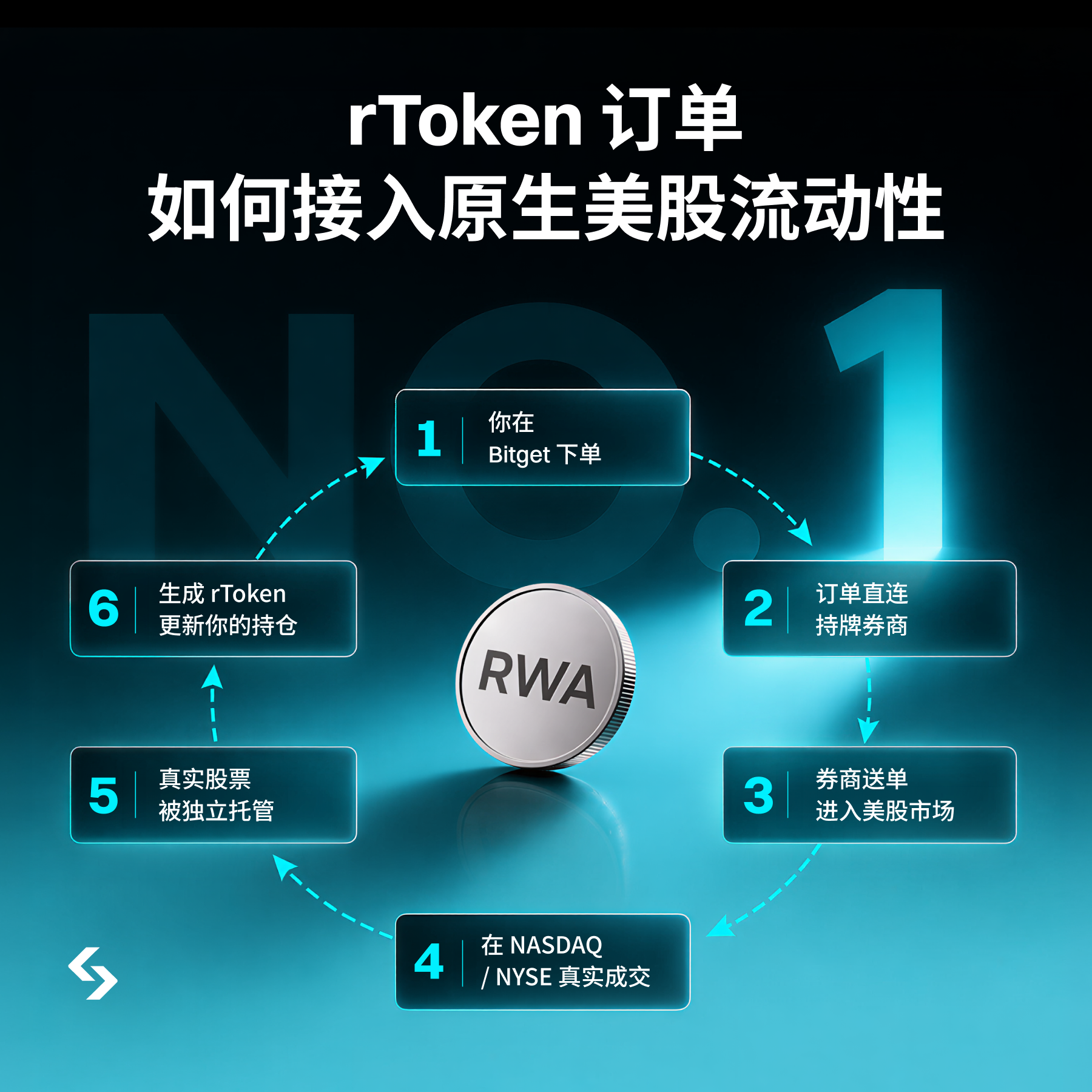
Gracy said Bitget has connected three parts of the stack in order to link rToken liquidity directly to Nasdaq and the New York Stock Exchange: the trading venue Bitget, the issuer Reality, and partner broker Alpaca.
When a user places an rToken buy order, she said, that order is sent to Alpaca, which routes it into the U.S. securities market for execution. After that, the underlying broker and clearing system complete settlement, the stock is held by a custodian, and the system mints the corresponding amount of rToken into the user’s account. In theory, every newly created rToken is backed by a corresponding quantity or value of underlying securities.
The selling process runs in the opposite direction. Once a user sells rToken, the token is burned, the underlying service providers sell the corresponding stock, and after settlement the proceeds are returned to the user in stablecoins or another supported settlement asset.
Gracy said rToken is not operating outside traditional finance. It uses a crypto account and token format on the front end, while the back end still depends on the conventional securities trading, clearing, and custody system. The user experience may look close to crypto spot trading, but the underlying process still relies on real securities infrastructure.
What happens when U.S. stocks are closed
Gracy said longer trading hours allow users to respond to events without waiting for the U.S. stock market to open, but once the equity market is closed, rToken’s main source of liquidity temporarily disappears as well.
At this stage, she said, trading during closure periods is mainly handled by market makers. Those counterparties build stock inventory before the U.S. cash session ends, and weekend rToken trades are matched largely against that inventory.
That does not mean depth is the same as during regular hours. During major events, market makers have to assess risk without a full primary market price signal, so they usually cut order size and widen bid-ask spreads. Blue Ocean and other overnight venues can provide some reference prices for hedging, she said, but their liquidity is far below normal market hours and cannot fully replace the New York Stock Exchange or Nasdaq.
As a result, prices during market closures reflect market makers’ quotes based on inventory and risk tolerance more than they reflect a fully discovered market price. Users need to accept lower liquidity, wider slippage, and the risk that execution prices may diverge from the next regular-session open. Longer trading hours solve the question of whether trading is possible, she said, not whether normal market depth is always available.
Pricing and liquidation during halts, circuit breakers, and major events
Gracy said two separate issues need to be distinguished here: how tokenized stocks are priced and whether a unified account triggers liquidation.
When the U.S. market is closed and rToken is posted as margin, Bitget uses the index price from the end of the most recent extended-hours session for valuation. She said the purpose is to avoid distortions in collateral value caused by fragmented trades when the underlying market lacks continuous quotes. Still, she said, that only freezes the pricing reference temporarily. It does not remove risk. If a major event happens over a weekend, the stock may still gap sharply when the next trading day opens.
At the same time, other assets inside the unified account continue to move. If a user holds crypto derivatives against rToken collateral, forced liquidation can still happen when losses elsewhere in the account push the overall risk ratio to the liquidation threshold, even if rToken itself is temporarily valued at the previous session’s level. Gracy said the risk engine looks at the account as a whole, including collateral, liabilities, and unrealized profit and loss, instead of judging each margin asset on its own.
If an underlying stock is halted, hits a circuit breaker, or is affected by a major event that makes reliable quotes unavailable, Bitget may take temporary risk-control steps based on the type of event, the length of the halt, and market liquidity. Those steps can include adjusting collateral ratios, limiting new margin, restricting trading, or suspending the relevant product. Gracy said there is no fixed rule for every case. A long halt with rising risk may prompt the platform to lower collateral value in advance, while a brief circuit breaker would more likely lead Bitget to wait for the market to reopen before updating prices.
Her point was that a market halt or closure does not pause risk. Users who post rToken as margin need to watch not only price changes, but also gap risk, halts, weaker liquidity, and the possibility that the platform may adjust risk parameters.
Why reserves are at 100% and what exits look like today
On the question of why Reality’s stock reserve ratio stays around 100%, Gracy said the equity side uses a one-to-one matching structure. For every rToken issued by Reality, Alpaca holds the corresponding quantity or value of stock underneath. At present, there is no extra inventory of shares purchased beyond what is needed to match token issuance.
As long as token supply and underlying holdings line up exactly, the reserve ratio naturally stays at 100%, she said. To push that ratio above 100%, Bitget, Reality, or another participant would need to commit additional capital to buy shares that are not tied to current user positions. In her view, the need for that is limited at this stage.
She also said rToken is currently the only RWA asset in the market that offers daily third-party proof-of-reserves results. Other RWA issuers also disclose reserves, but more often in self-reported form, which she said creates the risk of being both referee and player. Reality works with U.S. audit firm The Network Firm to provide daily PoR data, she said, adding that compliant exchanges such as Kraken and Gemini also work with the same firm on asset audits.
For long-term holders, Gracy said the main exit route today is still to sell rToken on the market and convert back into USDT. Whether rToken will eventually be redeemable directly into the underlying stock, or transferable to another broker in the way a traditional securities account allows, remains undecided, she said.
rToken as a test of Bitget’s wider UEX strategy
Gracy said rToken should not be viewed only as a U.S. equities product. In her view, it is also a test of whether the UEX route can work at all.
She said current data already suggests that trading traditional financial assets through a crypto platform is not a demand invented by the platform. Many users are not focused on the phrase “stock tokenization” itself. What they want, she said, is a simpler way to trade global assets they already believe in.
That demand also appears concentrated. Gracy said about 23.51% of rToken’s TVL comes from SpaceX, while Nvidia, Micron, and other AI supply-chain assets together account for about 45%. Including SpaceX, growth assets tied to AI and technology infrastructure make up more than 70%. She said that when crypto markets lack new high-growth targets, part of the capital naturally shifts toward AI, semiconductors, and commercial space names. In that sense, exchanges are not expanding into U.S. stocks merely to add products. They are responding to users who want cross-asset allocation.
Bitget has already built trading systems, liquidity management, and risk controls in crypto, she said. The next question is whether those capabilities can be transferred to much larger markets such as stocks, ETFs, foreign exchange, and commodities. Traditional finance, though, comes with mature brokerage, clearing, custody, and regulatory systems. What Bitget still needs to prove is not just that it can place these assets inside an app, but that it can handle tax treatment, corporate actions, asset segregation, and cross-border compliance over time.
That is why UEX matters, she said. It is not just a growth story. It is an answer to what value an exchange can still offer in the next stage. If business remains confined to crypto assets, exchanges may end up competing only on fees and listing speed. A cross-asset platform offers another path by letting users manage different asset classes in one account instead of moving funds each time the market changes.
Even so, Gracy said asset coverage is only the starting point. The hard part is connecting unified accounts, cross-asset margin, lending, yield products, and API infrastructure so that different assets can truly share capital and trading capacity. Whether UEX works in practice will depend on whether those underlying capabilities can be built well.
She added that she does not think Bitget is already the leader. Launching U.S. equity products earlier or covering more names does not establish a lasting advantage on its own. The real test, she said, is whether users keep using the product, whether institutions continue increasing trading size, and whether the product can withstand periods of extreme volatility and regulatory change.