
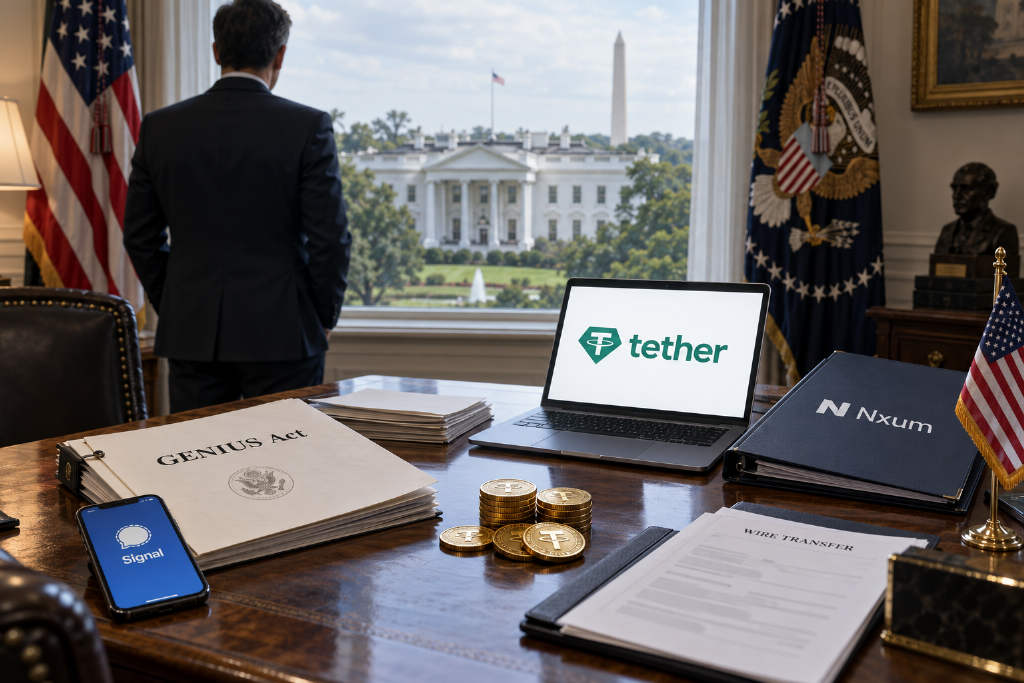
The Wall Street Journal reported that while former White House crypto adviser Bo Hines was helping advance the GENIUS stablecoin bill, Nxum, an investment firm he co-founded, received $6.3 million in transaction payments from Tether. According to the report, the first payment landed while Hines was still serving in the White House.
Legislative updates were shared with Nxum partners
The report said Hines remained in contact with Nxum partners through Signal during his time as a Trump crypto adviser in the White House, regularly updating them on the progress of the GENIUS Act.
It also said he pressured Nxum partners by describing Republican lawmakers who opposed the stablecoin bill as people who were "destroying the president" and as figures who had been "bought by Binance and a16z." The account suggests the bill did not move through Washington without internal Republican resistance.
The law was signed in 2025, but implementation is set for 2027
The GENIUS Act passed Congress and was signed into law in July 2025. Even so, the law still needs detailed rules from several federal agencies, including the Office of the Comptroller of the Currency, the Federal Deposit Insurance Corporation, the Federal Reserve, and the Treasury Department.
Those rules are expected to take effect in January 2027.
From the White House to Tether
Hines left the White House in August 2025 and joined Tether as a strategic adviser. The following month, he became CEO of Tether’s U.S. unit.
The report framed that move as part of Washington’s revolving-door pattern, with public officials moving into senior industry roles. Around the same period, former Commodity Futures Trading Commission commissioner Summer Mersinger resigned three years early and became CEO of the Blockchain Association. Kevin Webb, a senior adviser at the CFTC, also joined fintech startup Solidus Labs as vice president of policy.
The crypto interest network extends beyond stablecoins
The article also pointed to other crypto-related interests around the White House. Trump family disclosures in 2025 showed $1.4 billion in crypto investment income, including USD1, a stablecoin issued by World Liberty Financial.
Compared with that figure, the two payments Tether sent to Nxum were smaller. Still, the report said Hines kept a one-third stake in Nxum while serving in the White House, putting policymaking, legislative progress, and incoming payments on the same timeline.
Rulemaking is the next stage to watch
Although the GENIUS Act has already been signed, the rulemaking phase before the January 2027 effective date is likely to be decisive. The policy direction taken by the OCC, the Federal Reserve, and the Treasury Department will shape whether the stablecoin market favors reserve funds run by large banks or remains led by on-chain issuers such as Tether and Circle.
BlockTempo, citing reporting from The Wall Street Journal and Cointelegraph, said the Nxum case shows Tether had already built policy relationships in Washington. It also raised questions about whether other stablecoin players, including Morgan Stanley’s reserve fund and a16z’s OpenReserve, have been making similar moves there.
What BlockTempo highlighted for Taiwan
In its write-up, BlockTempo said the GENIUS Act sets a U.S. regulatory floor for stablecoins, including 100% reserves, regular audits, and transparent rules. The report said crypto exchanges in Taiwan mainly accept USDT and USDC, but there is still no dedicated stablecoin regulation. If the U.S. completes its framework in 2027, Taiwan’s regulatory baseline could move closer to U.S. standards, pushing compliance costs higher for local exchanges.
This article was based on reporting from The Wall Street Journal and Cointelegraph, and was compiled by BlockTempo editor Leng Mian.