Brazil’s banks are expanding their crypto product shelves as the country’s regulatory regime becomes more defined. Itaú, Brazil’s largest bank by assets under management, now offers 15 crypto assets through its investment app, including Bitcoin, Ethereum, and the dollar-pegged stablecoin USDC.
Nubank, the country’s largest fintech firm, lists 28 crypto assets. Banco do Brasil, described as Brazil’s most lucrative public bank, began letting customers buy Bitcoin and Ethereum directly in January. The bank told Folha de S.Paulo that the service has already processed more than 11 million reais, or about $2.1 million, in transactions.
Those client-facing crypto services have not translated into proprietary positions on bank balance sheets. Central Bank filings dated March 2026 and reviewed by Folha showed zero virtual asset holdings on the books of Brazilian banks, even though the institutions can custody and process crypto on behalf of customers.
Banks have expanded their crypto menus over the past year
The product expansion is recent. Since last year, Itaú, Bradesco, Santander, Banco do Brasil, and Nubank have all broadened their crypto lineups, tracking a record run in the underlying market.
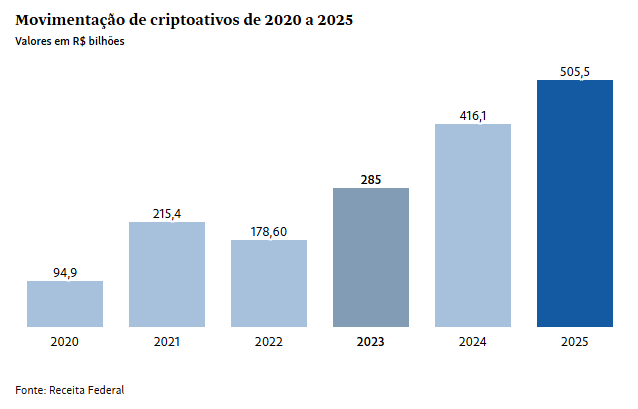
According to Receita Federal, Brazil’s federal tax authority, Brazilians moved 505.5 billion reais, or $98.7 billion, through crypto in 2025. That was more than five times the amount recorded in 2020.
Companies accounted for nearly all of that volume. Corporate crypto transactions reached 497 billion reais, or $97 billion, last year, representing 98.3% of the total tracked by Receita Federal. Individual investors made up the remainder.
Regulatory changes have given banks clearer ground to operate
The broader expansion lines up with a policy shift. Brazil passed its Legal Framework for Virtual Assets in 2022, giving the Central Bank authority over the sector. Three resolutions published by the bank in November 2025 then set out concrete operating requirements.
Under those rules, any company that allows customers to trade, hold, or send crypto now needs a license, a minimum capital buffer, and segregated client accounts. The compliance deadline is Oct. 30, 2026.
One of those measures, Resolution 521, treats any purchase or exchange of a dollar-pegged token as a foreign exchange operation, applying the same reporting threshold used for sending money abroad. The change brings stablecoins directly into the Central Bank’s reporting framework.
Carlos Akira Sato, co-founder of consultancy Syscapital, told Folha that this regulatory clarity is what pushed banks to act. Brazilian banks are usually conservative with new markets, he said, and clearer rules left them 「more secure to launch their products」.
Banks still have no proprietary crypto exposure
Banco Safra, a smaller bank known for serving high-net-worth clients, made the most aggressive move by issuing its own dollar-pegged stablecoin, Safra Dólar, in September 2025 and keeping full custody in-house. The bank presents the product as a way for clients to gain dollar exposure without opening an account abroad.
That fits a wider pattern described in the report: banks are building stablecoin rails themselves rather than leaving that business to crypto-native firms.
Sato said proprietary exposure exists only when a bank buys crypto with its own money and takes on the related price, liquidity, and credit risk. By that definition, none of Brazil’s banks has moved into ownership yet.
Selling crypto to customers who want it is different from putting the bank’s own capital into the market. With roughly 120 crypto firms operating in Brazil, most still without a license and racing to meet the Oct. 30, 2026 deadline, banks that have already cleared the compliance bar have more room to keep adding products.