
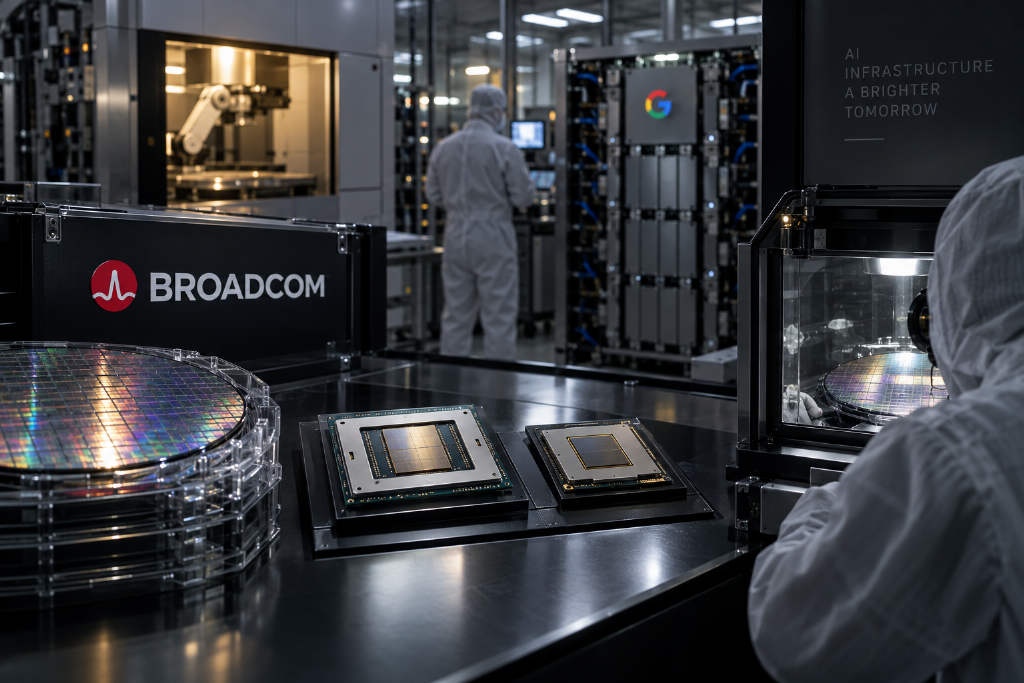
UBS said its latest supply-chain checks suggest Broadcom (NASDAQ: AVGO) has not exited Google’s TPU roadmap after v8i and will remain deeply involved in the next two generations: v9, which UBS expects to ramp at the end of 2027, and the 2 nm-based v10, which it expects to begin shipping at the end of 2028. The bank also said Broadcom’s N2 plan has not been canceled.
The findings run against earlier market chatter that Broadcom could lose part of the business after Google TPU v8, with MediaTek (2454) and other suppliers seen as possible beneficiaries. UBS said the conclusions come from channel checks in a research note, not from official disclosures by Google or Broadcom, and added that final market share and shipment volumes are still subject to change.
UBS says Broadcom stays involved after v8i
In its report, UBS said it carried out a series of supply-chain checks after a recent management meeting and made slight adjustments to its unit shipment model. According to the note, Broadcom management said on this week’s conference call that the company would remain deeply involved in the two generations following v8i in Google’s TPU program.
That comment addresses a recent investor concern. Some market participants had not seen 2 nm wafer allocations for Broadcom in the supply chain and took that as a sign that the N2 plan had been scrapped. UBS said its checks point instead to a misunderstanding of the roadmap, because the 2 nm transition belongs to v10 rather than v9.
v9 shifts to a multi-die 3 nm design
UBS said Google is replacing the original v9 "Pumafish" plan with a design built around multiple 3 nm compute dies. Those dies are larger than the current 3 nm v8i, code-named Sunfish, and are linked in a multi-chip module configuration.
UBS expects that design to begin volume ramping at the end of 2027 and to account for most shipments in 2028. In that framework, the absence of 2 nm wafers in the supply chain does not indicate Broadcom has been pushed out; it reflects the fact that v9 is staying on a 3 nm path.
v10 moves to 2 nm with new packaging
UBS said Broadcom will move to 2 nm with v10, which it expects to start shipping at the end of 2028 and become the largest share of TPU shipments in 2029.
On specifications, UBS expects v10 to use Broadcom’s new 3.5D packaging technology, scale to as many as 16 dies, and become the first product to adopt Broadcom’s 448G SerDes. The bank said that view is consistent with recent comments made by Charlie Kawwas, president of Broadcom’s Semiconductor Solutions Group, at an industry event.
UBS also said AI accelerators are getting larger and more modular as frontier model developers look to integrate more functions inside the package, including SRAM and ARM CPU cores.
Packaging capacity expands, while CoWoS remains central
On packaging, UBS said Advanced Substrate Technologies, the Broadcom-TOPPAN joint venture, recently opened its first FC-BGA facility in Singapore. The bank said that should materially expand Broadcom’s packaging capacity and added that Broadcom is likely to internalize more of that capacity over time.
Even so, UBS said TSMC’s CoWoS should still account for about 75% of Broadcom’s demand before the v10 generation, meaning TSMC’s role in advanced packaging is unlikely to change in the short to medium term. UBS added that it only made slight unit forecast adjustments to reflect the new v10 design and left its revenue estimates unchanged.
MediaTek speculation remains unconfirmed
Market talk had suggested that MediaTek or other partners might take over part of the TPU business after v8. UBS did not directly address MediaTek in its checks, but its conclusion points in the opposite direction: Broadcom still appears to hold an important role in both v9 and v10.
Some investors on X interpreted the situation by saying Broadcom’s odds of winning v9 were "well above 50%" and around 50% for v10, while also claiming MediaTek had shifted toward Amazon (NASDAQ: AMZN) after losing this piece of business. The original report said those views were personal judgments and could not be verified.
UBS also said its report is not enough on its own to determine Broadcom’s final market share across Google’s TPU supply chain. Whether MediaTek has actually lost out will still need to be tested against future supply-chain shipment data.