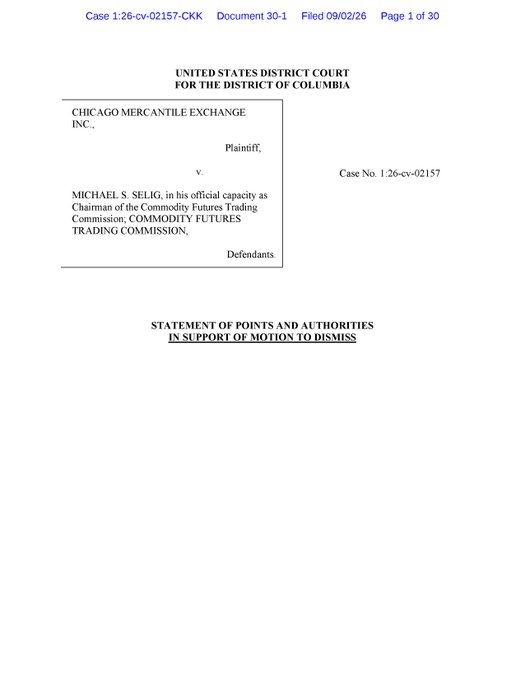
On September 2, the U.S. Commodity Futures Trading Commission (CFTC) and its Chairman Michael Selig moved to dismiss a lawsuit brought by the Chicago Mercantile Exchange (CME), according to court records in the U.S. District Court for the District of Columbia.
The CFTC said the CME’s attack on the Commission’s order and policy statement approving perpetual futures on Bitcoin and other digital assets does not show that the CME itself is blocked from listing those products. Pretty simple. The order says any CFTC-registered exchange can list digital commodity perpetual futures. But the CME argues the contracts should be treated as "swaps," not "futures." The CFTC’s position is the opposite: perpetual futures are futures.
And the CFTC also argued that the CME lacks standing under Article III of the Constitution. The exchange’s claimed "textbook competitive injury" rests on the idea that designated contract markets such as Kalshi can offer rival products to retail investors, yet the CME did not reasonably show how its own profits would be hurt. The CFTC also pointed out that the CME had publicly said clients do not demand perpetual futures products, and that its crypto futures trading volume actually rose after the order. And even if the classification changed to "swaps," Kalshi and others could still trade, so that label change by itself would not fix the claimed competitive injury. So the Commission asked the court to dismiss the case.