
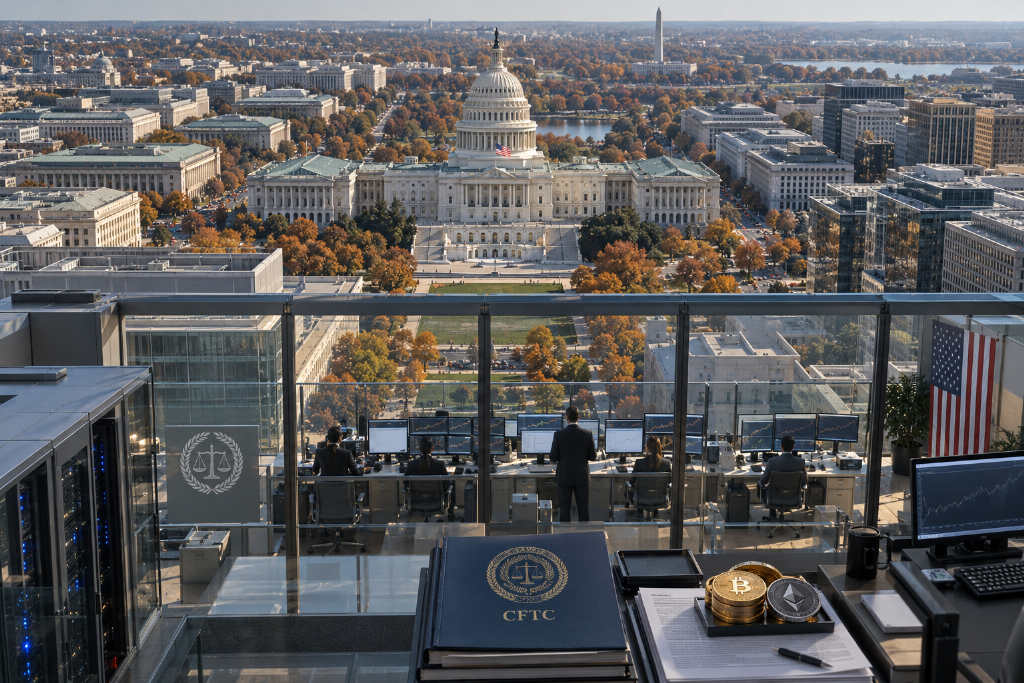
After U.S. crypto market structure legislation stalled again, the Commodity Futures Trading Commission is trying to move ahead with the authority it already has. On Oct. 5, the CFTC said it had opened a new rulemaking process to build a nationwide regulatory framework for crypto asset markets under the Commodity Exchange Act, giving eligible crypto trading platforms the option to come under federal supervision instead of relying entirely on different state licensing regimes.
The plan does not mean the U.S. government is setting up a state-run crypto exchange. What the agency is proposing is a new federally regulated category for trading platforms.
CLARITY Act blocked at the Senate procedural stage
The immediate backdrop is the stalled Digital Asset Market Clarity Act, or CLARITY Act. The bill was designed to redraw the regulatory line between the Securities and Exchange Commission and the CFTC for crypto assets, while also creating a full framework for digital commodity spot markets.
In May, the Senate Banking Committee advanced the bill on a 15-9 vote and sent it to the full Senate.
That effort stopped on Sept. 15, when the Senate held a cloture vote needed to proceed with consideration of H.R. 3633. The motion drew 49 votes in favor and 50 against, with 1 senator not voting. It fell short of the three-fifths threshold, so the procedural motion failed and the bill cannot move forward for now.
CFTC Chair Michael Selig later said Congress had discussed legislation to build rules for crypto markets but had “failed to get a bill to the President’s desk,” so the CFTC and the SEC would use their current statutory authority to start building a regulatory structure.
CFTC lays out CTX and CAM
The agency’s proposal has two main pieces: Regulation Crypto Asset Transactions, or CTX, and Regulation Crypto Asset Markets, or CAM.
CTX would create specific rules for crypto asset transactions involving retail customers where margin, leverage, or financing is used.
CAM would create a registered subcategory called “Crypto Asset Market” within the existing Designated Contract Market, or DCM, framework, aimed at venues that serve crypto asset trading.
Under that structure, platforms such as Coinbase and Kraken could choose to enter a single federal market oversight system if they meet the rules, rather than depending only on state money transmitter licenses.
The CFTC said federally supervised trading venues would need to meet market standards that include preventing manipulation, maintaining fair and orderly trading, managing conflicts of interest, and protecting customer assets.
One of the most important distinctions is that CAM is expected to allow retail margin, leveraged, or financed crypto trading on a lawful basis. The CFTC said it believes the Commodity Exchange Act already gives it authority in that area.
A voluntary federal option, not a replacement for Congress
The agency also said this should not be read as a full takeover of the crypto spot market, which is where much of the misunderstanding is likely to arise.
Selig explicitly acknowledged that the CFTC does not currently have the power to require all spot crypto assets to trade on CFTC-registered platforms. The new CAM structure would only offer a voluntary federal option.
A compulsory and comprehensive framework covering the entire U.S. digital commodity spot market would still require legislation from Congress, including measures such as the CLARITY Act.
In practice, the CLARITY Act was meant to deliver nationwide crypto market structure legislation. What the CFTC is doing now is narrower: it is trying to open a federal-level regulatory lane for trading platforms using authority already available under current law.
Selig also said rulemaking by executive agencies “cannot indefinitely substitute for a statutory framework passed by Congress.”
ANPRM stage begins with a 60-day comment period
For now, the CFTC has issued an Advanced Notice of Proposed Rulemaking, or ANPRM. The current stage is meant to outline the direction of the framework and collect market feedback before formal rules are drafted.
According to the agency, the public comment period will run for 60 days after the notice is published in the Federal Register, and those comments will feed into the next phase of rulemaking.
The policy shift points to a possible new phase in U.S. crypto regulation, where Congress moves slowly and the SEC and CFTC try to fill gaps with powers they already hold.
Market size and what this could mean for exchanges
The report said the crypto market currently stands at about $3.01 trillion. CoinGecko’s latest data put total crypto market capitalization at roughly $3.01 trillion, with Bitcoin accounting for about 57% of that figure.
BTC was trading at about $84,700, with a market capitalization of around $1.70 trillion and perpetual futures open interest of about $69.19 billion.
For crypto exchanges, the biggest change if CAM is ultimately adopted would not simply be one more license. It could mark the first time the U.S. offers a compliance route designed specifically for crypto markets, carrying federal status and covering retail leveraged trading.
Even so, the central question of whether the U.S. can build a complete regulatory system for spot crypto markets still rests with Congress. The CFTC is not replacing the CLARITY Act. It is moving forward with the legal authority already in hand after the bill stalled.