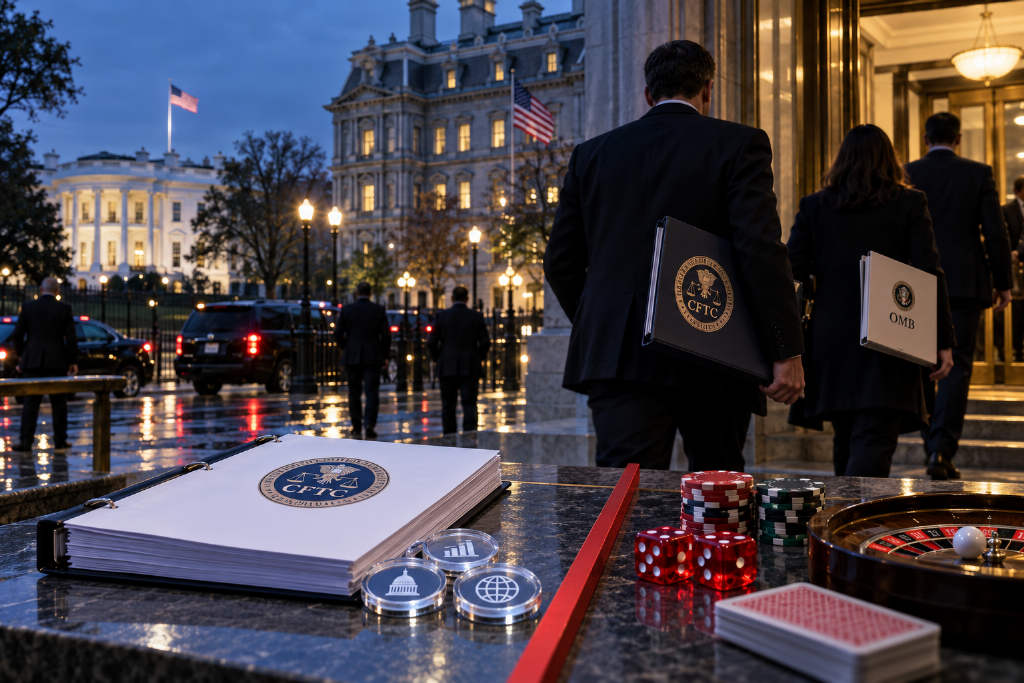
CFTC sends two rules to White House review, drawing a line around event contracts and gambling products

CFTC sends two rules to White House review, drawing a line around event contracts and gambling products

N
News Editor
2026-09-30 15:25:39
The U.S. Commodity Futures Trading Commission has submitted two rules to the White House Office of Management and Budget for review, according to ChainCatcher. One proposal would bring event contracts into the regulatory definition of swaps. The other, described as an interim final rule, would exclude "casino-style gambling products" from the scope of swaps. OMB received both items this week, and the documents are dated Sept. 28. The move comes as the CFTC and several states remain locked in a fight over how prediction markets should be treated. Event contracts are typically binary yes-or-no bets tied to measurable outcomes such as sports events and elections. Last week, the Sixth Circuit ruled that Kalshi's sports contracts are not swaps and should be governed by state gambling law, with the Eighth Circuit reaching a similar conclusion. The Third Circuit had earlier found that the CFTC has jurisdiction over prediction markets, leaving a split at the federal level. CFTC Chair Mike Selig has said the agency holds exclusive authority over prediction markets. If event contracts are deemed swaps and not gambling products, that could weaken states' positions in several lawsuits against platforms including Kalshi. OMB disclosures also show the CFTC recently sent the White House a preregulatory item focused on crypto oversight.

The U.S. Commodity Futures Trading Commission, or CFTC, has submitted two rules to the White House Office of Management and Budget (OMB) for review, according to ChainCatcher.

One proposal would place event contracts within the regulatory definition of swaps. The other, labeled an interim final rule, would exclude "casino-style gambling products" from what counts as a swap. OMB received both items this week, and the documents are dated Sept. 28.

OMB review is now underway

OMB review is usually the last step before a rule goes out for public comment. An interim final rule works differently: it takes effect right away while still leaving room for later comments and revisions.

Fight over prediction markets remains active

The filing lands as the CFTC and multiple states continue to contest the legal nature of prediction markets. Event contracts are generally binary yes-or-no wagers on measurable outcomes, including sports contests and elections.

Last week, the U.S. Court of Appeals for the Sixth Circuit held that Kalshi's sports-related contracts are not swaps and should fall under state gambling law. The Eighth Circuit issued a similar ruling.

The Third Circuit had previously found that the CFTC has jurisdiction over prediction markets, creating a split across the federal courts.

What the rules could mean for state cases

CFTC Chair Mike Selig has argued that the agency has exclusive jurisdiction over prediction markets. If event contracts are treated as swaps and are not classified as gambling products, states could see their position weakened in several lawsuits against prediction market platforms such as Kalshi.

Commission structure and crypto rulemaking

Under the law, the CFTC is supposed to have five commissioners. President Trump has not nominated additional commissioners so far, leaving Selig as the only current member and in a position to advance regulatory and policy decisions on his own.

OMB disclosures also show that the CFTC recently submitted a preregulatory item to the White House focused on crypto regulation.

This article was originally published by Bit.Fan. For more cryptocurrency news and market insights, visit www.bit.fan.
300

Disclaimer:

The market information, project data, and third-party content displayed on this platform are for industry information sharing only and do not constitute any form of investment advice or return commitment.

Cryptocurrency trading carries high risks. Users should fully assess their risk tolerance and make independent decisions. All profits, losses, and legal responsibilities are borne by the users themselves.