
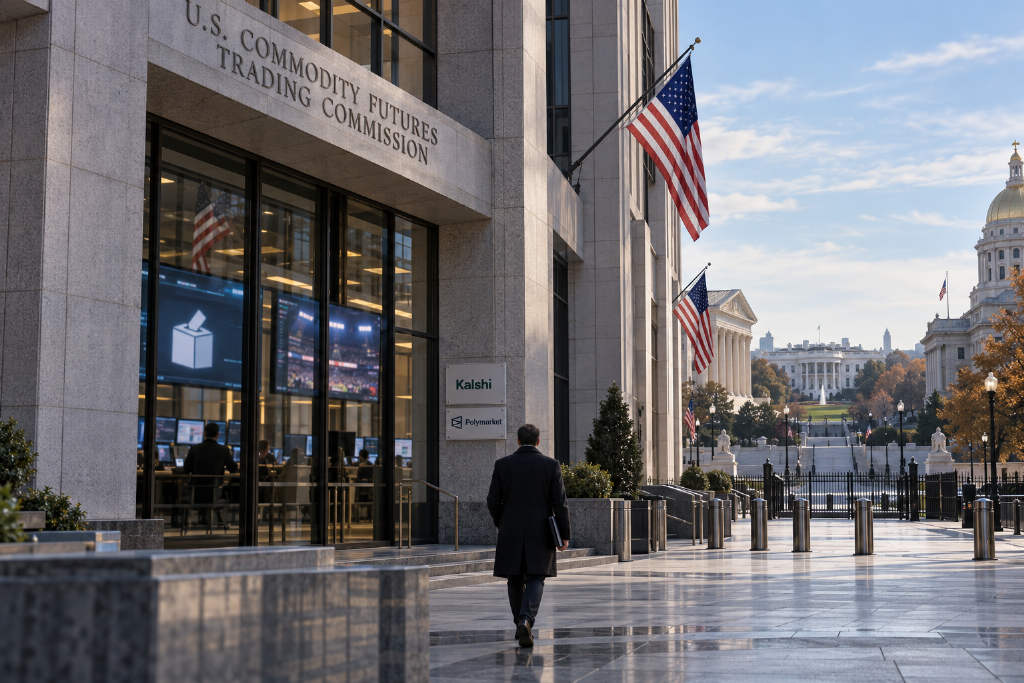
The U.S. Commodity Futures Trading Commission, or CFTC, has submitted two rulemakings to the White House Office of Management and Budget that aim to bring prediction market event contracts into the legal definition of swaps and, at the same time, exclude gambling products from that category. If adopted, the package could undercut the legal theory states have used to treat platforms such as Kalshi and Polymarket as illegal gambling operations.
Two filings target the legal status of event contracts
The first filing is a proposed rule that would classify event contracts as swaps. In the article, event contracts are described as binary yes-or-no wagers tied to measurable outcomes such as sports contests and election results. Swaps fall under the CFTC’s jurisdiction as financial derivatives and are regulated under the Dodd-Frank Act within the federal financial oversight system.
If event contracts are formally treated as swaps, jurisdiction would sit more clearly with the CFTC, making it harder for states to intervene through gambling law.
The second filing is an interim final rule that would remove what the article calls casino-style gambling products from the definition of swaps. The measure is framed as a defensive step: draw a line first, state that swaps are not gambling, and argue that event contracts may resemble wagers in form but are financial instruments in substance.
Under that structure, the interim final rule would take effect immediately once effective, while still opening a window for public comment and revisions.
OMB review began with Sept. 28 submissions
Both drafts were submitted to OMB on Sept. 28. The CFTC labeled them "not economically significant," a designation the article says is meant to lower the review burden. OMB review is typically the last step before a rule is released for public comment.
The article says the filings can be tracked through OMB’s public database.
Jurisdiction fight between states and the CFTC keeps widening
The rulemaking push did not emerge in isolation. Over the past year, CFTC Chairman Mike Selig has taken an expansive view of the agency’s role in overseeing prediction markets and has directly sued states in federal court, arguing that the CFTC has exclusive jurisdiction over the sector.
Federal courts, though, have not lined up behind that position. Last week, the U.S. Court of Appeals for the Sixth Circuit ruled against the CFTC, holding that Kalshi’s sports-related contracts are not swaps and should be governed by state gambling law. The Eighth Circuit reached a similar result. The Third Circuit, by contrast, had previously supported the CFTC’s jurisdictional claim.
With three federal appellate courts pointing in different directions, the dispute now appears increasingly likely to require a final answer from the U.S. Supreme Court.
The agency is trying to answer the courts through rulemaking
According to the article, the CFTC’s new definitions are meant to push back directly against the reasoning used by the Sixth and Eighth Circuits. If the regulatory definition of swaps is expressly expanded to cover event contracts, a court that says an event contract is not a swap would be colliding head-on with the agency’s own rules.
That turns the case into more than a platform compliance fight. It also raises a broader question about whether an administrative agency can use rulemaking to reshape the field after courts have interpreted existing law in a different way.
Platforms named in the dispute
The article says the market extends well beyond Kalshi. Major prediction market platforms in the U.S. and globally include Kalshi, Polymarket, Crypto.com, and Robinhood, which has joined more recently.
- Kalshi is described as a CFTC-authorized futures exchange focused on U.S. political and economic events.
- Polymarket operates as a decentralized prediction market on Polygon.
- Crypto.com offers event contract trading within its exchange.
- Robinhood has recently entered the space.
Across those venues, event contracts cover sports outcomes, election winners, economic data releases, and weather events. Most are structured as binary bets. The CFTC is trying to place those products inside a financial derivatives framework rather than a gambling framework.
The article says that approach rests on viewing prediction markets as tools for information aggregation and price discovery, not simply as gambling products.
A single sitting commissioner is driving the effort
The CFTC is statutorily structured to have five commissioners, but the article says the Trump administration has not nominated any others and that Mike Selig is the only sitting commissioner. That gives him room to make regulatory and policy decisions on his own, without cross-party negotiation.
The two rulemakings were advanced by Selig alone. The article adds that this kind of one-person commission is not without precedent, but it also means the agency’s policy direction is highly concentrated and lacks much internal counterweight.
Separate crypto prerule also appears in OMB disclosures
OMB disclosures also show that the CFTC recently submitted a separate crypto-related prerule to the White House, though no details have been made public. The article says that may point to broader regulatory activity by the agency in the digital asset sector.
What comes next
The practical significance of the CFTC’s move is that it is trying to redefine the battleground through regulation after suffering setbacks in court. If the administrative definition of swaps is broadened, the Sixth and Eighth Circuit rulings could face reversal or be sent back for reconsideration.
At the same time, the dispute raises a constitutional-level issue: whether an agency can use rulemaking to sidestep judicial interpretations of existing law. For the prediction market industry, the preferred outcome would be for the CFTC to succeed in classifying event contracts as swaps while separating them from gambling. That would strengthen the federal legal footing of platforms such as Kalshi and Polymarket and make it harder for states to shut them down through gambling statutes.
If the Supreme Court ultimately finds that the CFTC exceeded its authority, the industry could face a longer period of legal uncertainty.
The article identifies three near-term points to watch: how quickly OMB reviews the two drafts, when the CFTC opens the public comment period, and whether states file new federal challenges before the rules formally take effect.