
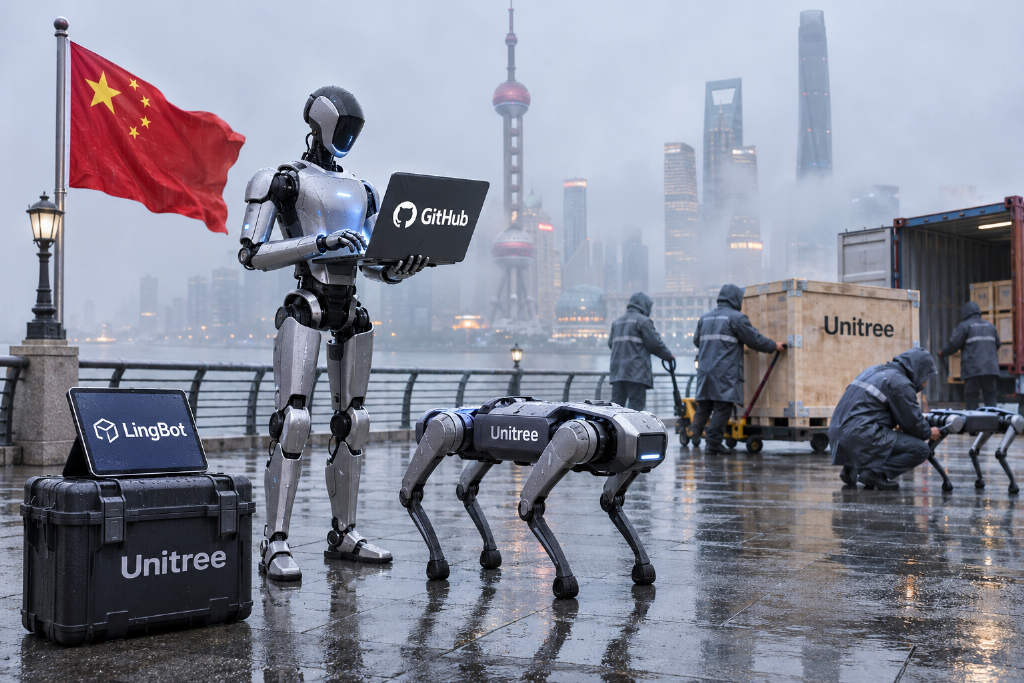
Chinese embodied AI companies are no longer limiting their overseas push to shipping robots. The expansion is now reaching models, toolchains, and open-source ecosystems.

The article says that during Tesla’s first-quarter 2025 earnings call in April 2025, Morgan Stanley analyst Adam Jonas asked Elon Musk who was ahead in physical AI fields such as humanoid robots, China or the United States. Musk said he was confident Tesla would rank first, then shifted the focus to China. He said he was somewhat worried that the companies ranked second through tenth in robotics could be Chinese.
More than a year later, the article argues that the trend Musk pointed to — Chinese embodied AI companies moving overseas — is becoming real.
Data from EO Intelligence cited in the piece shows that among 182 funded embodied AI companies in its sample, 73 have already expanded abroad and 21 are preparing to do so. Together, that accounts for about 51.6%. Unitree founder Wang Xingxing previously said overseas business made up about 50% of the company’s annual performance. The report also says companies including AgiBot and UBTECH have placed globalization and overseas expansion at the center of this year’s strategy plans and launch events, while hiring demand for overseas embodied AI talent has also picked up.
The article says this wave is not only about selling robot bodies overseas. Chinese embodied AI companies are also pushing at the “brain” layer by open-sourcing general-purpose embodied AI models and joining the construction of a global technical ecosystem. Ant Lingbo is used as an example. Its LingBot series has accumulated more than 33,000 GitHub stars and over 2.2 million downloads.
The report describes this as a structural turning point. Overseas expansion is becoming another growth curve for Chinese embodied AI. What began with body manufacturing and motion control attracting attention abroad is now extending into general model capability entering the global competitive frame.
Overseas expansion is no longer optional
The article says Chinese embodied AI companies going abroad is not new, but it is no longer a multiple-choice question.

Overseas investment banks including Morgan Stanley have repeatedly raised their shipment forecasts for Chinese humanoid robots. One of the main reasons, according to the report, is overseas opportunity. Morgan Stanley data cited in the article says Chinese manufacturers account for about 90% of the 13,000 to 16,000 humanoid robots expected to ship globally in 2025. On average, nine out of every 10 units sold would come from China. Morgan Stanley analysts also said humanoid robots and the broader robotics industry could become the next key driver of China’s machinery exports over the next five to 10 years, drawing a comparison with the electric vehicle industry a decade ago.
The report breaks the advantages behind this embodied AI export wave into three layers.
The first is the body and the “cerebellum,” or motion-control layer. China has a complete supply chain, component support, and advantages in cost and delivery speed, the article says. At the same time, companies that spent years prioritizing the “cerebellum” have built strong motion-control capabilities, helping speed up hardware-software integration.
The second is scenarios and data. China’s manufacturing and service sectors provide rich real-world settings for robots to validate tasks, collect interaction data, and keep iterating. The article says experience accumulated in real environments helps improve both products and models and lays the groundwork for overseas applications.
The third is open source and the “brain.” Through open-source work, local innovation in Chinese embodied general models is being turned into part of the global infrastructure for embodied technology, according to the report. As developers collaborate and technical and industrial ecosystems are built out, China’s influence and voice in embodied AI continue to expand.
The article says these three layers reinforce one another. Together they are pushing Chinese embodied AI from hardware exports toward open models and global ecosystem collaboration, supported by manufacturing and supply-chain strengths, real-world data accumulation and iteration, and participation from global developers through open source.

China’s embodied AI “brain” is moving into focus
If the body and motion-control layer solve whether a robot can be built and move steadily, the article argues that China’s strength in the “brain” layer has been underestimated.
One reason, it says, is a long-standing industry assumption: China is strong in hardware and robot bodies, while the United States is strong in brains and models. With the arrival of GPT-6 Astra, debate has resurfaced over whether large language models could absorb embodied models.
The report says several industry participants see the value of that debate elsewhere. The point is not to declare a winner between technical routes, but to push the field back toward real tasks and the physical world, and to ask what capabilities robots actually need.
Moving from understanding instructions to doing useful work requires more than language comprehension. After interpreting a task and making a plan, a robot still has to predict how actions will change the environment, revise those predictions based on execution feedback, and respond in real time. The article says those demands create new questions for training targets, model architecture, and inference methods, while also leaving room for Chinese teams to contribute foundational innovation.
Before the industry settled on whether large models could handle everything, some Chinese teams had already started offering their own answers. The article points to Ant Lingbo’s “embodied-native” approach. In July this year, the team released LingBot-VA 2.0 and chose to pretrain a causal video-action model from scratch so the model could learn the relationship between environmental change and action, then revise predictions using the latest observations during execution.
The report says “embodied-native” means the model is designed from the start around the perception, prediction, and action needed for robots to complete tasks in the physical world. More importantly, it marks an effort by Chinese embodied AI companies to build an original technical route of their own.

How overseas teams are using the LingBot models
The article then looks at what happened after the models were opened up and groups outside use cases into three categories.
First: extending the research
Researchers at Stanford University’s Vision and Learning Lab wanted to understand where capability gains in action models actually come from. Because different teams use different backbones, training methods, and datasets, they aimed to build a composable research framework that could compare different video-action interaction methods under one shared setup. That became the starting point for the OpenWAM project released in October.
At the implementation level, the article says the team directly reused LingBot-VA’s Transformer architecture, text encoder, and tokenizer as the reference implementation for the framework.
Researchers from the National University of Singapore focused on another problem in embodied AI: how a world model can retain memory of previously generated scenes during long-horizon interactive generation without slowing down as historical information accumulates.
To address that, they proposed a spatial-memory method called Velox. The core idea, according to the article, is not to delete world memory but to let the current frame read only the truly relevant historical regions. Instead of retraining a new world model, the team used LingBot-Fast-Cam as the base, kept the pretrained generator unchanged, and added a spatial information filtering mechanism only at inference time. That lets the model use camera viewpoint and depth information to retrieve only the historical content relevant to the current frame.
In the end, the article says that across 158 WBench navigation cases, Velox’s API-free average score was only 0.15 points behind the same LingBot-Fast-Cam baseline, suggesting it eased the slowdown problem in long-sequence generation while largely preserving generation quality.
Second: turning models into tools more people can use
For ordinary developers, the article says, even advanced model capability is hard to use if it remains locked inside papers or top-end hardware. A model’s value is ultimately tested by the number of developers who use it and modify it.

Developer RealRebelAI integrated LingBot-World v2 into ComfyUI. Users can drag in an image, set a camera movement path, and generate subsequent frames. To make the workflow run on a personal computer, the developer quantized the model and loaded it layer by layer, then tested it on an RTX 3070 8GB. The article says this shows world models beginning to move from the lab into ordinary developer workflows.
Developer Don Allen III built a Mac desktop tool based on LingBot-Map. Users can drag a video into the window, start reconstruction locally on Apple Silicon, and monitor progress. After completion, they can rotate and inspect a 3D point cloud, review camera trajectories, and save the result. The report says spatial understanding that once sat inside code and weights has been turned into a visual desktop application that people can operate directly.
The article argues that these community efforts show Chinese embodied model companies are lowering not only the barrier to using models, but also the cost for later developers to keep innovating. Code, experience, and workflows left behind by one developer can be reused and improved by the next, then passed on again, activating the open-source ecosystem through repeated handoffs.
Third: plugging into existing engineering toolchains
The report says open-source embodied AI “brains” still need to prove they can create practical value inside industrial toolchains.
Nvidia added support for LingBot-World in its open-source inference library FlashDreams, allowing developers to run world models with controllable camera motion through that toolset. AWS Labs, meanwhile, made LingBot-World-Fast the default EC2 deployment path and flagship entry point in its own open-source world-model deployment project. Following the project’s steps, developers can configure cloud compute, load weights, and call video generation services.
Some of the impact also appears in academic papers. The article says Nvidia’s SANA-WM team used LingBot-World as a comparison point for image generation quality. Generalist included LingBot-VA 2.0 as a reference in research on how robots can learn new tasks from one or a few demonstrations. Dyna Robotics also cited LingBot-VA in work comparing world-action models with VLA.

The article sums this up by saying overseas peers have already given their own answers to why a paper is worth comparing, why a piece of code is worth keeping, and why a model is worth adapting for deployment.
Two outbound paths are taking shape
In its final section, the article places embodied AI in a longer cycle of Chinese technology development. It says the answer has never been only cost and speed. It has also been openness, and the connections, reuse, and co-creation that openness makes possible. That was true for the internet, true for large models, and the article argues it is true for embodied AI as well.
The World Internet Conference in Wuzhen is presented as one example. Last year, when the “Hangzhou Six Little Dragons” appeared together for the first time, Wang Xingxing recalled his first attendance in 2017, when he brought the company’s first robot dog. At the same event, DeepSeek senior researcher Chen Deli spoke about how open-source innovation can broaden access to technology and let the community feed back into research and development.
This year, the article says, Ant Lingbo — after a dense period of open-source releases — also appeared in Wuzhen with the full-stack LingBot 2.0 technology and its open-source practices, and even moved a real retail pharmacy into the exhibition hall.
Those details, the report says, sketch a shift in China’s technology story: from bringing products to the world to trying to open innovation capability itself to the world.
At the same time, the article notes that embodied AI remains a long-cycle competition and overseas expansion is still in its early stage. Technical generalization, data compliance, local operations and maintenance, and commercial deployment all remain unresolved hurdles.

Against that backdrop, the report identifies two outbound paths that are starting to come into focus.
One is a capital-heavy route built around products and supply chains. Companies such as Unitree, AgiBot, and UBTECH are exporting robot bodies by building factories or R&D centers overseas. The next step for them, the article says, is to move from product delivery to local operations, using products, channels, and customer trust to complete commercial validation.
The other is a platform and ecosystem route. Companies represented by Ant Lingbo are entering the daily R&D workflows of overseas teams by opening models, toolchains, and interfaces. Their next step, according to the report, is to keep iterating on models, stick with open-source strategy, and speed up the formation of an innovation ecosystem around foundational models.
The article says the first route reaches customers and scenarios faster, while the second expands technical reuse faster. Both point to the same future for Chinese embodied AI overseas: only by solving real problems, improving efficiency, and delivering innovation in frontier exploration and real-world scenarios can companies secure an early position in this outbound race.
This “great voyage” has only just begun, the article says, but Chinese embodied AI has already taken a key first step.
The original article was published by the WeChat public account Phoenix Technology and credited to Phoenix Technology.



