


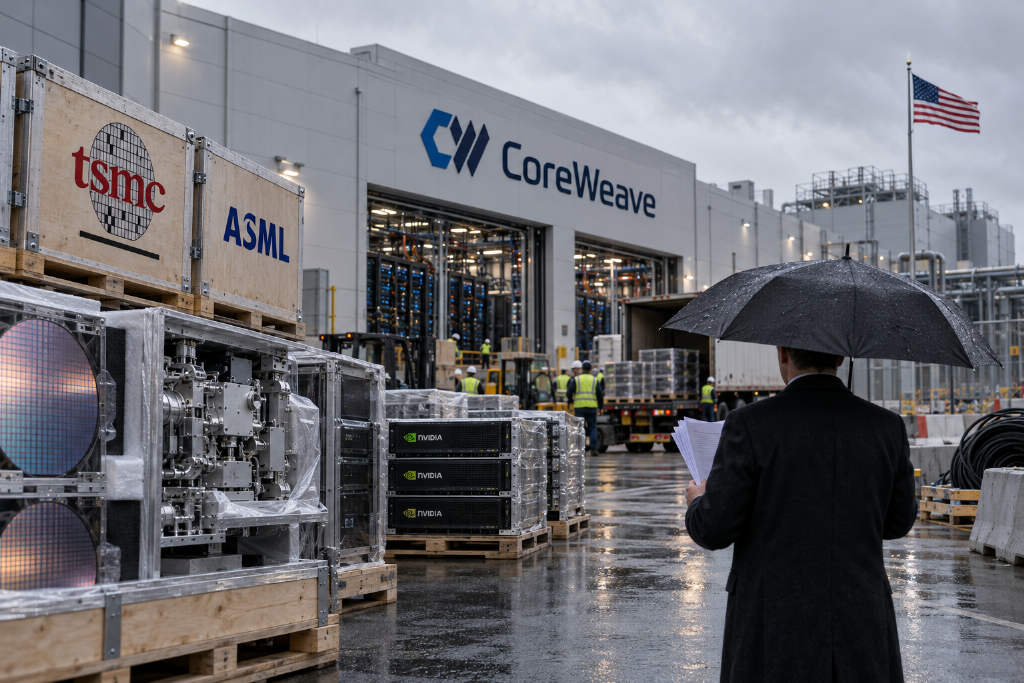
Two semiconductor earnings reports released this week stood in sharp contrast to pricing in the AI compute debt market. Taiwan Semiconductor Manufacturing Co. (TSMC) posted third-quarter net profit up 68.7% year over year, and ASML reported net profit up about 70% from the previous quarter. Upstream suppliers are still setting new profit records. Downstream, however, Nvidia-backed U.S. AI cloud company CoreWeave has seen its bonds sold off even as it sits on a backlog worth about $104 billion, with one bond's yield rising to roughly 15%. At the same time, the Financial Times reported that some junior debt in Anthropic's planned large-scale chip financing may need to offer yields above 10%.
Both sides are benefiting from demand for AI compute. The difference is that upstream profits are already showing up in earnings, while downstream operators still need to raise large sums to buy chips and build data centers. That gap is now visible in bond pricing and in how investors judge debt risk.
Upstream profits are booked, while downstream capital is still tied up
TSMC reported third-quarter revenue of T$1.49 trillion, or about $46.72 billion, and net profit of T$763.06 billion, or about $23.9 billion. Net profit rose 68.7% from a year earlier, and net margin reached 51.1%. Chips made on 7-nanometer and more advanced process nodes accounted for 79% of wafer revenue, while 2-nanometer, which has only recently entered volume ramp-up, contributed 8%.
ASML also turned in strong numbers. Quarterly revenue reached €11.662 billion, or about $13.05 billion, while net profit climbed to €4.96 billion, or about $5.55 billion. Sales of new lithography systems increased from 86 units in the previous quarter to 113.
Not all of that revenue comes from AI, but profit growth tied to demand for advanced manufacturing and equipment is already visible in reported results. ASML said some customers have started discussing equipment orders for 2029 and 2030, and that current production plans may not be enough to meet demand in 2027 and 2028.
CoreWeave presents a very different operating picture. The company, which rents GPU compute capacity to large AI customers, reported second-quarter revenue of $2.575 billion, up 112% year over year. As of the end of June, backlog stood at about $104 billion. During the same period, net interest expense reached $640 million, close to one quarter of quarterly revenue, and the company posted a net loss of $626 million.
The gap comes down largely to business model and cash recovery cycle. TSMC and ASML also require heavy upfront investment, but their chip and equipment sales are already generating substantial profit. CoreWeave must keep buying GPUs and deploying data centers, then recover those costs gradually through customer payments over the coming years. Depreciation, interest expense, and operating costs run through the full lease cycle. More orders can improve visibility on future revenue, but they can also increase the amount of capital needed upfront.
$104 billion in backlog still does not close a multibillion-dollar funding gap
CoreWeave's cash flow statement says more about its current position than its stock price does.
According to the company's second-quarter filing with the U.S. Securities and Exchange Commission, cash generated from operating activities in the first half of 2026 was $3.663 billion. Cash paid for purchases of property and equipment reached $14.117 billion, leaving a gap of about $10.454 billion. Existing operating cash flow is clearly not enough to cover the equipment and infrastructure spending required for rapid expansion, so the company still depends on borrowing, equity financing, and other funding sources.
The $104 billion backlog does provide stronger visibility into future revenue, but those contracts span multiple years and are not cash in hand. GPUs must be delivered on time, data centers must be completed, and customers must continue to perform before the company can recover its investment. Long-term contracts can reduce the risk of weak demand, but they do not guarantee that a company will always have enough liquidity to pay construction costs and debt service.
The bond market has already started to reflect that concern. Reuters reported that a CoreWeave bond issued in June this year came with an issue yield of about 9.675%. Its secondary-market yield has now risen to roughly 15%. A lower bond price does not directly raise the coupon on existing fixed-rate debt, but if the company needs to issue new debt under similar conditions, the cost of additional financing could rise sharply.
CoreWeave is still looking for cheaper capital. This year, the company has raised more than $35 billion through GPU-backed loans, high-yield bonds, convertible bonds, and equity, and it hopes to use investment-grade financing to attract long-term institutional investors such as insurers. For a company that needs to keep expanding compute capacity, the key question is no longer just whether customer orders are there. It is also whether new projects can secure enough funding, and at what interest cost.
Why financing costs differ so much across AI compute deals
Not every AI compute financing deal carries the same price. In March, CoreWeave completed an $8.5 billion GPU-backed financing facility that received investment-grade ratings of A3 from Moody's and A (low) from DBRS. The company said at the time that the reference funding cost was about 5.9%, with the actual fixed rate depending on when funds were drawn. That stands far below the roughly 15% secondary-market yield now seen on another CoreWeave bond.
The difference lies in what protection creditors receive. The $8.5 billion facility is backed by specific GPU equipment, customer contracts, and related data center leases, and it uses a standalone financing vehicle with no general recourse to the parent company. The other bond carries a different mix of credit risk and repayment terms. Investors are not only judging whether CoreWeave's customers will keep paying. They are also asking what assets would be available for repayment if a default occurred.
Anthropic's reported financing plan shows the same distinction. Citing people familiar with the matter, the Financial Times said the company is raising about $60 billion for roughly 1.5 GW of Google TPU deployment. Of that total, $42 billion would be senior debt with additional credit support from Broadcom, while another $18 billion would be junior debt. Blackstone is said to be considering a $9 billion participation and is seeking a yield above 10%. The transaction has not been fully completed, but even with five years of future chip lease payments as support, junior debt investors taking higher loss risk are still demanding double-digit returns.
Financing risk is also tied to project delivery. The report said Nscale, a U.K. data center developer, has seen its flagship project in Norway delayed by about six months. The site is planned for 30 MW of capacity, but only 6.4 MW is currently in operation. For companies that rely on debt to build data centers, construction delays can keep interest and buildout costs accumulating while expected lease revenue arrives later than planned.
That is why long-term contracts do not automatically translate into the same financing terms. How much protection a contract really offers, whether equipment value can cover the debt, whether a project starts operating on schedule, and where a financing sits in the repayment stack all shape the yield investors are willing to accept. Those differences explain more than backlog size alone why some projects can obtain investment-grade financing while other debt gets sold off in the market.
This week's takeaway
TSMC and ASML's latest earnings show that demand for advanced chips is still producing substantial profit. CoreWeave, by contrast, has about $104 billion in backlog but generated only $3.663 billion in operating cash flow in the first half of this year, against $14.117 billion in cash spending on property and equipment. Orders stretch across future years, while GPUs and data center construction require money upfront. That helps explain why demand for compute can keep growing even as operator cash flow remains under pressure.
The bond market is pricing a separate layer of risk. CoreWeave has been able to secure some funding through collateralized, investment-grade structures at around 5.9%, while another bond now trades at a yield near 15%. The two financings are not directly comparable, but they show that customer contracts are only part of the picture. Collateral, credit support, and repayment terms also shape the price of capital. For anyone assessing compute operators, order growth is only one piece; operating cash flow coverage and the cost of future financing matter just as much.