
Circle’s self-developed Layer 1 network Arc is set to open its public mainnet on Sept. 16, 2026.
From its launch as a project in August 2025, to the public testnet going live on Oct. 28, 2025, to a $222 million institutional presale completed in May 2026 at a $3 billion valuation, the market has stayed split on what Arc represents. One camp treats it as a dividing line for traditional capital moving onto blockchain rails. The other sees it as a break from decentralization, closer to a private consortium chain built for traditional finance.
Both views have support in the available facts. Strip away the marketing language, and Arc can be examined through four questions: why Circle wants its own chain, how its consensus works, what sets it apart from other networks, and what ordinary users are actually able to do with it.
Why Circle wants its own public chain
USDC has long been issued on Ethereum, Solana and major Layer 2 networks. As a user of those networks rather than the operator of the base layer, Circle faces three structural constraints.
The first is financial friction created by a two-token model. Enterprises using stablecoins for cross-border settlement or large transfers still need to buy and hold ETH or SOL to pay transaction fees. On a corporate balance sheet, that adds price exposure, an extra foreign-exchange step and another tax item to manage.
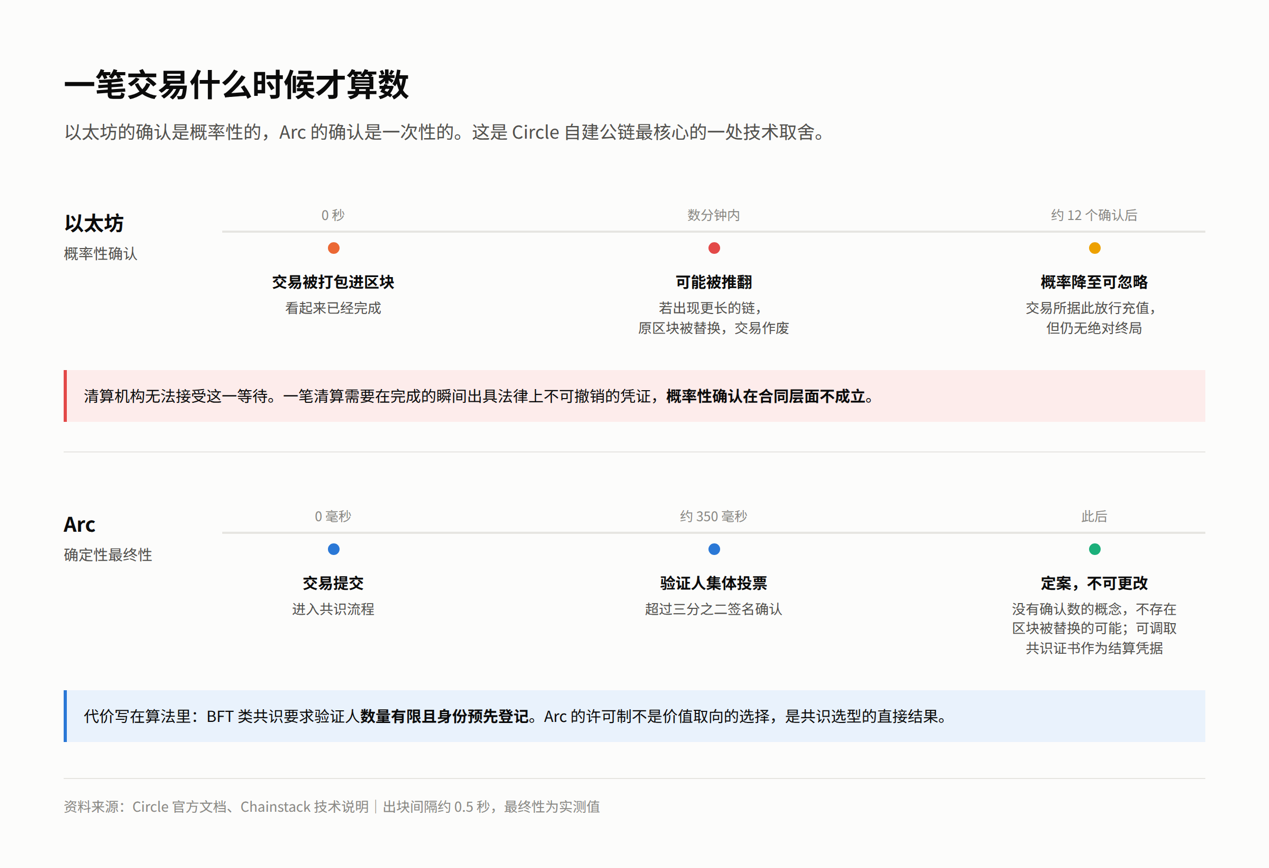
The second is that probabilistic confirmation does not fit clearing. On Ethereum-like networks, a transaction entering a block does not mean it is final in a legal sense. If a longer chain appears, the original block can be replaced and the transaction reversed. Exchanges asking users to wait for multiple confirmations are effectively waiting for reorganization risk to fall to a negligible level. Crypto users are used to that delay. Clearing institutions are not. Their workflows require a legally irreversible record at the moment a transaction is complete.
The third is the absence of protocol control. Hard forks, MEV congestion, gas-price swings and sequencer failures all sit outside Circle’s risk controls if the company depends on someone else’s base chain.
That is why Arc is not being framed as a general-purpose chain built to compete for DeFi liquidity. Circle is positioning it as a settlement network for stablecoins, tokenized real-world assets, or RWA, and foreign-exchange clearing.
Regulation: one law in force, one still facing a vote
Arc’s architecture is shaped by more than commercial incentives. The other half comes from regulation. That distinction matters because some design choices appear to reflect Circle’s preferences, while others look like the direct result of legal obligations.
The GENIUS Act is already in force
On July 18, 2025, the GENIUS Act took effect as the federal framework for payment stablecoins in the United States.
The law imposes four core obligations on issuers. Reserves must consist of high-quality liquid assets, with monthly reserve disclosures and quarterly third-party audits. Any issuer with more than $10 billion in outstanding liabilities must obtain a federal license and become a permitted payment stablecoin issuer, or PPSI. A PPSI is treated as a financial institution under the Bank Secrecy Act, making anti-money-laundering controls and customer identification mandatory. Issuers also may not pay interest or yield to holders, creating a legal boundary between payment stablecoins and bank deposits.
The Federal Deposit Insurance Corporation, or FDIC, has already said reserve assets backing stablecoins do not fall under federal deposit insurance.
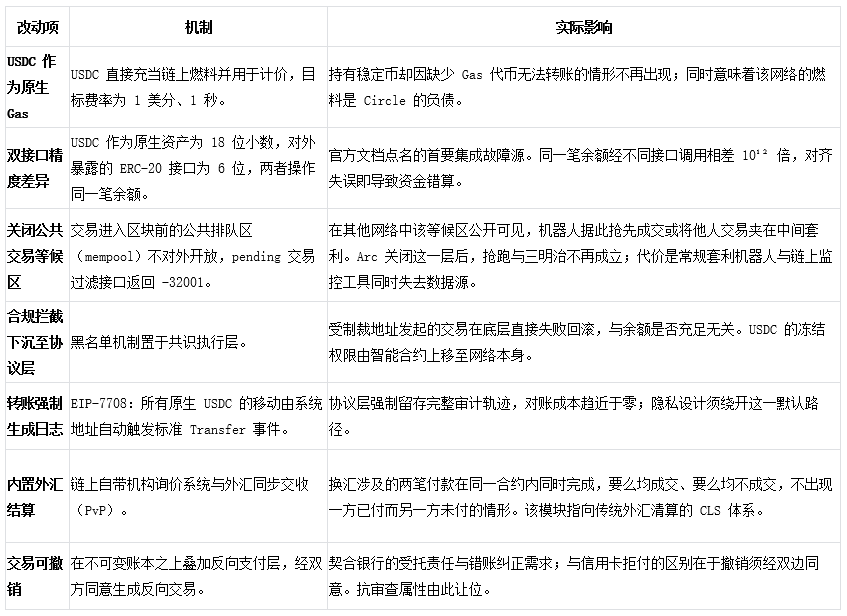
Several Arc design choices track directly back to those rules. A blacklist mechanism at the protocol layer maps to the issuer’s obligations under the Bank Secrecy Act. USDC as native gas, combined with the absence of interest-bearing assets onchain, lines up with the prohibition on yield. EIP-7708 audit trails appear built to support the evidence needed for monthly disclosures and quarterly audits.
In other words, Arc’s degree of centralization has a legal floor. As a PPSI, Circle would not have room to build a censorship-resistant network even if it wanted to.
The CLARITY Act is still pending
The Senate is due to hold a cloture vote on the CLARITY Act on Sept. 15, one day before Arc’s mainnet launch. The timing is close, but there is no dependency between the two events. The result of the vote does not determine whether Arc goes live.
The bill’s impact on Arc would be more medium-term.
First is jurisdiction. The bill would place digital commodity spot markets under the Commodity Futures Trading Commission, or CFTC, while leaving securities matters with the Securities and Exchange Commission, or SEC. Sixteen tokens already identified as commodities would be explicitly regulated by the CFTC, together accounting for roughly 78% of total crypto market capitalization.
Second is the legal basis for tokenized securities. One of the heaviest parts of Arc’s narrative is a plan by DTCC to move DTC-custodied assets onchain in the second half of 2027 and pair them with stablecoins for atomic settlement. What that plan lacks is not technical capacity, but legal certainty from market-structure legislation. If the bill fails, that foundation disappears and implementation becomes materially harder.
Third is the classification of ARC itself. The bill lays out a path for tokens to move outside securities treatment through a four-step “mature blockchain test,” along with a hard 20% holding cap.
The source text flags one inference here as requiring independent verification: Circle keeps 25% of the initial ARC allocation, above that threshold, while 60% is assigned to the ecosystem and the actual control structure of that bucket has not been disclosed. If the token generation event, or TGE, remains undated for an extended period and the reason is tied to this issue, that inference could be tested by watching how Circle ultimately handles its 25% stake. The white paper itself does not classify ARC as a security or not.
Two other parts of the bill are indirectly relevant. One clause bars stablecoin yields that resemble bank deposit interest but allows rewards tied to trading, payments, market making, liquidity provision, governance, validation and staking. A joint letter from 78 banking groups argues that this line is easy to engineer around. Section 604 would exempt non-custodial software developers from money transmitter registration and Bank Secrecy Act obligations, a move law-enforcement agencies oppose because they see it as an avenue to avoid compliance.
The voting outlook is weak. A cloture vote only decides whether debate can proceed, not whether the bill passes. Republicans hold 53 Senate seats, but Rand Paul and Josh Hawley have already said no, while Thom Tillis has made stronger ethics provisions a condition for support. On the Democratic side, only two members voted in favor during committee, and seven others released a joint statement saying the draft falls short on ethics, consumer protection and illicit finance. On Polymarket, the probability of passage fell from 82% in February to 16% by the end of August.
If the vote fails, the outcome is not simply the status quo. Regulation would revert to a fragmented path in which the SEC’s Project Crypto, the CFTC, the Office of the Comptroller of the Currency and the Treasury move separately, with comprehensive legislation potentially delayed until 2029.
Consensus: once confirmed, a transaction does not change
Arc runs on a consensus engine called Malachite, developed by Informal Systems, the team known for formal verification work around Tendermint and acquired by Circle in 2025. Its execution layer uses Reth and is fully compatible with the Solidity toolchain. Block time is about 0.5 seconds, and the mainnet Chain ID is 5042.
The key property is deterministic finality. After a transaction is submitted, validators vote on it. Once more than two-thirds sign off, it is final and cannot be changed. Tests cited in the source put that process at about 350 milliseconds. There is no notion of waiting for extra confirmations and no possibility of a block being replaced. Reorganization risk is removed at the mechanism level.
The tradeoff is written into the algorithm. BFT-style consensus depends on validator voting, which means the participant set must stay limited and identities must be registered in advance. Arc’s permissioned structure is not an ideological add-on. It is a direct consequence of the consensus design.
How Arc differs from a general-purpose public chain
To satisfy compliance requirements, Arc changes several things at the base layer.
Two details matter before anyone integrates with it.
The first is query cost. Standard nodes keep only a recent slice of full state. Older data has to be fetched from archive nodes that retain complete history, and that costs more. Arc places the boundary at 127 blocks behind the chain head, roughly one minute. On Ethereum, the comparable window is around 25 minutes. That means a transaction from an hour ago already counts as paid historical data on Arc. Wallets, market-data sites and data-service applications would face meaningfully higher operating costs than they do on Ethereum.
The second is the consensus certificate. Arc offers an arc_getCertificate endpoint that lets users retrieve proof showing which validators signed a transaction, while arc_getVersion returns node version information. For institutions, that certificate is significant because it can be archived as proof that settlement was completed. It is the technical expression of the “legally irreversible record” described earlier.
On privacy, Arc provides optional confidential transfers. Amounts are hidden while addresses stay visible, using TEE, or a hardware-isolated area inside a chip that outside systems cannot read. The security of that privacy layer therefore rests on hardware vendors rather than purely on cryptographic assumptions.
Its post-quantum path is split into four phases. At genesis, the network already supports post-quantum signature wallets, so users can create them immediately without migrating later.
For cross-chain movement, Arc natively integrates CCTP and Gateway. With CCTP, USDC is burned on the original chain and an equal amount is minted on Arc. There is no third-party bridge contract holding funds, no separate bridge-issued IOU token, and none of the usual bridge-hack exposure. Users receive Circle-issued USDC itself. Gateway aggregates balances across multiple chains into a single address. That advantage comes from Circle’s position as the issuer, not from a generic technical feature.
Validator structure: 12 nodes and a one-third security threshold
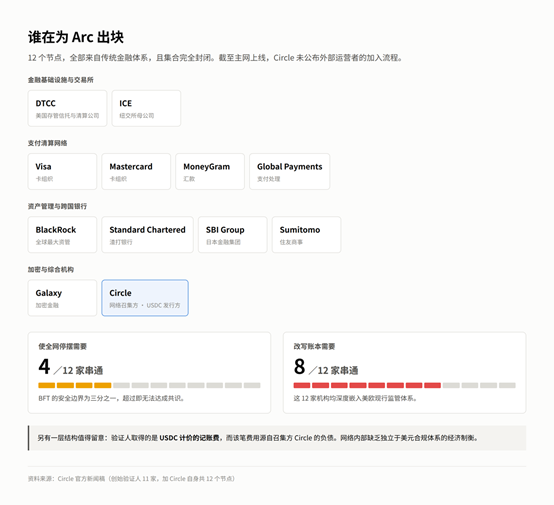
Arc’s validator set is fully closed at this stage. Circle named 11 founding validators, and with Circle itself the network starts with 12 nodes.
- Financial infrastructure and exchanges: DTCC and ICE, the parent of the New York Stock Exchange
- Payments and settlement networks: Visa, Mastercard, MoneyGram and Global Payments
- Asset managers and multinational banks: BlackRock, Standard Chartered, SBI Group and Sumitomo Corporation
- Crypto and mixed institutions: Galaxy and Circle
In a BFT system, the security threshold is one-third. With 12 nodes, collusion by four can halt the network, and collusion by eight can rewrite the ledger. All 12 institutions are deeply embedded in current U.S. and European regulatory systems. As of the mainnet launch window, Circle had not published a process for admitting outside operators into the validator set.
There is another structural point. Validators are paid bookkeeping fees denominated in USDC, and that fee stream ultimately comes from liabilities issued by Circle. The network lacks an internal economic counterweight independent of the dollar-based compliance system.
Adam Cochran’s criticism targets that exact issue. He wrote: “This is not an L1, calling it an L1 is offensive. It’s a private consortium chain with pre-approved validators.” His argument is that using USDC as gas removes the economic incentive for validators to remain independent, making centralization inevitable.
Defenders answer that Arc was never built for DeFi in the first place and that institutions are willing to accept the centralization tradeoff in exchange for predictable costs and smoother access.
The disagreement is partly about definitions. The more practical question is whether the trust model has been disclosed honestly. If Arc is understood as an institutional settlement network implemented with blockchain technology, its design is internally consistent. If it is judged by public-chain standards for censorship resistance, it does not pass.
The ARC token: not issued, no TGE yet
ARC and the Sept. 16 mainnet launch are separate matters. The token has not been issued, and a TGE has not started.
What has been disclosed
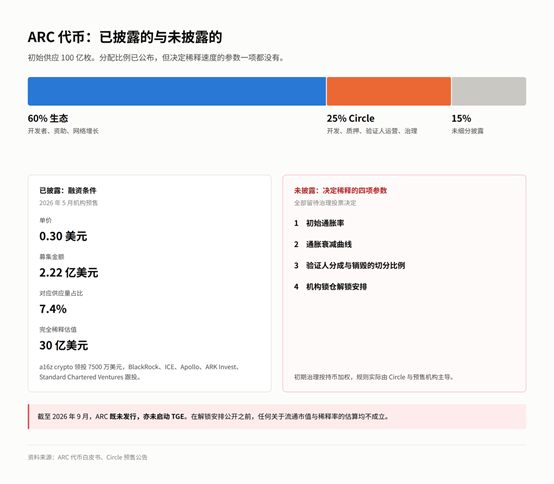
Initial supply is 10 billion tokens. Of that, 60% is allocated to the ecosystem, 25% is retained by Circle, and about 15% has not been broken down in detail.
In May 2026, the project completed a $222 million presale at $0.30 per token, corresponding to 7.4% of supply and a $3 billion fully diluted valuation. a16z crypto led with $75 million, with BlackRock, ICE, Apollo, ARK Invest and Standard Chartered Ventures participating.
ARC is meant to support the network’s transition from PoA to PoS, with the former relying on designated institutions that take turns producing blocks and the latter on nodes staking tokens. It also governs economic parameters and converts stablecoin fees into ARC at settlement before distributing them to validators and stakers. In other words, fee stability for users and value capture for the token are separated into two layers.
What has not been disclosed
The initial inflation rate, the inflation decay curve, the split between validator rewards and burn, and institutional lock-up and unlock schedules have all been left open. Those parameters are meant to be decided by governance, but early governance is token-weighted, meaning Circle and presale institutions would effectively control the rules.
Until an unlock schedule is published, any estimate of circulating market capitalization or dilution is speculative.
What ordinary users can do now, and what they cannot do later
During the testnet phase
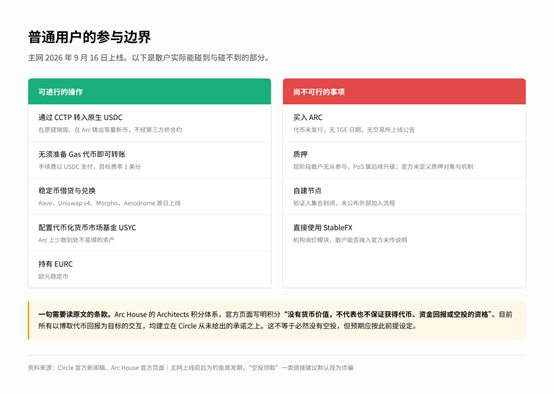
Users can claim test USDC and EURC, interact with Uniswap and Curve, deploy contracts through Remix, and participate in the Arc House Architects points system.
Architects has five tiers: 500, 3,500, 15,000, 40,000 and 90,000 points. Benefits include badges, priority registration for events, quarterly briefings with the Circle team, merchandise and, at the top tier, travel subsidies.
One line in the official terms matters. The page says Architects points “have no monetary value and do not represent or guarantee eligibility for tokens, financial returns, or an airdrop.” That means every interaction aimed at farming future token rewards rests on a promise Circle has not made. That does not prove there will be no airdrop. It does define the assumption users are working under.
After mainnet launch
Users will be able to bridge in native USDC through CCTP, transfer without holding a separate gas token, use Aave, Uniswap v4, Morpho and Aerodrome for stablecoin lending and swaps, allocate into the tokenized money market fund USYC, and hold EURC.
Several things remain unavailable. Users cannot buy ARC because it has not been issued. Staking is not open to retail participants at this stage, since PoS is part of a later upgrade. The source notes that some secondary reports have claimed staking could start on mainnet day, but the official materials do not define what exactly would be staked or how. Running a node independently is also not an option. StableFX is an institutional quote-request module, and Circle has not said whether retail users can access it directly.
Could Arc reproduce Robinhood’s meme frenzy?
Before Arc’s launch, Robinhood’s chain went through a meme-driven burst of activity. That naturally turned attention toward Arc and whether a similar cycle could emerge there.
Robinhood Chain’s stated goal and what actually happened
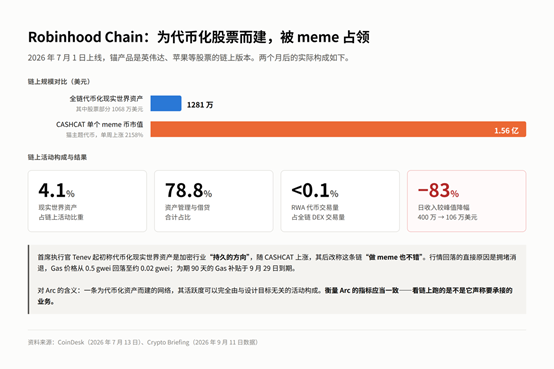
Robinhood Chain launched on July 1, 2026. It was pitched as a regulated venue bringing tokenized real-world assets into DeFi, with Stock Tokens such as onchain versions of Nvidia and Apple shares as the anchor product. At the time, many treated it as a template for traditional brokerages moving onchain.
Actual usage moved in a different direction. Meme trading dominated. A cat-themed token called CASHCAT rose 2,158% in one week and reached a $156 million market capitalization, while the chain’s total RWA size at that point was $12.81 million, including $10.68 million in stock-linked products. By share of activity, RWAs accounted for 4.1%, while asset management and lending together made up 78.8%.
Chief Executive Officer Vlad Tenev first described tokenized RWAs as a “durable direction” for crypto. After CASHCAT surged, he later said the chain was “pretty good for memes too.”
Within two months, DEX volume on the network exceeded $34.6 billion and stablecoin supply passed $1 billion. During the same period, actual trading volume in RWA tokens was below $30 million, less than 0.1% of total DEX volume on the chain.
What happened after the peak
The market has already pulled back. Daily revenue dropped from a $4 million peak to $1.06 million on Sept. 11, down 83% from the top and 76% week over week. The direct reason was the easing of meme congestion. Gas prices fell from 0.5 gwei to about 0.02 gwei, erasing the fee premium that had inflated revenue. A 90-day gas subsidy expires on Sept. 29, after which users will pay market rates.
At the corporate level, Robinhood Markets reported second-quarter crypto trading revenue of $100 million, down 38% year over year.
Two other incidents exposed structural problems in the model. On Sept. 4, block production on the network stopped for at least 14 minutes, with no public explanation. Around the same time, AMC Entertainment Chief Executive Officer Adam Aron publicly objected to AMC stock tokens trading on the chain, saying they were not registered under U.S. securities laws, demanding trading stop and threatening litigation. Robinhood’s chief legal officer Dan Gallagher rejected that demand. OpenAI had earlier denied any partnership with Robinhood.
The issue sits in the legal construction of Stock Tokens. They are debt securities issued by Robinhood Assets Limited. They provide price exposure but do not grant ownership of the underlying company or a claim on it, which is why they can be issued without the company’s consent. That design supports rapid expansion. It also creates ongoing friction with the companies being tokenized.
Arc is taking the opposite path on the same problem. Rather than issuing its own price-mapping claims, it is waiting for DTCC to move DTC-custodied assets onchain in the second half of 2027. That road is slower, but it avoids a direct collision with AMC-style disputes.
Four conditions behind the meme run
The source breaks Robinhood’s wave into four supporting conditions.
First, the network operator benefited directly. Robinhood earned revenue from meme trading, so it had reason to tolerate the activity.
Second, there was an existing retail gateway. Robinhood’s app and user base already formed a distribution channel.
Third, the chain had an asset that speculation could concentrate on. PONS used a buyback-and-burn model that turned protocol fees into price support.
Fourth, the structure was self-reinforcing. Onchain activity generated fees, fees funded buybacks, token prices rose, and rising prices pulled in new participants.
Pons illustrates the mechanics. On Sept. 3, the token launchpad generated about $5.95 million in 24-hour fees, ranking fourth among global protocols, above Pump at $4.64 million and above the $4 million Robinhood Chain itself collected during the same period. On Sept. 2, nearly 25,000 tokens were launched through Pons in a single day, with $544 million in trading volume. Since July, it has launched roughly 646,000 tokens from more than 167,000 creator addresses. The PONS token rose 300% in one week, driven by protocol buybacks and burns, with about 29% of original supply already destroyed. Since the network went live in July, it has generated around $20 million in fees and retained about $18 million. Robinhood charges several basis points per trade and shares revenue with Arbitrum. Tenev said developers were using the network in “ways we didn’t anticipate.”
Arc does not line up with those four conditions
According to the source, none of the four conditions holds cleanly on Arc.
The first points in the opposite direction. Arc’s validator list includes Visa, Mastercard, BlackRock and DTCC, and Circle itself is a New York Stock Exchange-listed company. For a network that plans to handle DTC-custodied asset settlement in 2027, a meme-driven speculative venue would create reputational risk more than revenue. Circle also controls a protocol-level blacklist. The issue is not whether it could be done technically. It is whether the operator would want it.
The second condition is missing. Arc’s distribution channels are card networks and asset managers, not speculative retail users. Support from MetaMask and Binance Wallet provides access, but not user acquisition in the way Robinhood’s app does.
The third is absent too. ARC has not launched, fees are denominated in USDC, and there is no native token being bought back, burned or speculated on to create a wealth effect.
The fourth loses its infrastructure base. Arc removes the public mempool. Instant sniping on new-token listings and bundling one’s own orders around others at the protocol level become impossible. A meaningful part of the business model for launchpads such as pump.fun and Pons depends on that layer. Without it, the economics need to be redesigned.
That said, the space is not fully closed. Arc is EVM-compatible, so anyone can deploy an ERC-20 and create a trading pool. Uniswap v4 and Aerodrome are expected on day one, and Aerodrome’s incentive model already fits long-tail assets. Using USDC as gas makes costs low and predictable, which can be friendly to high-frequency speculation. Even a narrative such as “the first meme coin on BlackRock’s chain” has obvious promotional value.
One project is already trying to position for that possibility. ARCLaunch says it plans to go live around the mainnet launch and offer token creation, trading, cross-chain tools, Uniswap launches, creator revenue sharing and a referral program. The source stresses that ARCLaunch is not affiliated with Circle and that its promotion was distributed through a paid press-release channel marked as sponsored content. That signal alone is worth noting.
Another point that can be misread is airdrop speculation before a TGE. That expectation by itself can generate a burst of interactions that resembles market enthusiasm in the data, even though the driver is different.
The source’s conclusion is that a meme run on Arc would be hard to form and, if it formed, hard to sustain. Its structure would be more fragile than Robinhood Chain’s because there is no native-token buyback support, no operator revenue alignment, and liquidity would depend entirely on externally bridged USDC, making outflows faster. Robinhood Chain had all four conditions in place, and still saw daily revenue fall 83% within two weeks after its early-September peak.
The broader lesson from Robinhood Chain is more useful than the meme comparison itself. A network built for tokenized assets can end up showing activity dominated by something unrelated to its stated purpose, and that activity can fade quickly once subsidies shrink and speculation cools. Arc may not repeat that exact pattern, but it should be measured the same way: by whether the business running onchain matches the business it claims it is there to support.
What to watch next
The first checkpoint is what gets disclosed on Sept. 16. If the TGE roadmap, validator admission standards and initial economic parameters are still left undefined, then the network’s economic model remains open-ended for the foreseeable future. The result of the Sept. 15 cloture vote on the CLARITY Act will arrive first, but the regulatory story and the product story should be evaluated separately.
The second is capital flow and integration readiness. There is a difference between “planned integration” and “deployed integration.” BlackRock’s BUIDL fund, which is described in the source at about $2.87 billion in size, is still labeled “expected” rather than completed. Reporting on testnet volume is also inconsistent, with one figure citing 166 million transactions in February 2026 and another citing a cumulative 671.5 million. There is no way to tell from those numbers how much came from airdrop farming.
The third is the planned DTCC integration in the second half of 2027. The proposal is to tokenize DTC-custodied assets on Arc and settle them atomically against stablecoins. If that happens on schedule, it would mark the first time a traditional securities settlement system connects to a public blockchain. Until then, it remains an intention.
The fourth is competition among similar networks. Arc is competing with Tempo, backed by Stripe and Paradigm, for institutional settlement. Tether’s Stable and Plasma are targeting retail and offshore payments. How those four networks split the market should become clearer within a year.
Bottom line
Within a framework defined by protocol-level blacklists, reversibility features and 12 regulated validators, assets on Arc are closer in legal and technical character to a crypto-shaped bank certificate than to censorship-resistant self-custodied assets. The difference is that this certificate has no deposit insurance. The FDIC has already made clear that stablecoin reserves are outside its coverage. That point matters more to position sizing than any performance metric does.
Arc was never designed to satisfy crypto-native ideology. Its customers are Wall Street institutions and multinational settlement channels. If the goal is lower-friction dollar movement across borders, enterprise payments and RWA-linked yield, Arc can be read as a polished settlement product. If the goal is to chase a token launch payoff that has not been defined, then the time cost is known and the probability of return is not.
The right yardstick for Arc is not retail activity. It is whether the network can actually carry the clearing business of traditional finance. The answer will not come from Sept. 16 alone. It will depend on whether the DTCC integration arrives in 2027 and, before that, whether the activity on the chain reflects real settlement or volume manufacturing.