
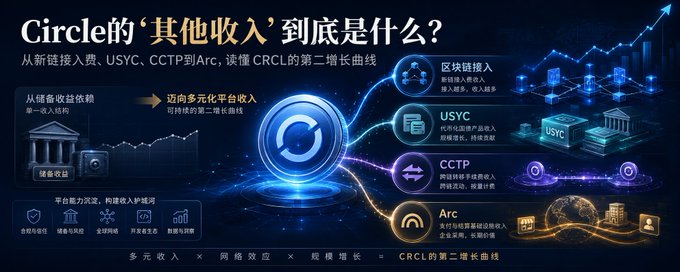
Circle’s easiest revenue stream to understand is still reserve income from USDC. Users hold the stablecoin, and Circle invests the matching reserves mainly in short-dated U.S. Treasuries, money market funds, and cash-like assets. The interest from those reserves remains the company’s main source of revenue.

What Circle wants from public markets, though, is a broader reading of the business. Management has tried to frame the company as an internet financial platform rather than a business that can be valued only by taking USDC balances and applying an interest-rate assumption. The key line item supporting that argument is “other revenue.”
That line is meant to show Circle can make money outside plain stablecoin issuance, through payments, cross-chain services, developer infrastructure, tokenized assets, and its own blockchain network. The problem is that “other revenue” is not one clean bucket. It combines recurring maintenance and subscription revenue, infrastructure revenue tied to transaction activity, one-time fees booked when a new blockchain is integrated, USYC management fees, blockchain rewards, redemption fees for stablecoins and tokenized funds, accounting revenue tied to Arc token presales, plus a small amount of non-recurring and legacy revenue.
For that reason, the article argues investors should not stop at the growth rate. Three questions matter more: what business produced the revenue, whether it can recur, and how much direct cost or economic giveback Circle had to absorb to generate it.
How Circle classifies “other revenue” in SEC filings
Based on documents Circle submitted to the U.S. Securities and Exchange Commission, the category is split mainly into subscription and services revenue, transaction revenue, and a residual other revenue line.
Subscription and services revenue
This includes blockchain onboarding and systems integration work, post-launch maintenance and technical support, fund management fees, time-based system access fees, and license fees charged by user count.
Deploying USDC for third-party blockchains, connecting those networks to Circle Mint, and providing ongoing support make up an important share of this segment. Management fees from the tokenized money market fund USYC are also included here. The source notes that Circle treats USYC performance compensation as variable consideration and recognizes it only when the company is entitled to it and a significant reversal is unlikely, according to the SEC filing.
Transaction revenue
Transaction revenue includes redemption fees on Circle digital assets such as USDC and EURC, USYC redemption fees, rewards generated by participating in blockchain networks, fees from processing digital asset transactions through Circle infrastructure, and usage revenue from cross-chain tools such as the Cross-Chain Transfer Protocol, or CCTP.
These items are usually recognized by transaction count, transaction value, or a specific event. In theory, that means they can scale with usage. But the filings also show that Circle recognizes certain activities on a gross basis when it is the accounting principal, recording both revenue and related fulfillment costs. A larger revenue figure does not automatically translate into the same jump in gross profit.
Other revenue
The remaining category mainly covers specific non-recurring service fees, revenue from discontinued historical products, and a small amount of items that do not fit the first two buckets. Circle has said discontinued non-core products account for less than 1% of total revenue and are not expected to have a material effect going forward.
In practical terms, the article sums this all up as integration fees, maintenance fees, management fees, usage fees, and transaction fees tied to blockchain and financial infrastructure.
How Circle makes money when USDC goes live on a new chain
If a new public blockchain wants native USDC support, Circle usually has to complete a full stack of technical and operational work. That can include deploying a native USDC contract on the chain, connecting the network to Circle Mint for issuance and redemption, integrating CCTP for cross-chain transfers, setting up deposit, withdrawal, burn, and minting flows, and providing APIs, wallets, smart contracts, and developer tools. It may also help exchanges, wallets, and applications migrate, then continue with maintenance, upgrades, and technical support after launch.
Circle’s fee structure for those blockchain customers usually has two parts.
The first is a one-time integration fee. Circle recognizes that revenue once the agreed technical implementation has been completed and accepted by the customer. A signed deal does not mean revenue appears immediately. Recognition may wait until the mainnet is live, USDC deployment is complete, CCTP is operational, customer acceptance is in hand, and any other contractual milestones have been met. A launch announcement date, a go-live date, and a revenue recognition date can all be different.
The second is continuing service revenue. Once USDC is live, Circle may keep collecting maintenance fees, technical support fees, software licensing fees, time-based service charges, and charges tied to users or usage. Those amounts are recognized over time as services are delivered, and they tend to be more predictable than one-off integration fees.
Circle has also disclosed that some customers may pay for services with digital assets at contract inception. In those cases, the consideration is measured at fair value when the contract begins, and the assets received are then handled under the company’s relevant accounting policies.

That creates an issue investors can miss. Revenue may be paid in cash, stablecoins, or other digital assets. So it is necessary to separate accounting revenue, cash actually received, the value of tokens received, and any price move in those tokens after revenue was recognized.
Why management describes the revenue as lumpy
Circle’s chief financial officer said on the Q2 earnings call that these blockchain partnership contracts often include both prepaid components and continuing components. The result is that revenue does not move in a smooth line.
Circle could be working on several projects each quarter and still report a pattern such as a sharp rise in Q1, a drop in Q2, a flat Q3, and another jump in Q4. Management used the word “lumpy” to describe that uneven timing of recognition.
That matters because investors cannot simply annualize one quarter by multiplying it by four.
What happened from 2025 Q4 to 2026 Q2
The source says Circle reported $109.8 million in other revenue for full-year 2025. For the first nine months of that year, the figure was $72.98 million, implying roughly $36.84 million in Q4. Of that amount, subscription and services revenue was about $24.69 million and transaction revenue was about $12.22 million, according to the SEC material cited.
In 2026 Q1, other revenue rose to $41.63 million. That broke down into $34.86 million in subscription and services revenue, $6.73 million in transaction revenue, and about $30,000 in other revenue. Circle said the increase was driven mainly by new integration services, blockchain rewards, stablecoin redemption fees, and fund management fees, partly offset by lower tokenized fund redemption fees.
In 2026 Q2, other revenue fell to $33.58 million, up 41% from a year earlier. At that stage, Circle only said the increase was led by subscription and services revenue and had not yet provided a full quarterly breakdown in the earnings release material.
Two points stand out. First, the category is still small in the context of the whole company. Across those three quarters, other revenue accounted for only about 4.8% to 6.0% of Circle’s total revenue and reserve income. The company’s profit engine is still shaped primarily by USDC circulation, reserve yield, revenue sharing with Coinbase and other channels, plus distribution and transaction costs.
Second, the number of publicly announced launches does not directly predict current-quarter revenue. Several important blockchain partnerships went live in Q2, yet other revenue still fell about 19% sequentially. The article gives several possible explanations: Q1 may have included a batch of previously accumulated integration fees; some Q2 launches may have been completed late in the quarter; contract sizes likely differed; some projects may lean more on ongoing service fees; and some contracts may not yet have met accounting recognition conditions.
Which blockchains were added across the three quarters
Circle has not disclosed how much revenue each chain contributed. The launches below indicate public go-live and technical delivery, not a direct revenue recognition list.
2025 Q4
- Monad: Circle launched native USDC, CCTP, Circle Wallets, and Circle Contracts on Monad. The article describes this as one of the most complete deployments of Circle’s technology stack in the three-quarter period, with a broader potential contract scope than a simple USDC listing.
- Starknet: Circle launched native USDC and CCTP on Starknet to support DeFi, payments, and institutional settlement use cases.
- Canton: Canton became the first production network connected to Circle xReserve and launched USDCx. Under xReserve, partner chains can issue a local stablecoin backed one-to-one by USDC held in a Circle contract while tapping into USDC cross-chain liquidity.
- Aleo: Aleo testnet launched USDCx through xReserve. Because it was still on testnet, the source says public information does not show whether the related contract had met full revenue recognition conditions.
- Stacks: Stacks launched USDCx through xReserve for Bitcoin ecosystem DeFi and payment applications.
2026 Q1
- Cardano: Cardano launched USDCx through xReserve. The token is issued by a protocol on Cardano and backed one-to-one by USDC held in Circle xReserve.
- EDGE Chain: Circle launched native USDC and CCTP on EDGE Chain. Circle Ventures also invested in the team behind the EDGE ecosystem.
- Morph: Circle launched USDC and CCTP on the payments-focused Morph network to support cross-border payments, remittances, and consumer finance applications.
- Movement: Movement became the fifth xReserve-connected network and launched USDCx backed one-to-one by USDC.
2026 Q2
- Pharos: Circle launched USDC and CCTP on Pharos for institutional payments, real-world assets, and on-chain finance applications.
- Injective: Circle launched USDC and CCTP on Injective, where USDC can be used for spot trading, derivatives, lending, payments, and RWA settlement.
- Cronos: Circle launched native USDC, native EURC, and CCTP on Cronos. USDC will also serve as the dollar settlement asset for tokenized equities, crypto assets, and prediction markets in the Cronos App.
Why xReserve matters on its own
Under the traditional model, Circle issues native USDC itself on each blockchain. xReserve opens a different path. A partner chain can deploy a local stablecoin, users deposit USDC into a Circle xReserve contract, the contract generates proof for minting on the partner chain, and the chain issues an equivalent amount of USDCx. That USDCx remains backed by the USDC sitting in xReserve.
The source says this can reduce the difficulty of expanding to non-EVM chains, privacy chains, and networks with specialized architectures. By the time of the relevant launches, Canton, Aleo, Stacks, Cardano, and Movement had all adopted the model.
Commercially, xReserve may generate initial integration revenue, recurring infrastructure service fees, cross-chain transaction revenue, growth in USDC reserve balances, and broader reach for Circle’s ecosystem. That makes it both a revenue tool and a distribution tool.
Revenue sources that are easy to overlook
The article argues that treating other revenue as nothing more than “new chain access fees” misses much of the picture.
USYC management fees
Circle manages the tokenized money market fund USYC and collects performance compensation. As USYC expands into Solana, BNB Chain, Arc, and other capital markets ecosystems, management income may grow with assets under management. The source frames this as an asset-management-style revenue stream driven by USYC AUM, fund yield, fee structure, adoption as collateral and treasury assets, and redemption activity.

Stablecoin and USYC redemption fees
Circle can charge fees on certain redemption transactions involving stablecoins and tokenized funds. Those fees are usage-driven, but can be influenced by free mint-redemption policies, bargaining power among large customers, redemption channel mix, market volatility, and promotional strategy.
Blockchain rewards
By participating in specific blockchain networks, Circle may receive validator rewards, staking rewards, protocol incentives, and other on-chain rewards. Because these payments may come in project tokens, investors need to track token prices and realizability as well.
CCTP and infrastructure transaction fees
Circle has already said fees from processing digital asset transactions through platform infrastructure such as CCTP are recorded in transaction revenue. As CCTP, Gateway, cross-chain forwarding, and wallet infrastructure expand, the company may move beyond simply growing USDC balances and charge based on infrastructure usage.
Software licensing and per-user charges
Circle has disclosed that subscription and services revenue includes license revenue based on time access and user counts. That suggests part of the business may resemble enterprise software pricing, though the company has not separately disclosed the scale.
Why Hyperliquid does not fit neatly into the standard integration model
The source says Hyperliquid should be treated separately. Circle and Coinbase’s work with Hyperliquid involves native USDC infrastructure, CCTP deposits and withdrawals, technical deployment, treasury deployment, reserve yield sharing, liquidity incentives, and economic arrangements between Coinbase and Hyperliquid.
The main value in that relationship comes from USDC balances, distribution position, and reserve economics, not just a conventional payment integration fee for a newly added chain. As a result, the deal may affect reserve revenue, distribution cost, transaction revenue, infrastructure service revenue, and the classification of USDC across Circle’s and Coinbase’s platforms. The article says analysts should not casually place Hyperliquid into subscription and services revenue.
Arc is changing the model behind Circle’s other revenue
Circle’s earlier infrastructure model was straightforward: help third-party chains integrate USDC and the Circle stack, then collect integration fees, maintenance fees, and usage fees. Arc changes that because Circle is now operating its own financial blockchain network.
Management has said Arc could eventually generate ARC token-related revenue, network transaction fees, staking and validator revenue, infrastructure operating revenue, partner and ecosystem incentive revenue, stablecoin settlement revenue on Arc, and services tied to real-world assets, foreign exchange, lending, and capital markets.
That implies a shift in role. Circle would no longer be only a technology supplier to other networks. It would also be an operator and economic stakeholder in a financial network of its own. Management has gone as far as saying Arc’s strategic opportunity may be larger than USDC itself, which has raised Arc’s resource priority relative to some third-party blockchain projects.
In the short term, that could mean fewer new chain integrations completed or delays in some one-time integration revenue. Over the longer run, the outcome depends on whether Arc can build sustainable recurring network revenue.
The accounting issue in 2026 guidance
In Q1, Circle guided 2026 other revenue to $150 million to $170 million. At that point, the company said the range did not include future ARC token presales, Arc incentive programs, or other potential Arc revenue.
After Q2, the company lifted that guidance to $310 million to $330 million. The updated range explicitly includes recognized ARC token presale revenue.
Both the low end and the high end increased by $160 million. The arithmetic is simple: $310 million minus $150 million equals $160 million, and $330 million minus $170 million also equals $160 million.
On the most direct reading of official guidance, that suggests roughly $160 million of additional ARC token presale revenue in 2026. The source notes that one earnings call transcript referred to “$180 million of expected Arc revenue,” which does not align neatly with the guidance math. It suggests two likely explanations: either the transcript misreported $160 million as $180 million, or Arc revenue is about $180 million while the earlier outlook for the rest of the business was cut by about $20 million.
Until Circle provides a fuller breakdown, the article says investors should give priority to official guidance and use roughly $160 million as the more reasonable initial estimate.

Why ARC presale revenue should not be treated like recurring revenue
The source says Circle raised about $222 million in cash from the ARC token presale. But cash raised, accounting revenue, and economic profit are not the same thing.
Some of that revenue may only be recognized as questions around token delivery, Arc mainnet launch, the network’s transition to proof-of-stake or delegated proof-of-stake, performance obligations, and buyer refund rights are resolved. Circle has also warned that if key launch and network-transition milestones are not achieved, it could face refund obligations.
That leaves ARC presale revenue with a distinct set of characteristics: it is large, may be recognized in only a few quarters, lacks natural repeatability, carries regulatory and delivery conditions, and differs in quality from future transaction-fee revenue generated by a live Arc network. The article’s view is that investors should exclude it from core recurring revenue when thinking about valuation.
A four-layer framework for breaking down other revenue
To judge revenue quality more accurately, the article proposes dividing Circle’s other revenue into four layers.
Layer one: recurring platform revenue
This includes maintenance fees, subscription fees, software license fees, per-user charges, and ongoing USYC management fees. It is the most predictable layer and would deserve the highest platform-style valuation weight.
Layer two: usage-driven revenue
This includes CCTP transaction revenue, infrastructure processing fees, stablecoin and USYC redemption fees, blockchain rewards, and future monetization from CPN and Gateway. The scale effect can be real here, but investors still need to watch take rates, transaction costs, and channel-sharing arrangements.
Layer three: one-time integration revenue
This includes native USDC deployment, CCTP deployment, Circle Mint integration, xReserve integration, and implementation of wallet and smart-contract systems. It helps extend the USDC network, but quarter-to-quarter volatility is inherent, and the universe of chains worth deep integration is not unlimited.
Layer four: Arc token and other non-recurring revenue
This includes ARC token presales, future special token transactions, non-recurring ecosystem arrangements, and legacy revenue. The article says these items should be shown separately so they do not overstate the persistence of platform revenue growth.
What investors should track next
The article says year-over-year growth in other revenue is no longer enough on its own. More useful indicators include the share of recurring revenue; the weight of one-time integration fees; deferred revenue and remaining performance obligations; the form of payment, whether cash, USDC, ARC, or third-party tokens; the direct cost tied to transaction revenue recognized on a gross basis; USYC assets under management and fee rates; monetization rates for CCTP, Gateway, and CPN; and Arc’s actual network revenue, separated from token presale accounting.
The bottom line for CRCL investors
The article’s final conclusion is that Circle’s other revenue has grown from a very small base in 2024 to about $109.8 million in 2025, then reached $41.63 million in 2026 Q1 before slipping to $33.58 million in Q2. The category now covers far more than new-chain access fees. It spans maintenance, licensing, fund management, redemptions, blockchain rewards, and CCTP infrastructure usage.
Even so, from 2025 Q4 through 2026 Q2, it represented only about 4.8% to 6.0% of Circle’s total revenue and reserve income. The source says Q1’s high point likely reflected a concentrated wave of project acceptances from previously built blockchain work. Q2 still saw launches on Pharos, Injective, and Cronos, yet revenue fell sequentially, reinforcing management’s point that the business is lumpy.
Circle is in the middle of a business-model transition, from helping third-party chains connect to USDC and charging project fees to operating Arc, CPN, Gateway, CCTP, and tokenized asset platforms. The upside could be meaningful because transaction fees, asset management fees, and network revenue might reduce dependence on reserve rates.
The risks are also clear in the source material. Revenue from third-party chain integrations may slow. Arc has not yet produced enough recurring income. ARC token presales are lifting other revenue in the near term. Arc may create resource and interest conflicts with Circle’s existing partner chains. And infrastructure usage does not automatically become billable revenue.
That is why the increase in 2026 guidance to $310 million to $330 million does not, by itself, prove that Circle has already completed platform monetization. On the article’s reading, about $160 million of that range may come from ARC token presale revenue. Strip that out, and the implied size of the more traditional other-revenue business is still close to the earlier $150 million to $170 million guidance.
The article’s working conclusion is straightforward: Circle has established multiple non-interest revenue entry points, but those streams have not yet formed a recurring revenue pool that is large enough, stable enough, and transparent enough. A more durable shift in how CRCL is valued would likely require sustained growth in recurring service revenue, measurable monetization in CCTP, Gateway, and CPN, expanding USYC management fees tied to asset growth, real transaction-fee and infrastructure revenue from Arc, a higher share of non-reserve revenue, and less dependence on token presales and one-off integration fees.