
Circle released its fiscal 2026 second-quarter results before the U.S. stock market opened on Aug. 5 Beijing time, posting mixed numbers that left the Wall Street debate over the company’s valuation very much alive.
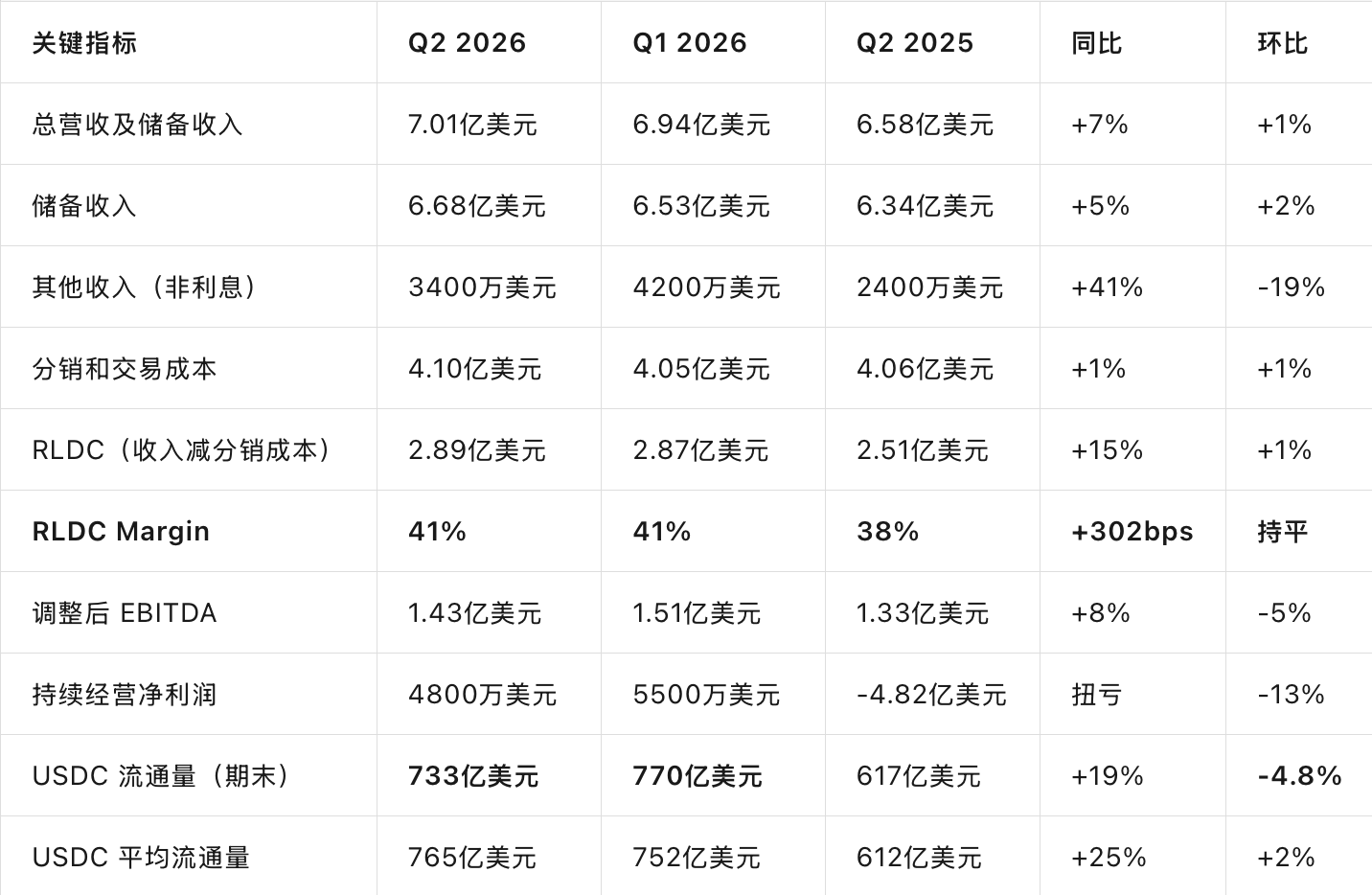
The stablecoin issuer reported $701 million in total revenue and reserve income for the quarter, below the $717 million expected by the market, but still up 7% year over year. Adjusted EBITDA came in at $143 million, up 8%, while net income from continuing operations reached $48 million, above the $43 million consensus and up by $530 million from a year earlier.
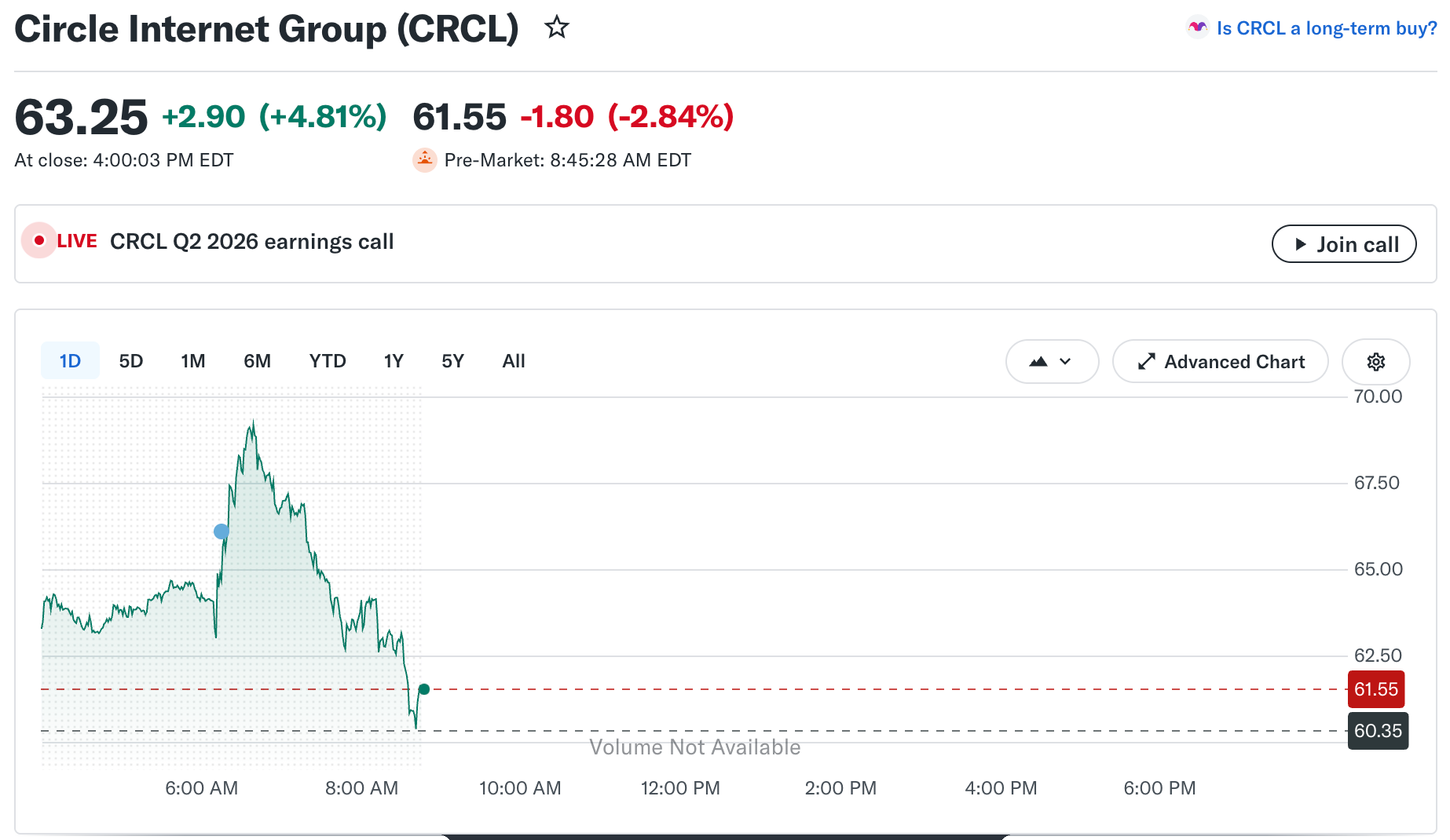
CRCL initially moved higher in premarket trading after the release, then lost momentum. As of 20:45, the stock was quoted at $61.55, down 2.84% in premarket action.
Revenue missed expectations, but the prior slide was reversed
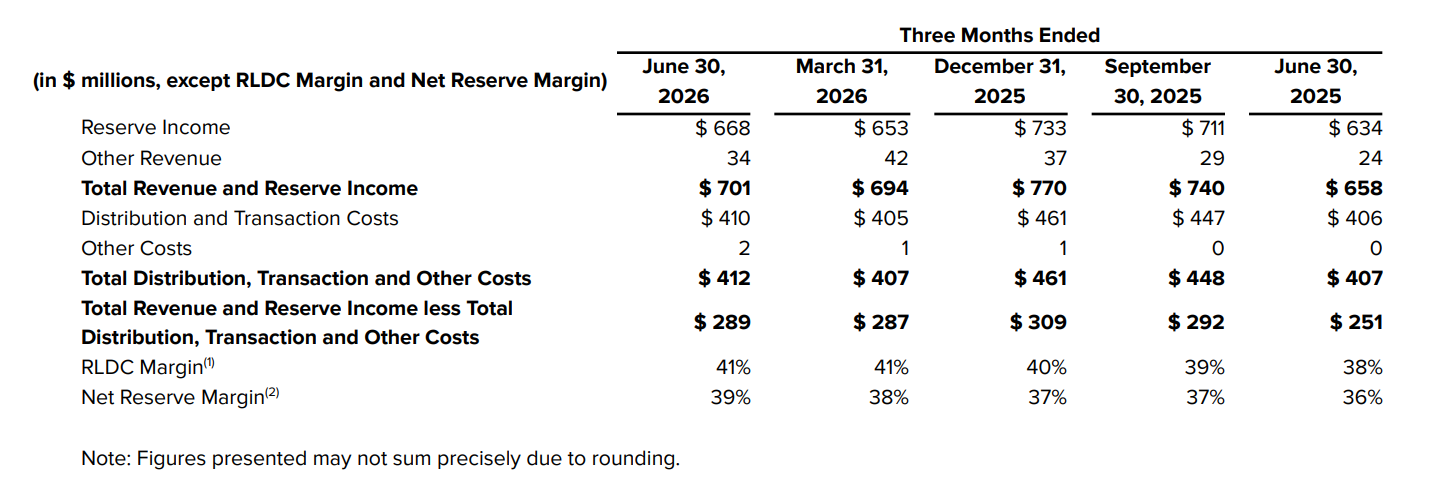
Circle’s headline revenue line did not clear expectations, though it did improve from the prior quarter and broke the contraction seen previously. The sequence cited in the source runs from $579 million to $658 million, then $740 million, $770 million, $694 million, and now $701 million.
Reserve income remained the clear driver. That segment generated $668 million in the second quarter, up 5% from a year earlier and 2% from the previous quarter.
USDC average circulation rose, but quarter-end supply fell back
The quarter showed a split pattern in USDC circulation: average supply increased, while the quarter-end figure contracted.
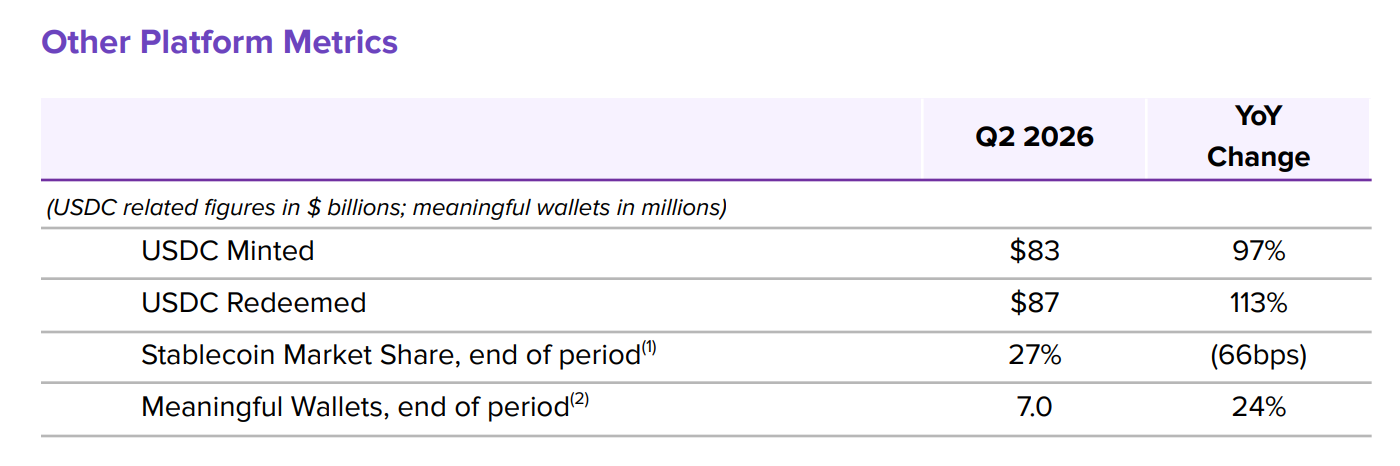
According to the filing details cited in the article, average USDC circulation in the second quarter was $76.5 billion, up 25% year over year and about 2% higher than the $75.2 billion average in the previous quarter.
By quarter end, though, circulation stood at $73.3 billion. That was still 19% above the year-earlier level, but about 4.8% below the prior quarter-end figure of $77.0 billion. The article read that as evidence that outflows were concentrated near the end of the quarter. The overall base is still larger than it was a year ago, but the marginal trend weakened.
Market share also moved the wrong way for Circle. USDC accounted for 27% of dollar stablecoins at quarter end, down 66 basis points year over year. In a period when total industry supply was shrinking, the company did not gain share.
Other revenue fell sequentially, even as full-year guidance was lifted sharply
Outside reserve income, Circle reported $34 million in other revenue for the quarter. That was up 41% from a year earlier, but down 19% from the previous quarter, ending a five-quarter run of sequential growth. The progression listed in the source was $21 million, $24 million, $29 million, $37 million, $42 million, and then $34 million.
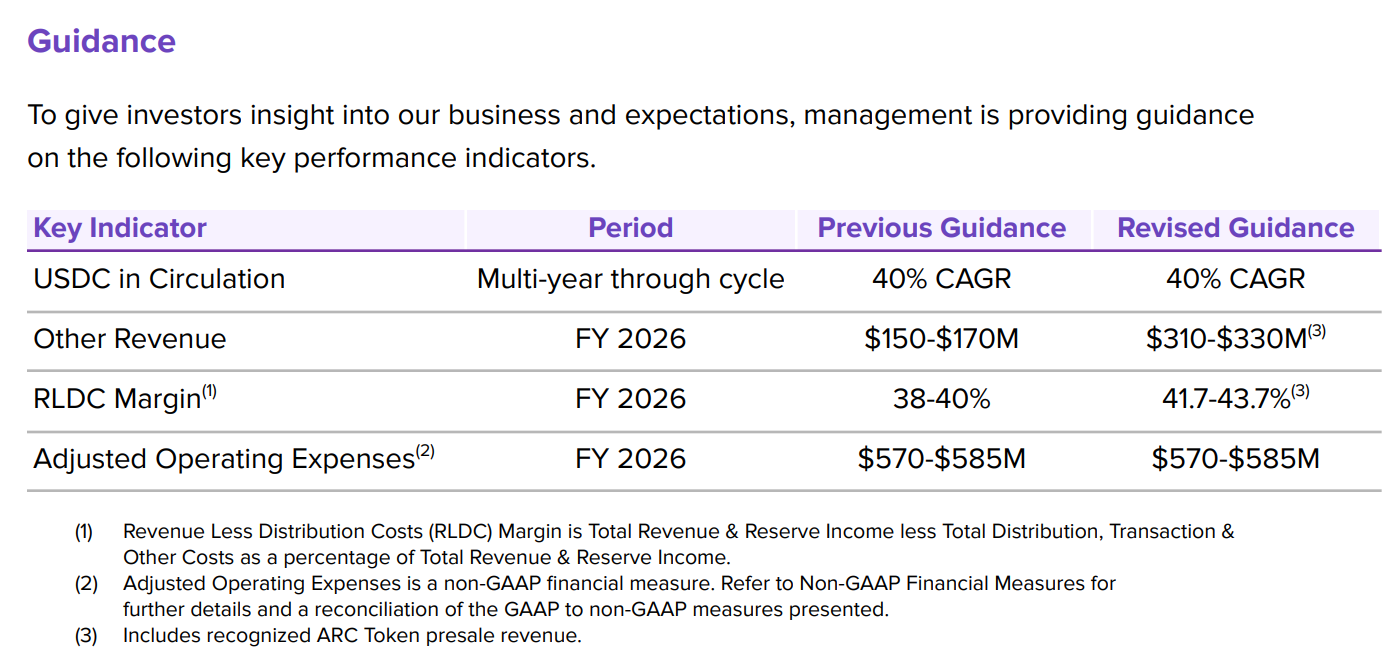
At the same time, Circle raised its fiscal 2026 outlook for other revenue to $310 million-$330 million from the prior $150 million-$170 million range. The company specifically said the revised guidance includes recognized ARC token presale revenue.
The article also referenced commentary from Circle’s first-quarter earnings call: ARC tokens held by the company, once presale agreement obligations are fulfilled, will be recognized at fair value as other revenue and will flow directly into RLDC and adjusted EBITDA. That means future quarters could show a noticeable lift in other revenue as ARC is recognized.
The source added an important caveat. That contribution looks closer to a one-off accounting gain than to recurring subscription or service revenue. Strip out the ARC effect, and the growth trajectory of core other revenue still needs to be watched.
RLDC margin stayed elevated as distribution costs remained contained
One of the more resilient metrics in Circle’s quarter was RLDC margin, described in the source as the margin after subtracting distribution costs from revenue and a key indicator of the company’s core earnings power.
Circle reported RLDC of $289 million in the second quarter, up 15% year over year. RLDC margin was 41%, up 3.02 percentage points from a year earlier and unchanged from the prior quarter. Over the last five quarters, the figure moved from 38% to 39%, then 40%, 41%, and 41%.
That held up even as reserve yield declined year over year, which the article attributed to Federal Reserve cuts to the federal base rate. The support came from cost control. Distribution and transaction costs were $410 million in the second quarter, up just 1% year over year, much slower than the 5% increase in reserve income.
Management also raised its full-year RLDC margin outlook to 41.7%-43.7% from 38%-40%. Still, the source noted that this revision also includes recognized ARC token presale revenue, which gives the second-half margin profile a non-recurring element.

Distribution remained the biggest cost, while product and infrastructure spending increased
On the expense side, distribution and transaction costs were still Circle’s largest outlay at $410 million, up 1% year over year, with sequential growth also held below 1%.
GAAP operating expenses came to $254 million, down 56% from a year earlier. The article said that drop was heavily shaped by the comparison base, because the same period last year included unusually high stock-based compensation tied to the IPO, which reached $435 million.
Adjusted operating expenses offered a cleaner read on current investment levels. That figure was $146 million in the second quarter, up 23% year over year, reflecting continued spending on product development, infrastructure, and AI capabilities.
General and administrative expense rose to $66.3 million. IT infrastructure costs increased to $16.4 million. Depreciation and amortization doubled from a year earlier to $29.9 million. Based on management’s comments about continued investment in product development, infrastructure, and AI, the article linked those increases to businesses such as Arc, Agent Stack, and CPN.
Arc mainnet got a launch date, and CPN kept expanding
Beyond the financials, Circle used the quarter to highlight several business developments.
The company said the Arc mainnet will go live on Sept. 16. Initial network validators will include BlackRock, DTCC, Galaxy, Visa, Mastercard, and Standard Chartered. Circle also said BlackRock’s tokenized money market fund BUIDL will be deployed on Arc, while DTCC plans to support tokenization on Arc for assets held in custody by DTC.
Compared with earlier descriptions that focused more on technical direction and long-term vision, this disclosure showed actual participation from traditional financial institutions. In the framing cited by the source, Arc is no longer just a public chain built around USDC. Circle is positioning it as base infrastructure linking stablecoins, real-world assets, and traditional finance.
Circle Payments Network, or CPN, was another area of progress. As of the end of the second quarter, the network’s annualized transaction volume over the previous 30 days had climbed to $14.7 billion, up about 76% from the $8.3 billion disclosed for the first quarter. The number of connected financial institutions rose from 136 to 175, a 29% sequential increase.
The article noted that CPN’s direct revenue contribution remains limited for now. Even so, both transaction activity and institutional participation point to a growing network effect.
OCC and NYDFS approvals added to Circle’s regulatory footing
Circle also reported regulatory progress during the quarter. The company said it had received approval from the Office of the Comptroller of the Currency, or OCC, to establish Circle National Trust, making it one of the first stablecoin issuers to obtain a U.S. federal trust bank charter. At the same time, its application to establish Circle New York Trust was approved by the New York State Department of Financial Services, or NYDFS.
For a stablecoin issuer that treats compliance as a core competitive strength, those approvals strengthen Circle’s standing in the U.S. financial system and provide a firmer institutional base for custody, payments, and other financial services aimed at institutions.
The earnings report did not settle the valuation debate
Before this earnings release, Wall Street had already split on how to value Circle. The article cited Aug. 3 research moves from two firms. Morgan Stanley downgraded Circle to Underweight from Equal Weight and cut its price target to $38 from $106. TD Cowen, by contrast, initiated coverage with a Buy rating and set an $82 target.
The core disagreement is about what should anchor Circle’s long-term growth outlook. Is the company’s value still mainly tied to USDC, or should investors focus more on the digital financial infrastructure being built around it?
This quarter gave support to both camps. On one side, the concerns highlighted by Morgan Stanley remain visible. Quarter-end USDC circulation kept falling sequentially, market share did not improve, and the company still depends heavily on reserve income. While full-year guidance for other revenue was raised sharply, the increase mainly comes from recognized ARC token presale revenue rather than sustained scaling in payments, APIs, or RWA-related business. In practical terms, Circle’s near-term earnings model is still closely tied to USDC growth and the interest-rate environment.
On the other side, the business evidence behind TD Cowen’s bullish case is building. Arc now has a firm mainnet date. BlackRock and DTCC are joining the ecosystem. CPN is expanding quickly. The federal trust bank license has been secured. None of those pieces is the main revenue pillar yet, but each adds to Circle’s platform buildout.
The conclusion drawn in the source was narrow but clear: Circle is moving in a platform direction. Whether that shift can become durable non-interest revenue growth, and whether it can justify a digital financial infrastructure valuation framework, will likely need several more quarters of results to prove out.