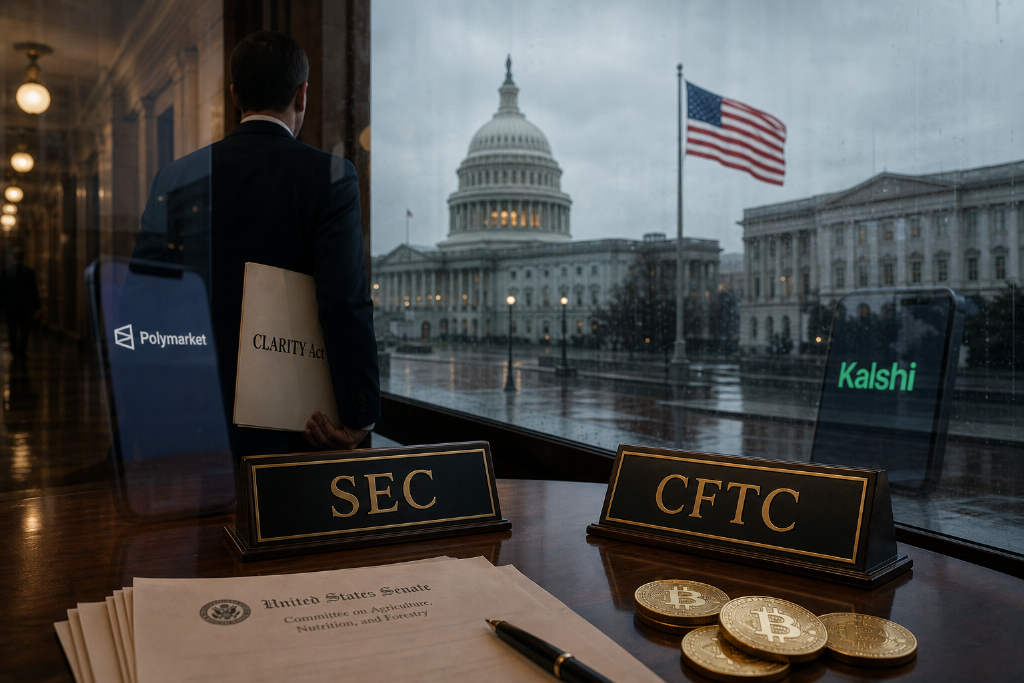
Prediction market pricing for the CLARITY Act has dropped sharply. On Polymarket, the implied probability that the bill will pass and become law by 2026 stands at 13%, with trading volume around $11.5 million, down from an 82% market estimate seen in February. The U.S. Senate is scheduled to hold a procedural vote on Sept. 15, after Majority Leader John Thune filed a cloture motion to begin the process, a step that typically requires 60 votes. On Kalshi, the probability of a Senate vote taking place before Oct. 1 is priced at 91%, with more than $1.25 million in trading volume. According to Bitcoin.com News, the CLARITY Act would create a federal regulatory framework for crypto markets, giving the Commodity Futures Trading Commission sole oversight of spot digital commodities markets, while the Securities and Exchange Commission would retain authority over certain securities issuance and exchange activities. The bill still faces disagreements over conflicts of interest involving officials and the crypto industry, stablecoin yield, and protections for decentralized finance and non-custodial software developers.
Prediction market platform Polymarket puts the implied probability of the CLARITY Act passing and becoming law by 2026 at 13%. Trading volume in the contract is დაახლოებით $11.5 million, down sharply from the 82% market pricing seen in February.
The U.S. Senate plans to hold a procedural vote on the bill on Sept. 15. The cloture motion to start the voting process was filed by Senate Majority Leader John Thune, a step that typically requires 60 votes.
Kalshi, another prediction market platform, places the probability of a Senate vote taking place before Oct. 1 at 91%. Trading volume in that market has exceeded $1.25 million.
According to Bitcoin.com News, the CLARITY Act would set up a federal regulatory framework for crypto markets. Under the proposal, the Commodity Futures Trading Commission, or CFTC, would have exclusive authority over spot digital commodities markets, while the Securities and Exchange Commission, or SEC, would oversee certain securities issuance and exchange activities.
The bill still faces unresolved disagreements, including potential conflicts of interest between officials and the crypto industry, stablecoin yield, and protections for decentralized finance and non-custodial software developers.
This article was originally published by Bit.Fan. For more cryptocurrency news and market insights, visit www.bit.fan. Disclaimer:
The market information, project data, and third-party content displayed on this platform are for industry information sharing only and do not constitute any form of investment advice or return commitment.
Cryptocurrency trading carries high risks. Users should fully assess their risk tolerance and make independent decisions. All profits, losses, and legal responsibilities are borne by the users themselves.