

Boris Cherny, identified in the source article as the creator of Claude Code, said in a YC interview released on July 28 that AI product builders should regularly delete the scaffolding wrapped around their models: Claude.md files, skills, hooks, system prompts, and harness code.
In the interview, titled “Boris Cherny: We Cut 80% of Claude Code’s Prompt,” he argued that teams should not assume they know what a model needs. His advice was to remove as much as possible, then add pieces back line by line and watch what changes.
Delete first, then measure what matters
Cherny’s line in the interview was direct: “You should delete the entire system prompt, then add it back one line at a time and see what effect each line actually has.”
He framed that approach as an ablation study: hold the rest of the system constant, remove or replace one module, then compare the effect on performance, stability, efficiency, or cost.
According to the article, Cherny said that for Opus 5, his genuine recommendation is to try deleting all of that material because the model may no longer need it.
The piece also notes, in reference to recent controversy around Claude, that users could just as easily say: “Actually, for Claude, I genuinely recommend deleting it, because we no longer need it.”
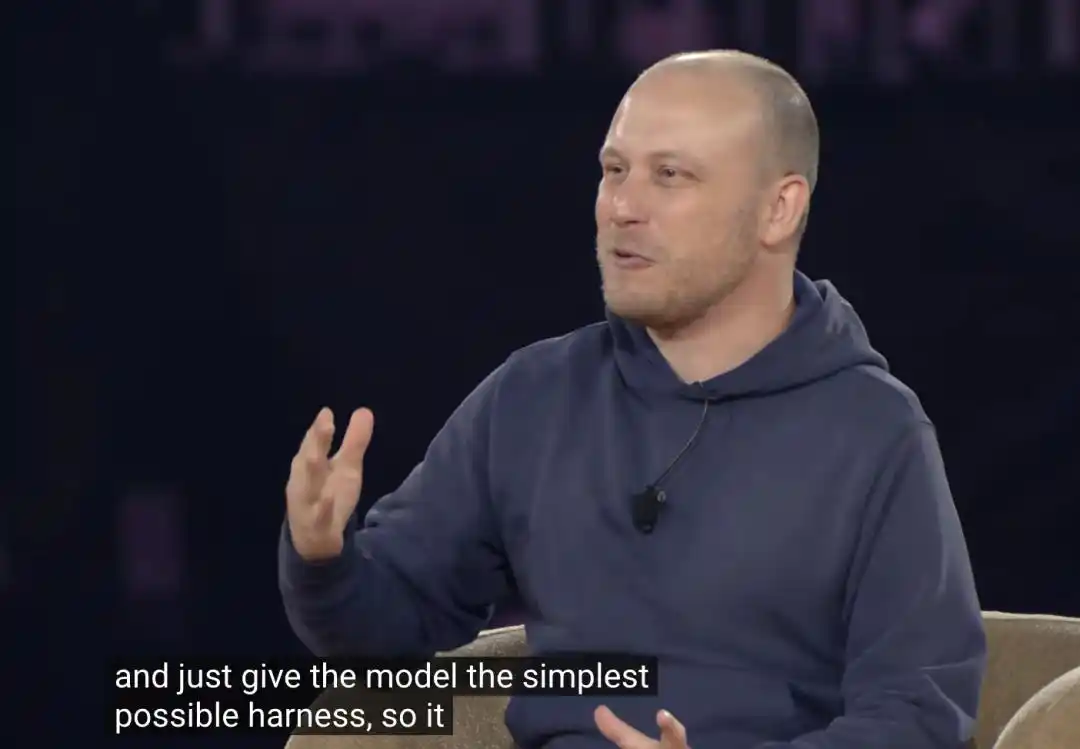
Claude Code’s harness has already been pared back
Cherny said that today, the code inside Claude Code’s harness is “almost down to safety, permissions, and static analysis.”
The article links that view to Anthropic’s July 24 guidance on context engineering for Claude 5. For newer models including Opus 5 and Fable 5, Claude Code’s system prompt was heavily reduced, with more than 80% of the previous instructions removed.
It also points readers to a QbitAI article titled “Claude Code狂删80%提示词,Opus 5反手加回去了” for more detail on that change.
Cherny’s broader product rule is not to predict which instructions a model needs, because, in his view, those guesses are usually wrong. Instead, teams should delete line by line, test, and identify the points where the model repeatedly gets stuck.
As quoted in the article, he said: “You have to think of the model as a living organism, something more organic. Each generation behaves differently, each has a slightly different personality, and you need to spend time understanding it and then adjust the harness accordingly.”
An empirical loop, not a fixed theory
For Cherny, this is an empirical way of building products: try things without overcommitting to prior assumptions, inspect the result, iterate, and repeat.

He said even evals do not stay stable for long in a world where models improve quickly. Evals may last longer than harnesses and prompts, but many test sets are soon driven to perfect scores. The answer, in his telling, is to observe where the model still struggles and design new evals around those failure points.
“Product Overhang” and why capability outruns product design
Cherny also used the interview to explain a concept he called “Product Overhang,” which he said has been useful in his own product work.
His point was that model capability tends to move in discontinuous jumps, while product integration usually advances in continuous, incremental steps. That leaves models with abilities that exceed what current products are set up to expose.
He gave one example from late 2024, when sonnet 3.5 had just launched. By his account, the model could already write an entire file of code in one go, while coding products such as Copilot and early versions of Cursor were still focused on smaller tasks like code completion.
In that framing, Claude Code, with full terminal access, helped narrow part of the gap.

“Unhobbling” a model
That leads to a second concept from Cherny: “Unhobbling,” or removing constraints so a model can take on harder work.
He cited an internal Anthropic example in which someone connected Opus 5 to OpenCV, the open-source computer vision library. The result, he said, was that the model could produce portraits, animals, and landscapes even though it had not previously been trained to draw.
He described that as “model elicitation”: exposing capabilities the model already has, without changing the model weights, through prompt design, context, tools, or product structure.
The article notes that a causal question still remains. Did the product setup simply unlock an existing capability, or did the scaffolding itself teach the model something new? Cherny’s position, as presented there, is that the commercial opening matters more than the attribution debate.
He said: “I’m not saying every startup will capture it. But I know people are thinking about these questions, and there really is a huge opportunity here to elicit astonishing, interesting, and commercially valuable behavior from models.”
Three ways he tries to remove constraints
Cherny outlined three methods he personally uses to “unhobble” models:

- Give the model tasks that are harder than you think it can handle. Define the goal, the boundaries, and the stopping condition, then step back.
- Run more experiments. Let the model try things that may not have a clear commercial purpose but are still interesting, and give yourself room to explore creatively.
- Have the model verify its own work. In his view, the central problem is no longer prompt engineering alone, but how to make Claude check its progress while it works through a difficult assignment.
He said that this third piece is probably one of the weakest areas in current practice. If a model cannot verify its own task, it cannot run independently for long stretches.
A task that kept running for more than two weeks
Cherny offered one example from his own workflow. He said his instruction to the model was: rewrite an Electron application in Swift, run the Electron app in a Mac virtual machine, take screenshots, compare them pixel by pixel against the Swift version, and do not stop until the job is done.
The interviewer asked, “That’s your prompt?” Cherny replied, “That’s my prompt.”
Asked how long the task had been running, he said it was still going. He then added that it had already been running for more than two weeks, around 14 or 15 days.
He also said Claude decided to livestream the process by creating an internal Slack channel and posting a progress screenshot every few minutes.

Advice for AI users and founders
Near the end of the interview, the host asked how others could learn to use Claude more effectively.
Cherny’s answer was to ignore the influencers on LinkedIn and stop scrolling Twitter for tricks. In his telling, people keep searching for hidden tactics, but “there is no such thing.”
He urged users to approach models empirically, to forget habits formed around older systems, and to put aside classroom abstractions long enough to observe where the model actually fails before tuning around those points.
As quoted in the article, he said: “So it’s no longer a theoretical science. It has become an empirical science. The people who are very, very good at setting aside their priors, setting aside the idea that ‘this didn’t work before,’ and trying again — they will be very, very successful.”
Treat the model like a colleague
Cherny also argued for a different mindset. Rather than trying to control the model too tightly, he said builders should work with it more like a colleague: avoid overspecifying every step, do not make the instructions excessively rigid, and do not expect the model to solve the task exactly the way a human operator would.
His reason was simple: “The model doesn’t work that way.”

What he told people learning to code
For people still learning programming, Cherny said they should not focus only on pure computer science theory. They also need to learn application.
The article says his own original motivation for learning to program was to cheat on a math exam.
He then tied programming to a wider set of skills: startups, product building, design sense, commercial sense, data science, and talking to users. In his view, those are the areas that make computer science and engineering truly useful when they are combined.
The article condenses that line of thought into a short takeaway: first build what you want for yourself, then level up to build what other people want.
The source article says these views were drawn from YC’s July 28 interview video “Boris Cherny: We Cut 80% of Claude Code’s Prompt.” It also credits the original Chinese write-up to the WeChat account QbitAI, with authorship listed as “关注前沿科技.”