
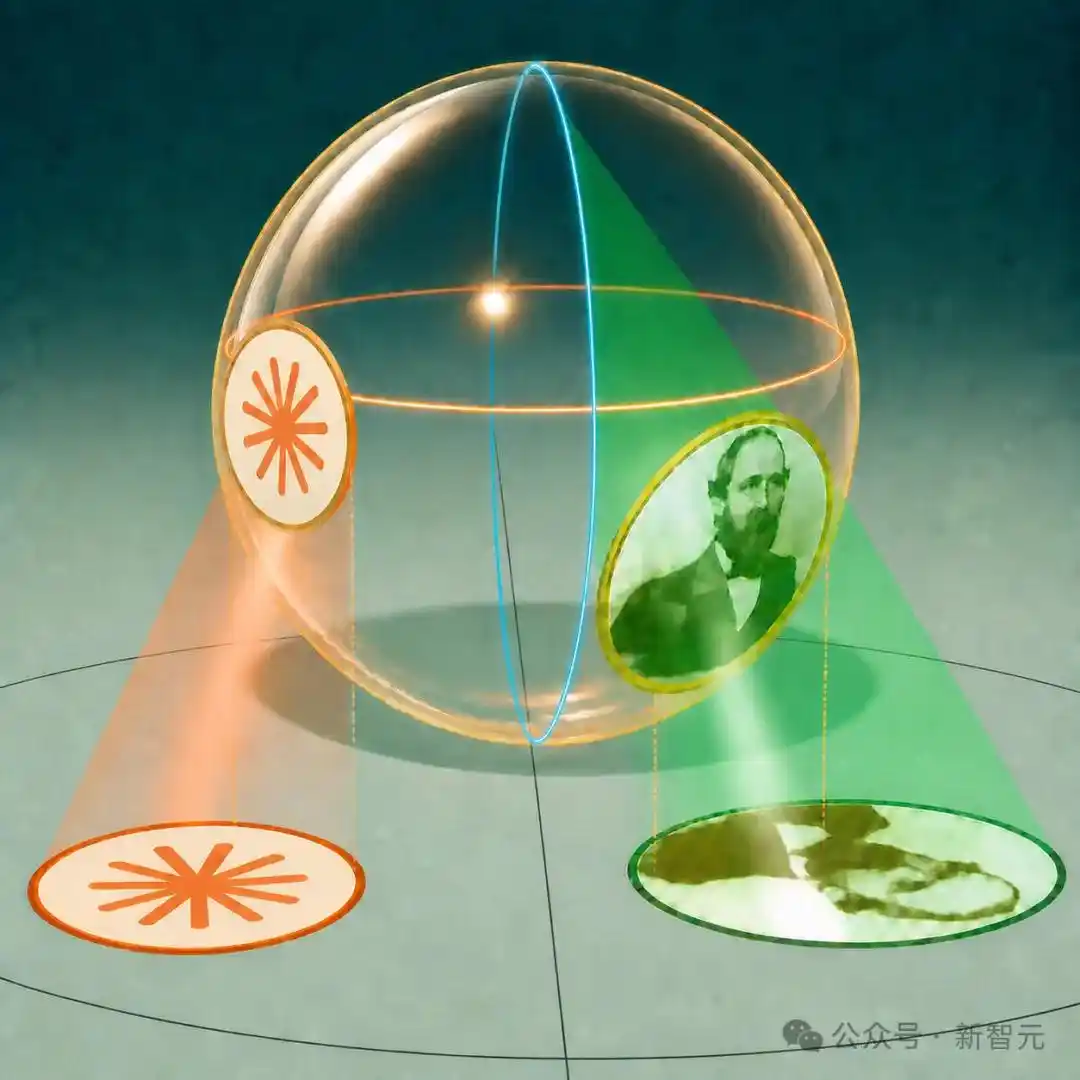
A 78-year-old question in mathematics may have a new answer: Levent Alpöge and Claude say the six-dimensional sphere S⁶ does admit a complex structure.
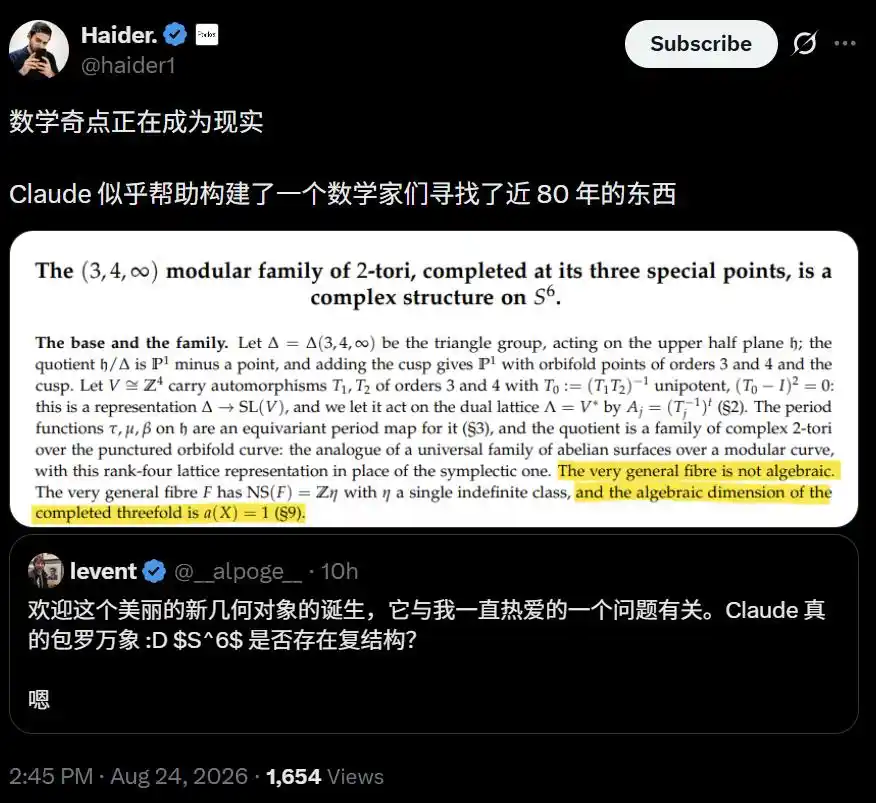
The result was presented by Harvard mathematician Levent Alpöge working with Claude. When Alpöge announced it on X, the first line read like the introduction of a new object into mathematics: 「Welcome this beautiful new geometric object into the world.」
Why S⁶ has held attention for decades
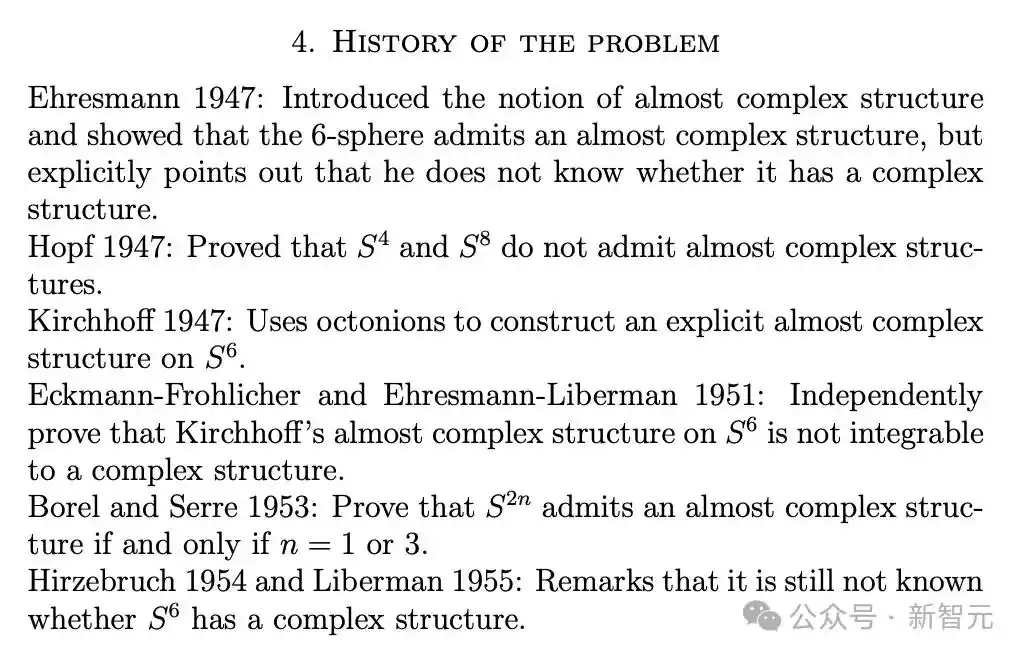
Among spheres, the article says only S² and S⁶ are candidates for carrying a complex structure. Every other dimension has already been ruled out. S² is standard territory in complex geometry, which left S⁶ as the lone unresolved case for more than seven decades.
Claims on both sides have appeared before and failed to settle the matter. The report points to Michael Francis Atiyah, a Fields Medal winner, who said in 2016 that he had solved the problem, only for gaps to be identified in the argument. It also notes that Shiing-Shen Chern studied the question late in his career.
A 108-page proof and an AI review
Alpöge’s submission runs 108 pages. According to the article, every matrix, coordinate chart, and gluing rule used in the construction is spelled out explicitly.

Mathematician Qiaochu Yuan then used GPT-5.6 Sol to probe the manuscript for weaknesses. The article says Sol spent six minutes on an initial pass and found no flaw, then reviewed it for another 15 minutes with the same result. Instead of locating a break, it came away with a clearer grasp of the logic. Sol’s conclusion, as quoted in the piece, is that if the 108-page argument stands, it could be the most important AI math result to date. The article adds that if the work had been done entirely by humans, its impact alone could make it Fields Medal level.
The construction starts from a triangle group
The article frames the breakthrough as a change in method. Rather than continuing down the routes that dominated earlier work, Alpöge and Claude built the object directly and then argued that it gives a complex structure on S⁶.
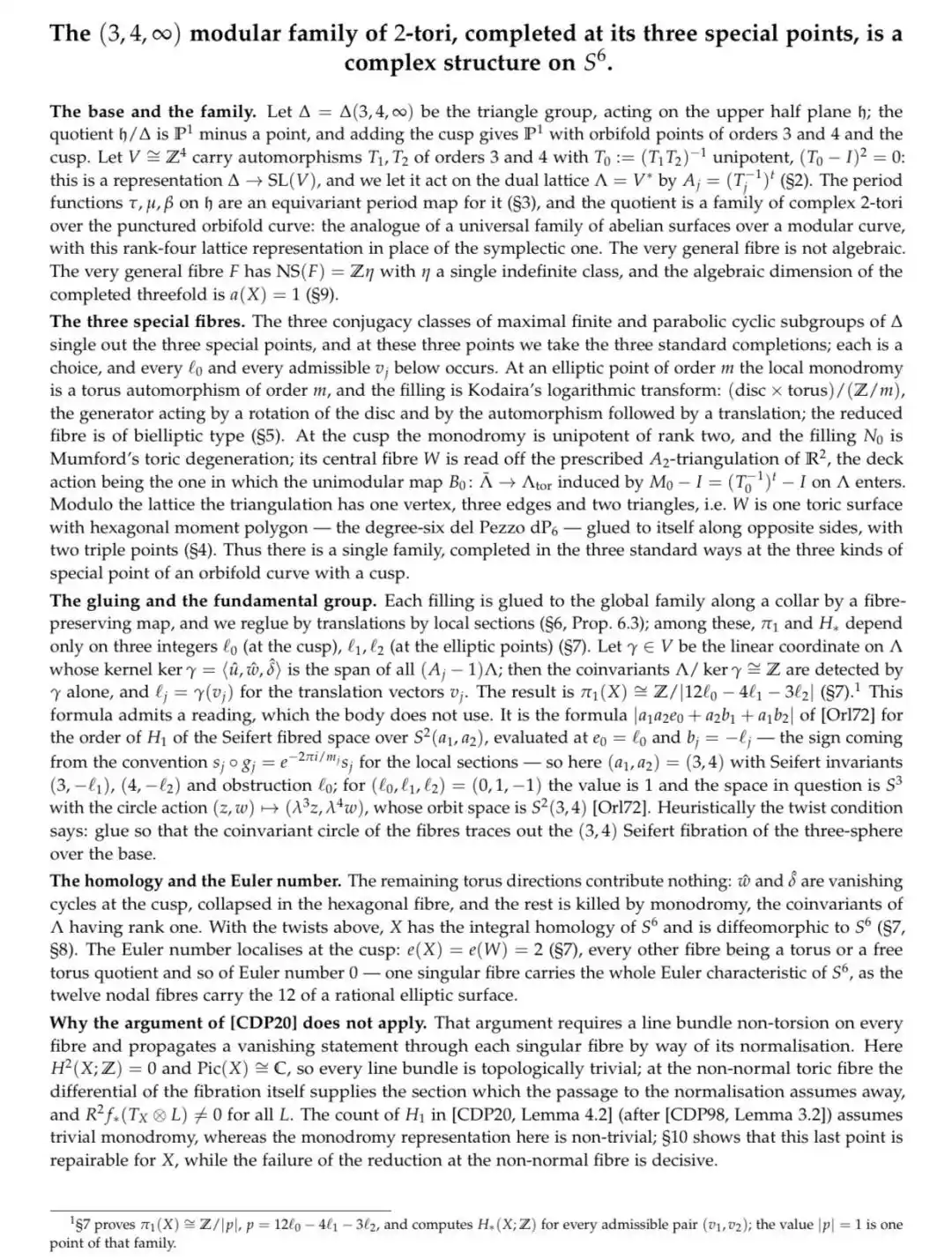
The first step is the base. Alpöge takes the (3,4,∞) triangle group and folds the upper half-plane by it. What remains is, intuitively, a sphere carrying three marked points: an order-3 point at t = 0, an order-4 point at t = 1, and a cusp at t = ∞.
The article says Alpöge openly singled out the triangle group and the family of tori over it as his favorite part of the construction.

Attaching complex 2-tori over the base
The second step is to place fibers over the ordinary points of the base. Every point except the three special ones carries a complex 2-torus, an object that is two-dimensional over the complex numbers and four-dimensional over the reals.
Each such object is the fiber over its point, and the total space X is assembled fiber by fiber in that way. At this stage, the points t = 0, t = 1, and t = ∞ still have no fibers above them, leaving three missing pieces in the space.
Three holes, three classical filling methods
The third step is to fill those three gaps and turn the space into a compact manifold.
This is where the article places the most delicate part of the construction. The three holes are not handled by one uniform recipe. Each falls into the range of a different classical compactification or surgery method.
- At the cusp t = ∞, the construction uses Mumford torus degeneration. The inserted fiber is called W. It is obtained by taking the hexagonal boundary of a degree-6 del Pezzo surface and gluing its three pairs of opposite sides.
- At t = 0 and t = 1, the construction uses Kodaira logarithmic transforms with multiplicities 3 and 4, matching the order-3 and order-4 data on the base.
Once those three insertions are made, the article says, a compact complex threefold named X comes into being.
From X to S⁶
Building X is not the end of the argument. The next task is to show that X really is S⁶.
Section 7 of the paper computes the fundamental group as
π₁(X) ≅ ℤ / |12ℓ₀ − 4ℓ₁ − 3ℓ₂|.
The article explains the role of this formula in intuitive terms: the fundamental group records whether the space contains loops that cannot be contracted away. On a sphere, every loop can shrink to a point, so the fundamental group is trivial.
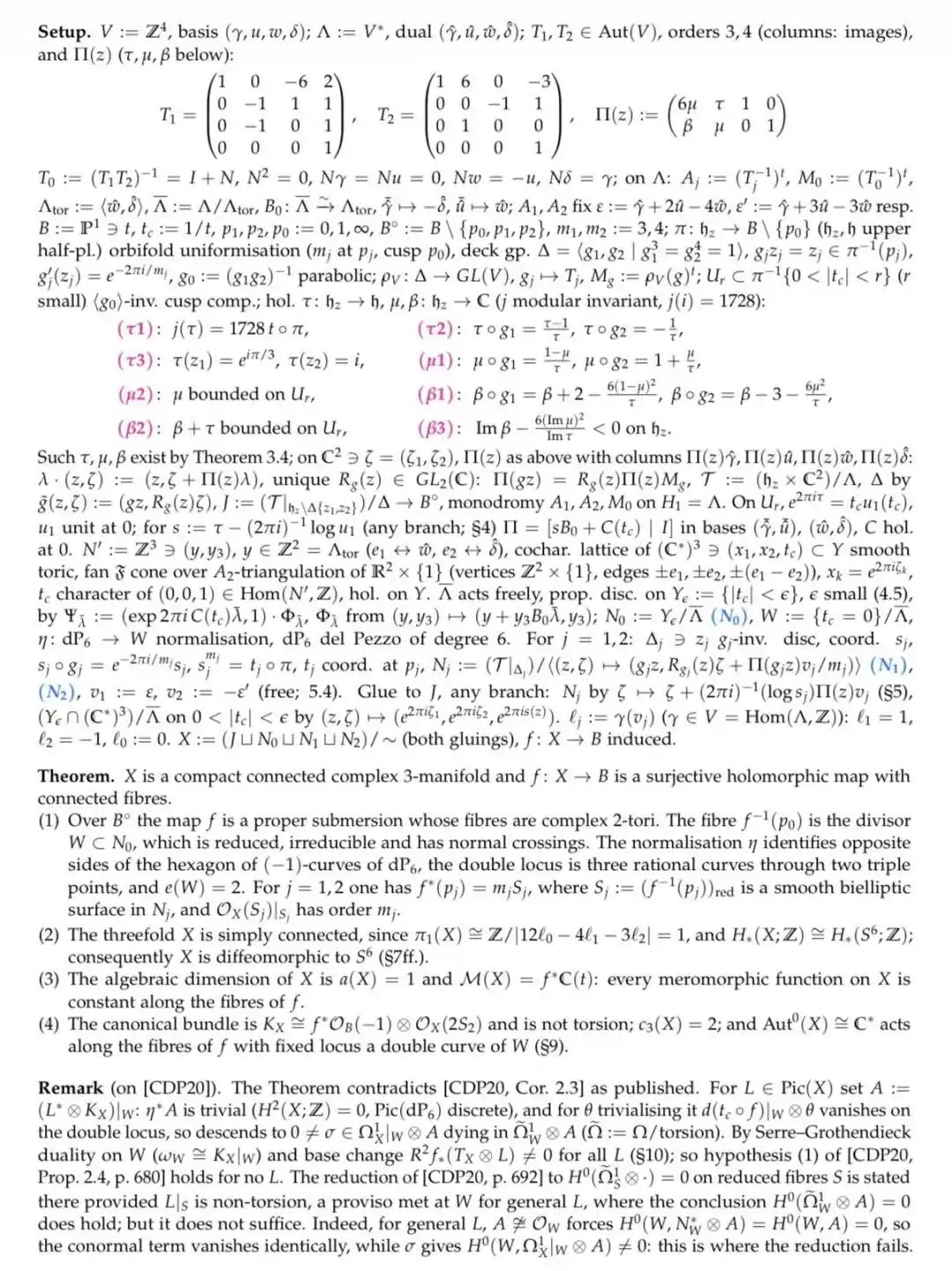
The three integers (ℓ₀, ℓ₁, ℓ₂) measure how the fibers are twisted when the three gaps are filled. Plugging in (0, 1, −1) gives 12×0 − 4×1 − 3×(−1) = −1, whose absolute value is 1. That makes ℤ mod 1 the trivial group, so the fundamental group disappears.
The report then says X is simply connected and has integral homology matching S⁶. Using the Hurewicz and Whitehead theorems, X is identified as a homotopy 6-sphere. Smale’s 1961 generalized Poincaré conjecture then gives a homeomorphism between X and S⁶.
No exotic spheres in dimension six
One last step remains after homeomorphism: the smooth structure. In topology, being homeomorphic does not automatically mean being diffeomorphic. A manifold can be topologically the same as a sphere while carrying a different smooth structure. Such objects are called exotic spheres.
The article cites a 1963 result by Kervaire and Milnor saying that dimension six has no exotic spheres, while dimension seven has 28. Because six dimensions are free of that obstruction, the homeomorphism upgrades to a diffeomorphism. On the article’s account, X is S⁶ itself.
Who made the claim, and when
Alpöge is identified in the article as a junior fellow at Harvard’s Society of Fellows and also a postdoctoral researcher at Anthropic. His usual field is number theory and arithmetic geometry rather than complex geometry.
Yuan said that only three days before this result, he had discussed the deadlock with Alpöge.
The article also places the S⁶ work in a short sequence of Claude-linked mathematical results. On July 20, Alpöge used Claude Fable 5 to produce what the article calls a fatal counterexample to the Jacobian conjecture, a problem it says dates back to 1939 and had remained open for 87 years. On Aug. 10, an unreleased research version of Claude, whose identity has not been made public, raised the proved proportion of zeros of the Riemann zeta function on the critical line from 41.6% to 67.2%.
In that second effort, the model reportedly coordinated about 60 sub-agents, executed more than 2,400 shell commands, and consumed 31 million output tokens. The S⁶ result followed on Aug. 24.
From searching to constructing
The article argues that the earlier two cases could still be read as very strong search over known territory: one hunted for a counterexample, the other combined existing papers already in the literature. The S⁶ case is presented as different in kind.
Here, the geometric object was not sitting in an existing answer bank. The model built it.
Justin Curry, an associate professor of mathematics and statistics at the University at Albany, State University of New York, said: 「If the proof is true, this is absolutely the most remarkable AI achievement in recent times.」
That leaves the old question in a new place. For 78 years, mathematicians kept asking whether S⁶ carries a complex structure at all. After this proof, the article says, the next question may be how many such structures could be hiding there.
Reference and source note
The cited reference is https://alpo.ge/s6.pdf. The source article says the piece originally came from the WeChat public account Xinzhiyuan, written by ASI Qishilu and edited by Moxi and David.