
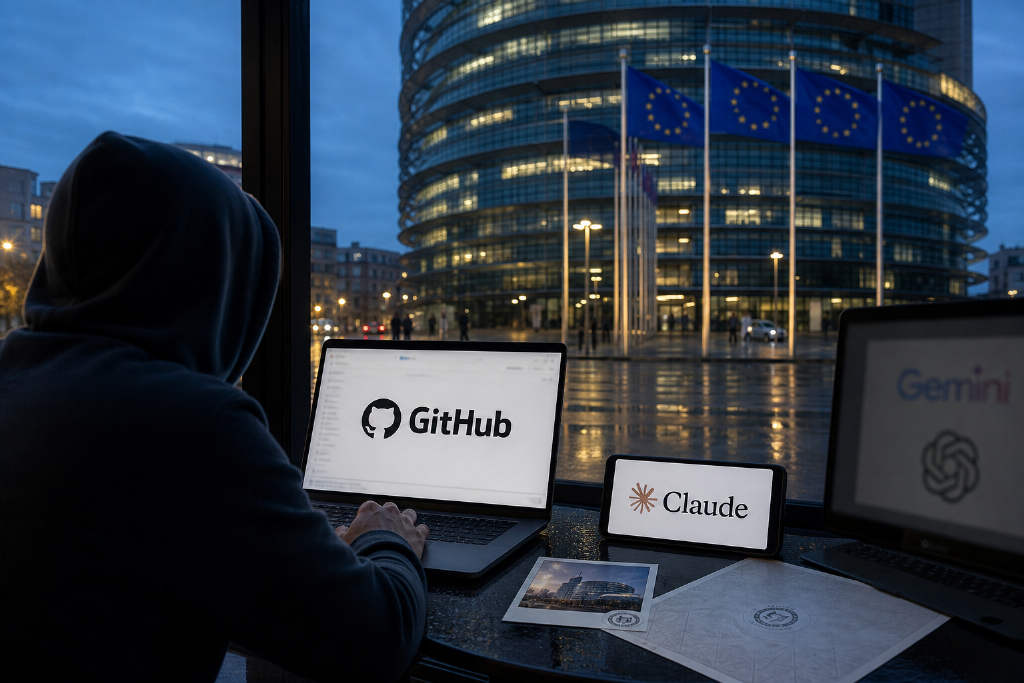
Anthropic said on Aug. 11 that the latest Claude models will embed hidden watermarks in all generated text, while images will carry C2PA digital signatures. The move was presented as a response to transparency requirements under the European Union’s AI Act. Models launched in the EU from Aug. 2 are covered first, with the policy then expanding globally.
On the same day, developer Guillaume Meyer opened a GitHub repository. By Aug. 13, the project had reached 4,102 stars. At the time BlockTempo checked it, the count had climbed to 8,983 stars with 919 forks, meaning interest roughly doubled again within two days.
The repository was originally called remove-claude-marks and is now named watermarks-remover. It uses the MIT license and is written in Python. The project’s own migration note says the earlier name was remove-claude-marks, and the old command, /remove-claude-marks, is still available.
Three layers of removal
According to the repository description, the tool works across three layers.
- The first layer removes invisible Unicode characters, including unusual spaces, bidirectional control characters, and tag characters, using rule-based processing.
- The second layer targets statistical text watermarking, where models alter token selection patterns. The stated method is to have another model rewrite the entire passage.
- The file layer strips C2PA signatures and metadata such as EXIF and XMP, with support for PNG, JPEG, WebP, SVG, PDF, DOCX, ODT, HTML, and Markdown.
The project says it covers Claude, Gemini’s SynthID-Text, OpenAI source markers, and the Kirchenbauer-style markers commonly used in open-source models. It is also packaged as a skill that can be called directly by an AI agent. After installation, users can run it with the command /remove-ai-marks. The repository says the purpose is privacy and cleanliness for content people already own.
No public way to confirm whether it works
That is where the story becomes difficult to verify. Anthropic has introduced watermarking, but it has not released a public detector. Without a detector, there is no outside method to check whether a piece of text has actually been cleared of Claude’s embedded markers. That includes the project author.
BleepingComputer made a similar point, saying AI watermark-removal tools are spreading online and that almost none can prove they actually work.
The second layer is especially hard to judge. In practice, “removing” a statistical watermark here means asking another model to rewrite the full passage, swap vocabulary, change clause order, and alter transitions and sentence boundaries. That may disrupt a signal hidden in token probabilities, but by that stage the output is effectively a different article.
So far, the parts that appear easier to remove are the rule-based elements, such as invisible Unicode characters and file metadata. The harder claim involves statistical watermarking, where the current approach is largely to bet on rewriting.
A fight with no clear end
Viewed over a longer timeline, watermarking and content labeling have been pushed repeatedly this year. In July, YouTube cut monetization for three categories of AI fake-original content. The same month, the EU began enforcing transparency rules that carry penalties of up to 3% of global revenue for failing to disclose AI-generated material. In early August, Suno said it would add watermarks to AI-generated music. On Aug. 11, Claude joined that line.
As regulation turns labeling into an obligation, model providers are pushed to stamp outputs. Once those stamps exist, removal tools follow. A project approaching 9,000 stars in three days suggests there is strong demand for that kind of tool, and BlockTempo noted that privacy is unlikely to be the only reason users are interested.
Still, neither side has produced proof that settles the matter. Anthropic has not shown whether its watermark can reliably survive adversarial attempts, and tool authors cannot demonstrate that they have fully stripped it out. Until a detector is made public, claims from both sides remain unverified.
What the source report highlighted
BlockTempo said online reaction to Claude’s watermarking plan was poor, with some community comments focusing on the fear that such markers could expose AI use in workplaces or school assignments.
The source report also noted that the EU began enforcing the relevant transparency requirements in August, with penalties of up to 3% of global revenue for non-disclosure, and said Taiwan is also within scope.