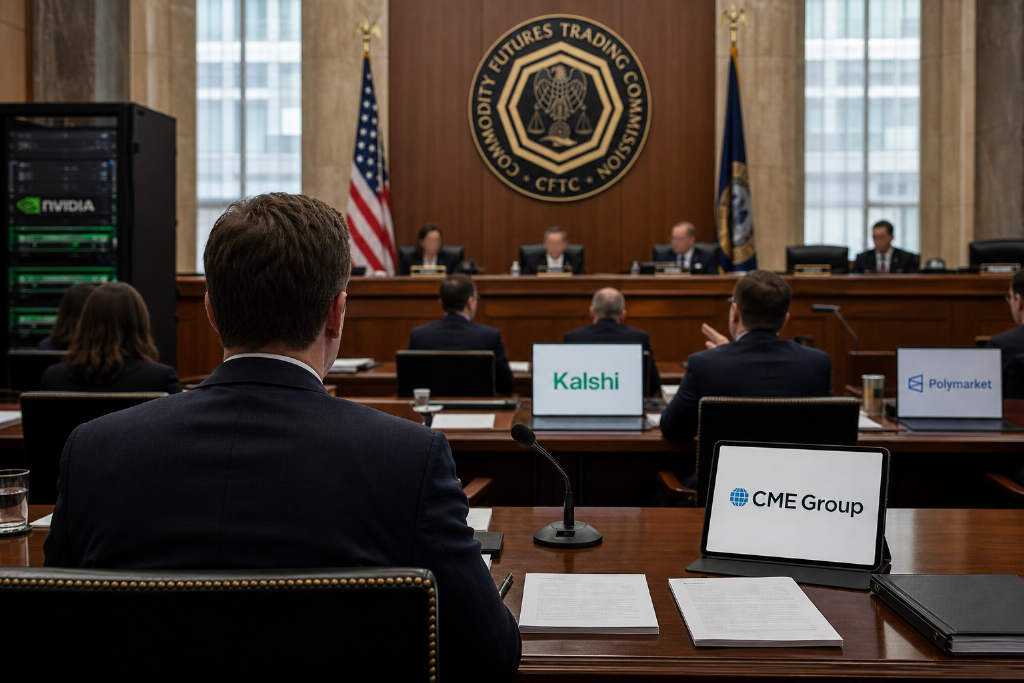
CME Group CEO Terry Duffy challenged the self-certification process for prediction market contracts during the first meeting of the Commodity Futures Trading Commission’s Innovation Advisory Committee, saying roughly 2,500 self-certified contracts had been filed with the agency since January 2025 without a single objection. He argued that some of those contracts could run against core principles that bar trader manipulation.
Duffy cited two examples during the discussion: a soldier allegedly profiting on Polymarket using inside information, and Donald Trump’s teleprompter operator allegedly making more than $100,000 on Kalshi by predicting the content of a presidential speech. CFTC Chair Michael Selig interrupted him and said those products were not listed in the United States, calling the remarks “fake news.”
Duffy also said Kalshi launched a prediction market in July tied to Nvidia chip rental costs, while CME plans to list a similar contract on Oct. 5. The CFTC, he added, opened a 60-day public comment period on computational derivatives on Aug. 19, a window that would extend beyond CME’s planned launch date.
CME Group CEO Terry Duffy questioned the self-certification process for prediction market contracts at the first meeting of the Commodity Futures Trading Commission’s Innovation Advisory Committee.
Duffy said roughly 2,500 self-certified contracts had been submitted to the CFTC since January 2025 and none had been challenged. He said some of them could violate a core principle that prohibits trader manipulation.
Two examples led to a direct exchange at the meeting
Duffy pointed to two cases. In one, he said a soldier profited on Polymarket using inside information. In the other, he said Donald Trump’s teleprompter operator made more than $100,000 on Kalshi by predicting the content of a presidential speech.
CFTC Chair Michael Selig interrupted Duffy during the meeting and said those products were not listed in the United States, calling the remarks “fake news.”
Kalshi and CME are both moving into similar contracts
Duffy also said Kalshi launched a prediction market in July tied to Nvidia chip rental costs, while CME plans to list a similar contract on Oct. 5.
He added that the CFTC opened a 60-day public comment period on computational derivatives on Aug. 19. That review window would run past CME’s planned listing date, according to the account cited by BeInCrypto.
This article was originally published by Bit.Fan. For more cryptocurrency news and market insights, visit www.bit.fan. Disclaimer:
The market information, project data, and third-party content displayed on this platform are for industry information sharing only and do not constitute any form of investment advice or return commitment.
Cryptocurrency trading carries high risks. Users should fully assess their risk tolerance and make independent decisions. All profits, losses, and legal responsibilities are borne by the users themselves.