
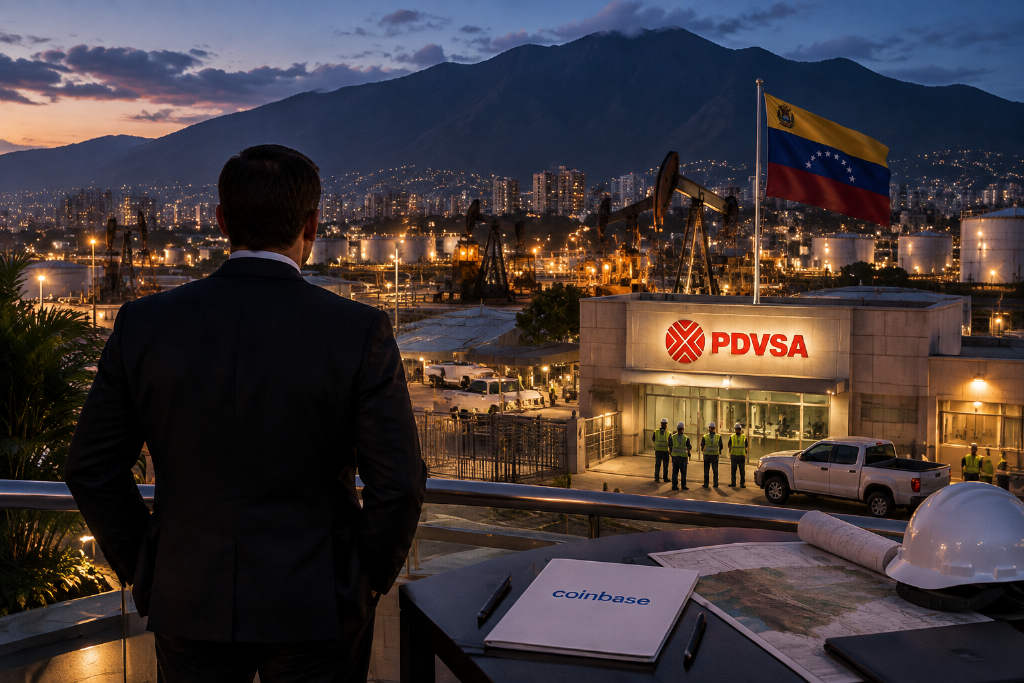
Fred Ehrsam, the Coinbase co-founder who built his fortune in crypto, has turned to a far older business: oil.

Over the past few months, the 38-year-old investor has made frequent trips to Caracas and at one point stayed in a local hotel for an extended period. In early September, that effort produced its first concrete outcome. Primavera Infinita, a company Ehrsam co-founded, formally signed a production participation contract with Venezuela’s state oil company Petróleos de Venezuela, S.A. (PDVSA), securing the right to develop the Budare-Elotes block. PDVSA’s long-term target is for the block to contribute more than 70,000 barrels a day in additional output.
The investment sits awkwardly, at least on the surface, with Ehrsam’s résumé. He worked as a foreign exchange trader at Goldman Sachs, co-founded Coinbase with Brian Armstrong in 2012, and later launched crypto investment firm Paradigm in 2018. His broader portfolio has stretched into frontier technology names including OpenAI, Anthropic and SpaceX.
Now he is backing an oil venture in one of the world’s most politically complicated jurisdictions.
He entered as Venezuela’s oil sector reopened
On resource endowment alone, Venezuela has always been too large for the oil industry to ignore. Yet over the past two decades, its underground reserves have not translated into comparable production. Output was around 3 million barrels a day in the late 1990s. Today, it stands at 1.25 million barrels a day.
Long-running sanctions, weak investment, aging equipment, and persistent political and property-rights risks have left the country in a category of its own. The oil is there. What has been missing is sustained capital, working infrastructure, and the technical and operating talent needed to keep the system functioning.
According to the report, conditions began to change in 2026. After Nicolás Maduro was arrested by the U.S., Delcy Rodríguez became interim president, and relations between Washington and Caracas were rapidly reshaped. In the oil sector, Venezuela revised its petroleum laws to let more private capital in through a new production participation model. At the same time, the Trump administration made oil central to its Venezuela strategy, pushing changes to sanctions and contract frameworks while urging U.S. energy companies to invest roughly $100 billion in the country.
That created a market being repriced by institutional change. A country that global capital had long avoided because of sanctions and economic distress suddenly looked like a place where reopening could produce returns well above those available in mature markets. Ehrsam appears willing to take that trade.
He co-founded Primavera earlier this year with Manuel Iribarren, a Venezuelan and Stanford graduate. In February, the two traveled to Venezuela to look for investment opportunities. After meetings with Venezuelan leaders and PDVSA executives, they came away most interested in oil and gas, the riskiest segment available.
The setup resembles a venture-style wager. It is not about finding a 10% mispricing in a stable, transparent market. It is about accepting a high probability of failure in a place many investors refuse to enter, in exchange for a chance at a much larger revaluation if the rules of the game keep changing in your favor.
Why some oil majors still held back
That possible upside comes with obvious depth and difficulty. The report says Trump urged companies including ExxonMobil, ConocoPhillips and Continental Resources, the company tied to oil billionaire Harold Hamm, to invest $100 billion in Venezuela. Those established players did not move.

ExxonMobil and ConocoPhillips both operated deeply in Venezuela and both lived through asset nationalization during the Hugo Chávez era. Those legacy claims have made them especially sensitive to property rights, arbitration protections, and whether a future government would continue to recognize contracts signed today.
Not every major took the same view. Chevron, which has operated in Venezuela for decades, said in early September that it would invest $7 billion in Venezuelan oilfields over the next five years and hopes to lift its output in the country to about 600,000 barrels a day. People familiar with the matter said the contract terms tied to Chevron’s new joint venture with PDVSA are expected to be highly favorable, lowering the risk of further investment there.
The report notes that Chevron’s new terms even include international arbitration rights. For a mature oil company, the central question is not whether it can sign a deal now. It is whether a contract remains enforceable five or 10 years after billions of dollars have already gone in.
Political access has become part of the asset
Alongside veterans such as Chevron, a new group of smaller and more risk-tolerant energy companies and investors has started to appear in Venezuela’s latest opening. They come from different backgrounds, but one trait stands out: varying degrees of connection to Trump and his political network.
Ehrsam rarely discusses his political views in public. Federal fundraising records, however, show he donated $1 million to the Trump-Vance inaugural committee. He has also built ties with the Trump administration and now serves on the President’s Council of Advisors on Science and Technology. For an oil project whose economics depend heavily on U.S. sanctions policy, Venezuelan law, and the direction of bilateral relations, that kind of political access can matter on its own. It can reduce information asymmetry and shape how investors assess reversal risk.
Other new entrants show similar patterns. Denver-based Aspect Holdings has already signed a contract with PDVSA to participate in technical studies. Aspect is a private energy investment and exploration company founded by billionaire Alex Cranberg, a long-time Republican donor.
Sable Offshore, another company seeking entry into Venezuela, is led by industry veteran Jim Flores. Sable comes from a more traditional oil background, but it also has policy overlap with the Trump administration. Earlier, when California regulators opposed the restart of offshore oil production near Santa Barbara, Sable ultimately secured federal backing through an executive order signed by Trump, allowing the project to keep moving.
A clearer case is Dallas-based Hunt Oil. On Aug. 18, the company signed a production participation contract with Venezuela covering development and output growth at the Caro and Carisito oil and gas fields in the east. Hunt Oil is not a newcomer to energy. It is an independent company with decades of experience, and the Hunt family behind it has long backed Trump and the Republican Party.
The report stops short of describing this as the Trump administration “allocating” Venezuelan oilfields. Its point is narrower. These U.S. investors appear more willing to believe the current policy window will stay open, and more willing to absorb the tail risks that come with that judgment. The hesitation of ExxonMobil and ConocoPhillips reflects the opposite instinct, shaped by experience rather than unfamiliarity.
That contrast has already drawn concern inside Venezuela’s oil industry. Some veteran figures question whether these new entrants have enough capital and technical depth for the country’s complex heavy-oil projects. Venezuelan crude is highly viscous, infrastructure is old, and both development and transportation require constant spending. The country’s heavy debt load may also leave banks cautious on project finance, pushing deals to rely more heavily on equity capital.

Pedro Burelli, a Venezuelan opposition figure and former PDVSA board member, said oilfields should go to companies with the capital base and project experience to handle them, rather than being quickly carved up once a policy opening appears. He said the current disorderly rush for acreage helps no one.
Can a venture playbook work in oil?
For Ehrsam, the challenge is not only winning access to a block. It is operating in an industry where he has no direct background, and doing so in the most demanding market he could have chosen.
Venture capital has a familiar pattern: find an undervalued asset or founder first, then solve execution through management hires, additional financing and resource coordination. Ehrsam appears to be trying something similar here. The report says he has already brought in a professional team that includes experienced oil executive Dheeraj Verma.
But oilfields differ from software companies in ways that go beyond the usual heavy-asset versus light-asset distinction. The deeper divide is in how capital is deployed and how long it takes to come back.
A software company can turn fresh funding into hiring and market expansion quickly. If growth falls short, it can cut staff, trim spending, adjust the product or pivot. Even when those steps are costly, incremental capital can usually be staged, reduced or redirected.
Oil works differently. Well repairs, pipelines, equipment upgrades and storage and transport systems all require large upfront spending before production gains are realized. A meaningful share of that spending is not reversible. Whether the project makes money depends on sustained production, export capacity, settlement ability and the recovery of upfront costs over years.
That is why the biggest risk for Ehrsam and Primavera may not be technical geology. It may be the mismatch between the return cycle and the political cycle. An oilfield can take years to reach stable cash generation, while U.S. sanctions policy toward Venezuela, local petroleum law, contract enforcement conditions, and the broader relationship between the two countries can all change over that same stretch.
Seen through that lens, Ehrsam is not simply betting on how much production Budare-Elotes can add. He is betting on how long the current political opening lasts.
Crypto fortunes are moving toward physical assets
Viewed on its own, Primavera can still be read as a single crypto billionaire’s adventure. Step back, though, and the preference is not isolated.
In February, BitMEX co-founder Arthur Hayes publicly disclosed his asset allocation, an unusual move for him. Alongside crypto positions in BTC, ETH, ZEC and HYPE, his equity portfolio includes gold, silver, copper and uranium miners, major oil companies, Latin American energy firms and defense businesses. He also directly holds physical gold.

That mix shows a clear shift. For someone who accumulated wealth through crypto, Bitcoin no longer sits in opposition to gold, copper, uranium or oil. They can all sit on the same balance sheet at once.
Tether has taken the trend further. The report says the USDT issuer posted net profit of more than $10 billion in 2025. By the end of that year, the company said the standalone investment portfolio it had built using profits and excess capital had grown past $20 billion, spanning AI, energy, precious metals, agriculture, land and telecommunications.
One of Tether’s clearest examples also came in South America. In 2024, it bought roughly 9.8% of agricultural group Adecoagro for $100 million. In 2025, it followed with a cash tender offer and lifted its stake to 70%. The later offer alone covered 49.597 million shares at $12.41 each, implying cash spending of about $615 million.
Tether did not buy control of Adecoagro to put the business on-chain or wrap it as an RWA agriculture token project. It bought control of a conventional company that owns land, farms, processing facilities and power assets. Adecoagro manages more than 200,000 hectares of sugarcane plantations in Brazil and owns three sugar mills producing sugar, ethanol and electricity. It also operates rice and dairy businesses in Argentina and Uruguay. Its mills can use sugarcane waste for cogeneration and sell surplus power into the local grid after meeting their own energy needs.
That creates an inversion of the industry’s favorite story from the past few years. Crypto has spent much of that time asking how to bring real-world assets onto blockchains. Tether took another route: it directly acquired control of an agriculture and energy producer.
From digital scarcity to physical scarcity
Hayes, Tether and Ehrsam represent three different approaches: gaining exposure to resource prices through equities, taking control of operating companies, and joining oilfield operations directly. They do not form a strict sequence, but together they point to the same development. Crypto capital is no longer interested only in how to tokenize real-world assets. It is also showing a willingness to own and run them in traditional ways.
The flow into energy, metals and land is not random. These assets carry a form of scarcity that is different from crypto’s. Bitcoin’s 21 million cap is written into code. The supply constraints on oilfields, mines and land are written into geology, geography and long development timelines. The first is a designed and highly credible digital scarcity. The second is a physical scarcity that capital and technology cannot easily rewrite in the short run.
Ehrsam’s Venezuela push is one of the most extreme examples in that shift. He came out of a wealth system built almost entirely on code and networks, then chose to commit real money to an oilfield that requires years of spending, cannot be moved, and depends at once on geology and politics.
Crypto can create and move wealth quickly. But once part of that wealth starts looking for a larger and longer-term home, it is increasingly moving toward physical assets that do not disappear when the internet cable is pulled.