
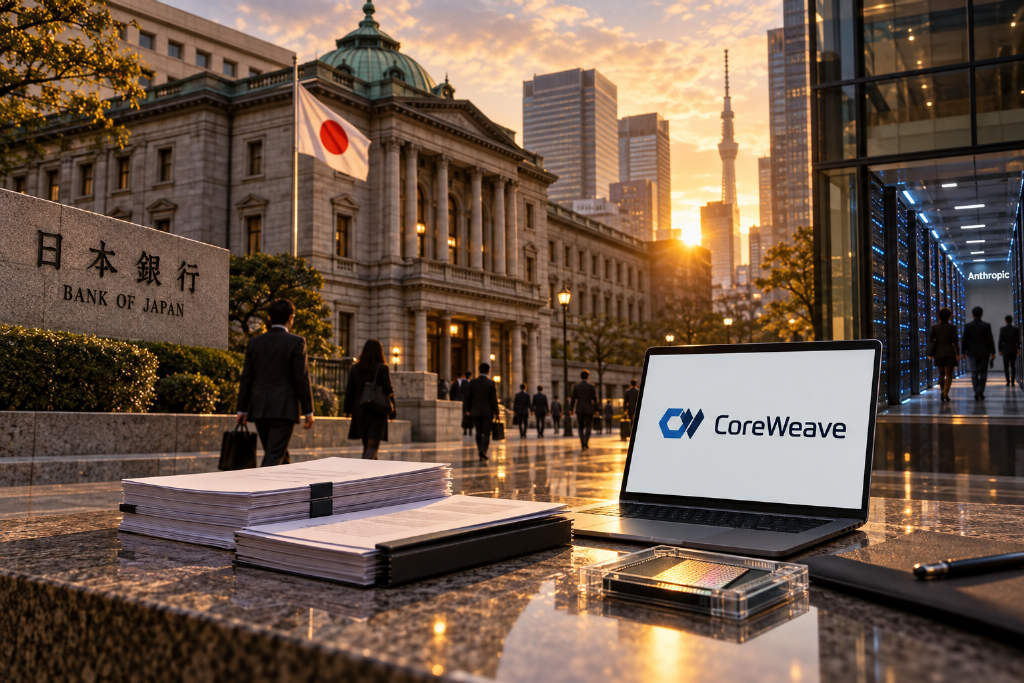
WuBlockchain’s WhiteLine Daily on Sept. 18 highlighted a set of developments around AI deployment, supply expansion, financing, and macro funding costs. The report focused on four items: CoreWeave’s latest funding plans, ChangXin Memory Technologies’ reported move into NAND, a Bank of Japan rate increase, and Anthropic’s disclosure on internal agent usage.
CoreWeave sets up a $3 billion convertible note deal and a stock sale program
On Sept. 17 U.S. Eastern Time, AI cloud provider CoreWeave said it plans to issue $3 billion of convertible senior notes due 2033. It also granted initial purchasers an option to buy up to an additional $500 million of notes.
The company said part of the proceeds is expected to be used for capped call or other option transactions intended to reduce potential dilution from conversion, with the rest for general corporate purposes. At the time of the announcement, the coupon rate and initial conversion terms had not been set. The report stressed that this was a proposed offering and should not be treated as funds already received.
According to Barron’s, CoreWeave also launched an at-the-market equity program covering up to 35 million Class A common shares. Taken together, the two arrangements show the company continuing to tap both debt and equity markets for capital, though the actual number of shares sold, the sale price, and the amount ultimately raised will depend on execution.
WhiteLine Daily said the company is widening its funding channels, but the added capital also comes with future debt obligations and potential equity dilution. Whether that financing works out will still depend on computing revenue growth covering those costs.
Reuters says CXMT plans a NAND push with an R&D line in Beijing
Reuters reported on Sept. 18, citing people familiar with the matter, that ChangXin Memory Technologies, or CXMT, plans to enter the NAND flash market and build a NAND research and development line at a new facility in Beijing. The report said the company has already been in contact with potential customers, including one AI startup.
CXMT has previously focused mainly on DRAM. If the plan moves ahead, it would extend the company’s business into flash memory and place it in more direct competition with Samsung, SK Hynix, Micron, and Yangtze Memory Technologies.
Still, what has been disclosed so far is a research and customer engagement plan, not new mass-production supply. WhiteLine Daily said the move adds a potential medium- to long-term supply variable, but an R&D line remains some distance from large-scale output, so it is too early to conclude that flash shortages will ease in the near term.
Bank of Japan lifts policy rate to 1.25%
On Sept. 18, the Bank of Japan voted 7-2 to raise its policy rate from 1.00% to 1.25%, a 25 basis point increase that brought the rate to its highest level in 31 years.
Reuters said the move was broadly in line with market expectations. The stated policy aim was to address persistent inflation pressure and prevent inflation from overshooting the central bank’s 2% target.
The report said a higher Japanese rate raises the cost of borrowing in yen to invest in overseas assets, narrowing the return from carry trades. If the yen strengthens further, borrowers could also face foreign-exchange losses, adding to pressure to cut positions. Even so, because the increase had been expected, whether it leads to a clear repatriation of capital will depend on the pace of future rate moves and the path of the yen.
WhiteLine Daily’s takeaway was that the BOJ has raised the cost threshold for yen funding, while the effect on flows into overseas assets such as technology stocks still depends on exchange-rate moves and the policy path ahead.
Anthropic says Claude now leads 26% of internal AI R&D work under human oversight
In its latest official research release, Anthropic said that as of August 2026, Claude was leading about 26% of the company’s internal AI research and development work under its own internal automation metric. More than 90% of work had reached AI collaboration or a higher level.
In this context, “leading” means the model can complete most of a task’s workflow based on high-level instructions, while humans still supervise the process. Anthropic said it did not find any tested R&D work category that had reached fully autonomous operation.
The company also disclosed that around 30,000 agents were simultaneously carrying out research and engineering tasks on its most-used internal platform. That offers a concrete sample of real-world agent deployment scale.
The report added that the automation ratio was calculated by the company itself rather than verified through an independent third-party audit, and it should not be read as meaning R&D costs have fallen by 26%. WhiteLine Daily said the presence of tens of thousands of agents working at the same time shows that complex workflows are already generating real inference demand. The next question is how much efficiency those calls produce and whether the gains can cover compute costs.
The day’s common thread: AI usage, supply expansion, and funding constraints are moving together
WhiteLine Daily said actual AI usage, supply expansion, and funding constraints are all advancing at the same time. Anthropic disclosed the scale of internal agent usage, CXMT is preparing a possible move into NAND, and CoreWeave is still replenishing capital through both debt and equity channels.
Against that backdrop, the BOJ rate increase adds another macro layer. The report said demand growth still matters, but the time needed for new investment to turn into revenue, profit, and free cash flow will increasingly shape what shareholders ultimately receive.