
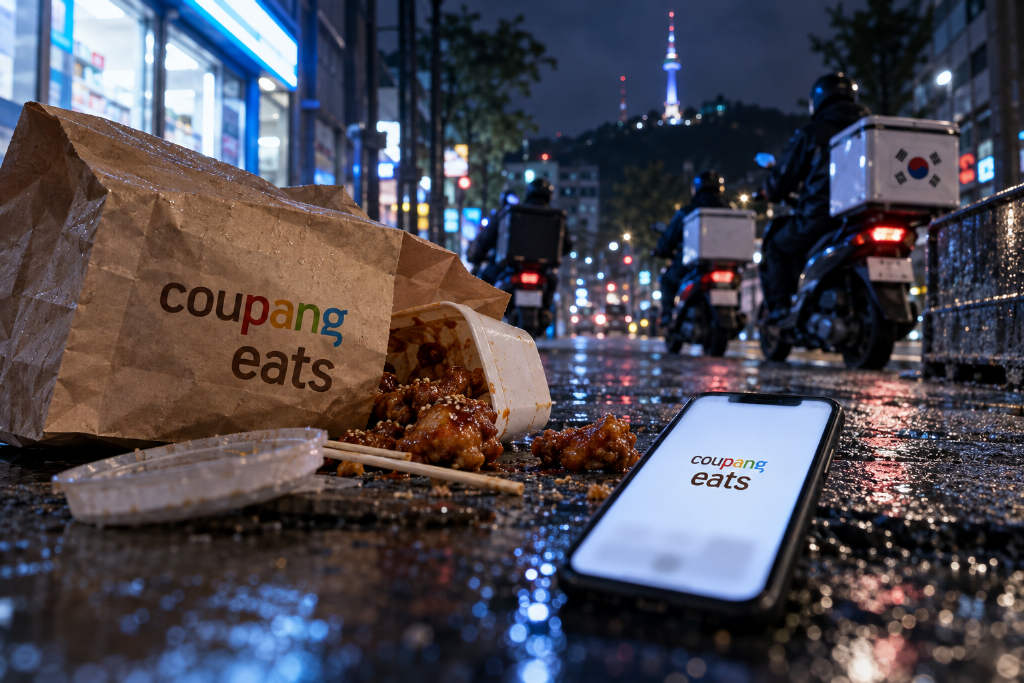
Coupang, one of South Korea’s largest e-commerce platforms, suffered a system outage around 12 a.m. local time on Oct. 9 that disrupted its shopping service, Coupang Eats delivery platform, and Coupang Play streaming service at the same time. The article says that in Taiwan time, the disruption began around 11 p.m. on Oct. 8. During the outage, delivery riders who had already collected meals could no longer view customer addresses, and a large number of orders were canceled.
According to the report, the problem spread across the platform at about 12:30 a.m. and service was restored at roughly 2:30 a.m., putting the total disruption at about two to three hours. The outage hit during a late-night meal window just before the Hangul Day holiday period, leaving restaurants with prepared food that could not be delivered and drivers with an app that had stopped working.
Forum posts showed riders eating food that could not be delivered
The report says Korean delivery platforms may instruct riders to "dispose of the item themselves" when food cannot be delivered, such as when a product has a problem or a customer cancels the order. After the outage, multiple posts appeared on Korean forums showing what users described as proof of disposal, including assorted sashimi, pizza, and fried chicken.
Some riders who posted the photos appeared to present them as a form of self-protection rather than an attempt to wrongfully take customer food. One post showed a full platter of assorted sashimi with the caption, 「Thanks to the person who ordered assorted sashimi.」 Another said, 「Whether it’s compensation or a deduction, it won’t be the full amount anyway」 and 「I ate an order worth 100,000 won and got charged 20,000 won.」 The article converts those amounts to about TWD 2,380 and TWD 480, respectively.
Korean media, as cited in the article, said the remark meant that even if part of the meal cost would later be deducted during settlement, the food would still be eaten rather than wasted. The posts split public opinion. Critics argued that customers who never received their orders and could not reach the platform would naturally see the photos as mocking. Others defended the riders, saying they were forced to stop working without earning their usual daily income and were only dealing with food that had already been treated as discarded.
Coupang blamed a service upgrade error
Coupang said the outage was caused by a temporary error during a service upgrade and ruled out the possibility of a hacking attack. Because South Korea’s financial sector has recently faced a series of hacking incidents, the outage also triggered concerns about cybersecurity.
On compensation, Coupang said customers whose shopping orders were canceled because of the outage would receive 5,000 won in Coupang Cash, worth about TWD 120, valid for six months. Customers whose Coupang Eats orders were canceled would receive a 3,000 won coupon, while customers whose payments failed would receive 1,000 won. Riders would receive 1,000 won if an order was canceled after they had arrived at the store, and full delivery pay if the cancellation happened after pickup. Merchants with canceled orders would also be compensated.
Questions remain over losses not covered by the plan
The Chosun Ilbo said the compensation package did not mention orders that were never successfully placed in the first place, and did not address business lost by merchants and riders while they were left waiting during the outage. A sashimi shop owner in Seoul’s Gangnam district said losses should be estimated based on normal sales during that time period.
Government data showed Coupang led major platforms in reported outages
The Chosun Ilbo, citing data obtained by Democratic Party lawmaker Kim Nam-guk from the Ministry of Science and ICT, said South Korea began requiring major online platforms to report outages lasting more than 30 minutes starting in January 2024. Through August this year, 65 cases had been reported in total, with Coupang accounting for 18 of them, the highest among platforms, or about once every two months.
JTBC reported that Coupang’s WOW paid membership extends benefits to Coupang Eats and Coupang Play, linking the systems behind the three services. The article said this outage occurred when all three platforms were being updated at the same time, causing the services to fail together.
Article also pointed to a previous personal data leak case
The report added that Coupang was also hit by a large-scale personal data leak late last November. According to a September report cited in the article, South Korea’s Personal Information Protection Commission fined Coupang 624.7 billion won in June this year, including 423.6 billion won tied to that leak. The number of affected members and non-members combined was 37.55 million.