

MarsBit published a long commentary by Evanss arguing that crypto is being forced into what the author calls an "aging" phase, one where the market is screened with standards more familiar to older traditional investors: cash flow, growth, payout policy, and clarity over whether token holders actually receive economic value.
The piece opens by contrasting that view with crypto’s earlier culture. Phrases such as "have fun staying poor," laser-eye avatars, and calls for Bitcoin to hit $100,000 before Thanksgiving once dominated sentiment. At the time, asking what real yield or economic output a token produced was often treated as missing the point.
The article says that stance no longer matches market reality. It points to the largest onchain exchange using about 97% of daily fees to buy back its own token, with cumulative purchases already above $1 billion and still rising. It also notes that the Financial Times has started auditing crypto buyback programs and that S&P Dow Jones has licensed the S&P 500 index to a perpetual DEX. In the author’s view, 2026 crypto winners are now being selected on cash flow, growth rates, distribution policy, and the absence of equity-token conflict.
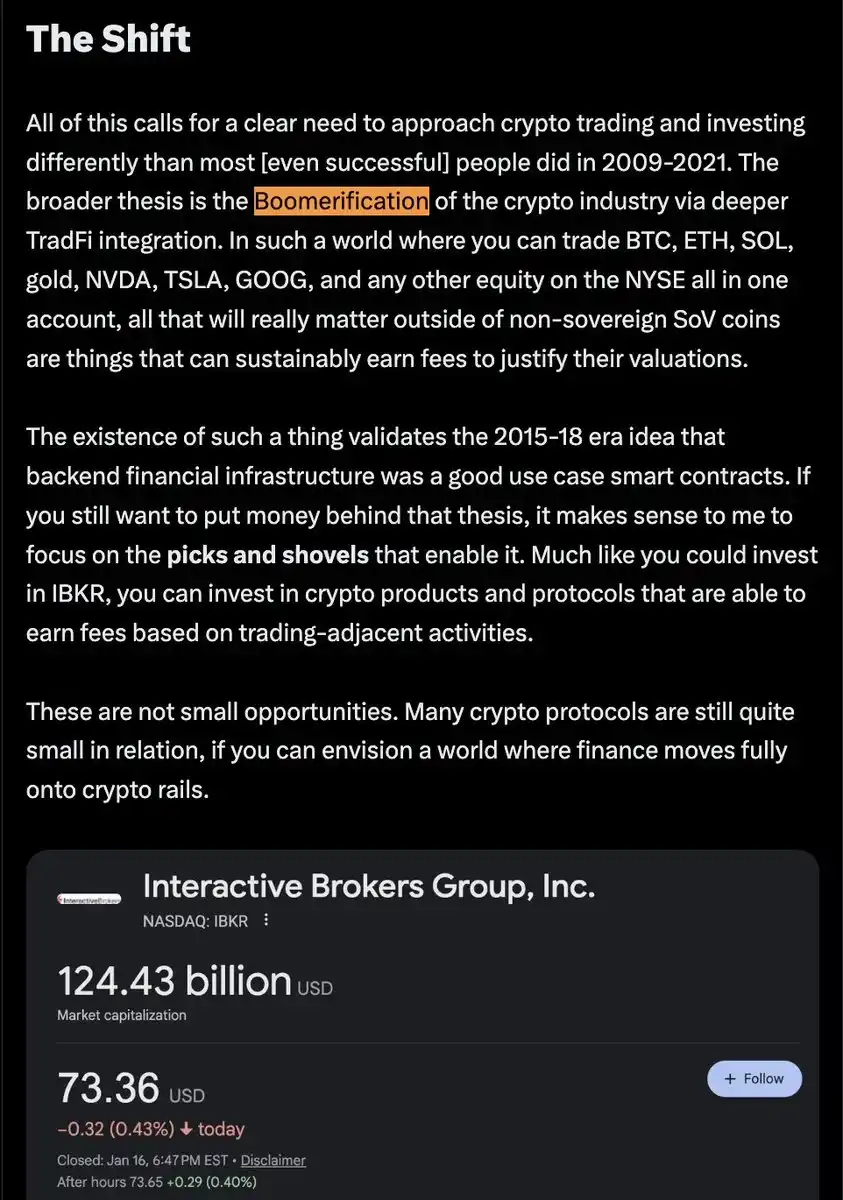
Evanss says this argument was outlined earlier in January in a separate essay, where the author wrote that as baby boomer capital and broader TradFi forces move in, altcoins will have to compete on real fundamentals rather than vision statements and dreams. That process is described as crypto’s "baby boomerization," or simply its aging.
Eight months later, the article argues, market action has begun to reflect that shift. Traditional portfolios, in the author’s framing, usually contain two broad asset types: productive assets such as stocks, and stores of value such as gold that do not need to generate income. Bitcoin, the piece says, has already traveled the gold path through ETFs, institutional allocation, and inclusion in retirement portfolios. Only a small number of crypto protocols have traveled the stock path. Most assets fit neither.
Two questions, three buckets
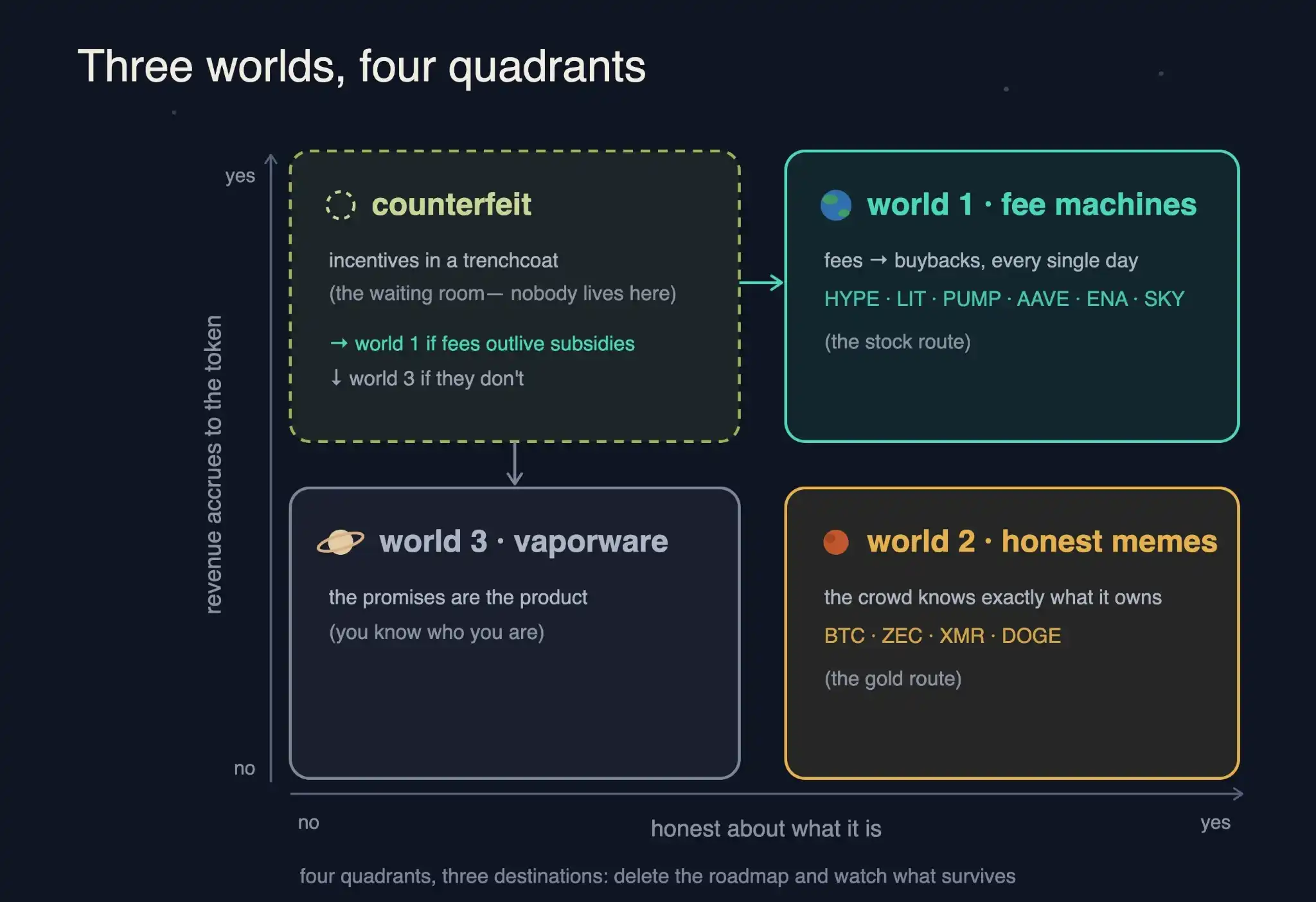
The commentary proposes a simple test for sorting the market into three categories.
- Does the token actually receive economic value through fees, buybacks, burns, or some other mechanism?
- Are the people around the asset honest about what it is?
The second question is turned into a practical exercise: remove the roadmap and see what remains.
If everything still makes sense after the roadmap is removed, the asset belongs to the meme bucket. The author places Dogecoin, Bitcoin, Monero, and Zcash in that broader group, though for different reasons. People hold such assets, the article says, because of ideals, narrative, humor, or a monetary thesis, not because they are waiting for a roadmap to turn into a product. Some of them barely have a roadmap at all. In that sense, the piece says meme assets are, ironically, among the purest assets in crypto.
If nothing remains once the roadmap is removed, the asset is treated as an abandoned project or what the article calls an air coin. In that case, the original promise itself was the product, whether that promise was future bank adoption or some similar slogan.
If cash flow remains after the roadmap is stripped away, the token belongs to a much smaller group of actual businesses, perhaps only around 15 in total according to the author. These projects may lose growth premium if their future plans disappear, but they do not vanish. The article cites HIP-3 as an example, saying it went from a line on a roadmap to enabling the first licensed S&P 500 perpetual contract in roughly one year. Growth expectations matter, but the underlying venue can still produce profits while token holders sleep.
That distinction sits at the center of the essay. A roadmap built on cash flow is not the same as a roadmap built on nothing. Older investors, the author says, have always been willing to pay up for growth, but only when that growth is anchored in a real business.
Category one: crypto businesses
The first category includes protocols that sell products people actually use, collect fees, and return value to token holders. The article names Hyperliquid, Pump Fun, Lighter, Aave, Ethena, and Sky as examples. Seen through a traditional finance lens, these assets resemble profitable public companies that are actively buying back stock.
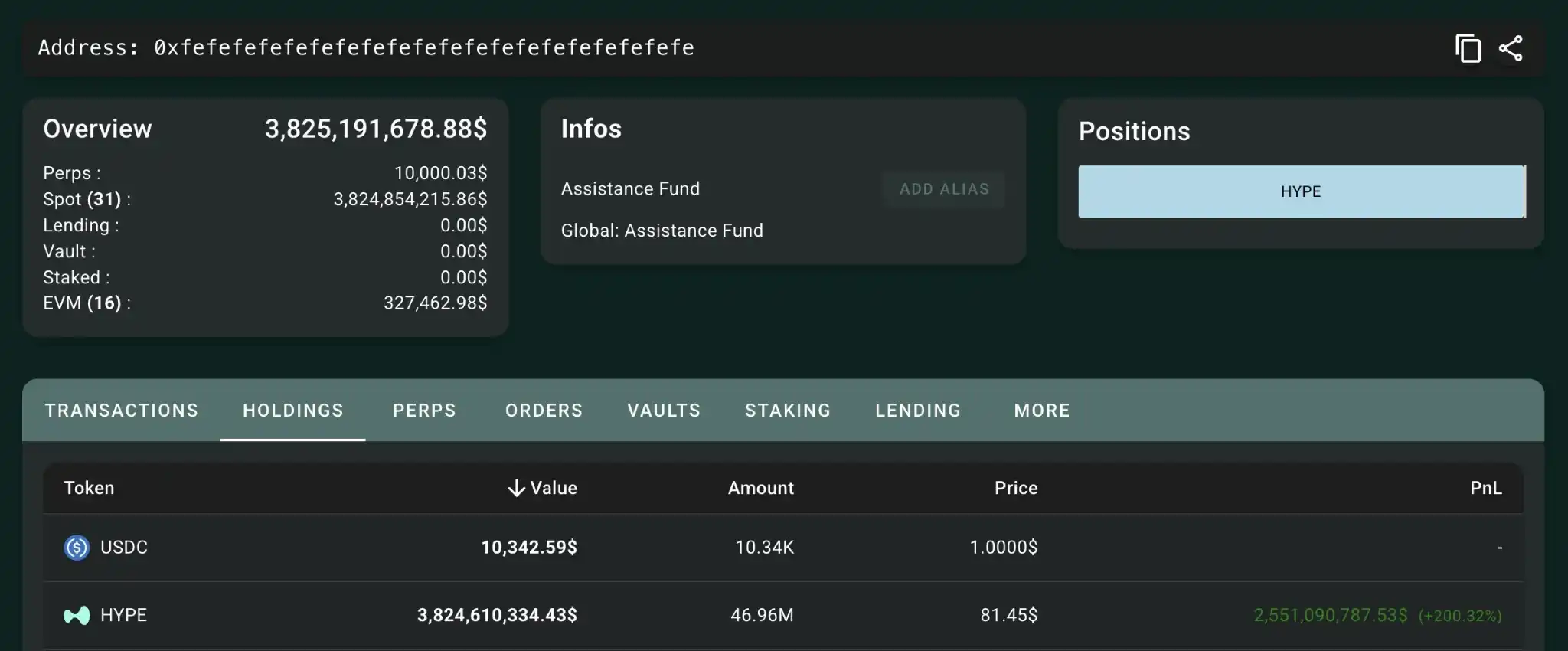
Hyperliquid is presented as the clearest model. According to the article:
- Its assistance fund takes about 97% of protocol fees and uses them to buy HYPE onchain, with cumulative purchases already above $1.3 billion.
- As of late August, yield generated from idle USDC reserves on the platform was also being routed into the same buyback activity.
The commentary adds that, according to the Financial Times, projected crypto buybacks for 2026 total $638 million, with roughly 90% coming from Hyperliquid and Pump.fun alone. For the author, this matters because traditional investors did not just bring capital into crypto. They also brought discounted cash flow thinking, and for the first time there are tokens that can plausibly be run through that framework.
The article still warns against a simple one-to-one stock analogy. First, these revenues often come from trading fees, and trading fees are cyclical. In weak markets, volume can collapse and valuation multiples can contract at the same time. Even a strong business token can still fall more than 60%. Evanss notes that HYPE traded at $22 earlier this year, and says investors should focus on fees across a cycle rather than peak annualized revenue.
Second, the article warns about projects that only look like category one because incentives are creating the activity. Examples include points farming, subsidized taker flow, or other volume juiced by token emissions. The author concedes that nearly every project uses this at launch, and says Hyperliquid also relied on points during its cold start. The difference, in this framework, is whether the protocol survives after the incentives fade.
Category two: honest memes
The second category includes assets with no revenue, no dependence on a roadmap, and no pretense about that fact. Their value rests on collective belief, and market participants understand that.
The author splits this bucket into two subgroups. The first is non-sovereign store-of-value tokens such as BTC, ZEC, and XMR. These are described as meme assets with a monetary ambition. The article says their roadmaps are mostly about security and usability, not about promotional spectacle. Money itself, the author writes, is one of humanity’s oldest and most successful memes. Gold has run on the logic that people agree it has value for 5,000 years, yet no one asks it for an earnings call.
That is also how the article reads Bitcoin’s evolution. BTC, in the author’s view, has already completed the aging path: ETF infrastructure exists, corporations hold it as treasury reserve, and institutional allocation has become part of portfolio construction. The asset did not change. The holders did.
ZEC and XMR are treated a bit differently. The essay argues that privacy is one thing the fully monitored and institutionally absorbed financial system associated with baby boomer capital cannot offer. That, it says, helps explain why ZEC’s sharp move in the current cycle followed its own rhythm rather than mirroring BTC. The article says these assets will rely more on narrative and absorb spillover flows from BTC, ETH, and SOL, along with fiat capital seeking to avoid confiscation.
The second subgroup is attention tokens such as DOGE, PEPE, and assorted meme coins. They belong in the same broad category, the article says, but pursue different ends. Some aspire to monetary status, while others simply aim to entertain or spread virally. The key point is that they are not traveling the mainstreaming route. They do not produce cash flow like equities, and they do not carry a credible monetary premium like gold. That does not make them untradeable. It makes them closer to entertainment products.
Evanss says participation in that space can make sense, but only as a smaller, tactical allocation. The strategy the author describes as the safest is to buy leaders in the later part of the early phase of a move and ride momentum. That may not deliver a 1,000x return, but it can still work. BTC and ZEC remain favored in this category, while the author avoids naming specific pure meme picks.
Category three: air projects and false hype
The third category covers what the article calls air projects. These are presented as the majority of the market: assets that look, economically, as empty as Dogecoin might appear to an outsider, but without Dogecoin’s honesty or humor. Their prices depend entirely on promises. They have no realistic path to monetary premium and no line of sight to future cash flow.
Still, the article is careful on one point: identifying an asset as hype or fraud is not itself a trading strategy. The author says that is where many traders get run over. In the short and medium term, price may have little to do with intrinsic value and much more to do with market structure and positioning.
- Only a small portion of total supply may actually be liquid and trading. Large amounts can sit in dormant hands from prior cycles, held at high cost bases and not automatically sold on the first bounce.
- Thin order books and scarce spot borrow can force shorts into perpetuals, making short liquidations part of the fuel for squeezes. When positioning becomes crowded and sentiment turns blindly bullish, squeezes can feed on themselves. Dormant supply often wakes up only after strength appears, which is when upside finally gets capped.
- Catalysts such as ETF filings, legal wins, or exchange listings can temporarily turn an air project into a liquid trading instrument. The author stresses that this creates a trade, not an investment.
For that reason, the article recommends that anyone who is not an experienced derivatives trader should largely ignore this category. That keeps attention focused on a much smaller list of meaningful assets. If someone insists on trading them, especially with cross margin, the author says caution is essential. Even larger-cap tokens in this group have posted multi-fold moves in short windows.
The pick-and-shovel trade
The essay’s central connection between category one and category two is what the author calls the pick-and-shovel strategy. Much of category one cash flow, in this view, comes from activity generated by category two.
Pump.fun is described as the factory at the top of the meme supply chain, collecting a toll on every token created. Hyperliquid and Lighter sit farther downstream, where the winners gather alongside the deepest books, biggest volume, and highest leverage. The casino does not need to know which table will be hottest tonight. It still gets paid.
That leads to what the author calls the most useful perspective shift in the piece: the smart way to be long memes is to own the infrastructure. Instead of trying to guess which dog wins, investors can capture aggregate flow and get paid through buybacks rather than hope. Evanss says that while individual meme tokens may still be traded on short horizons, the longer-held meme-linked positions are HYPE, LIT, and PUMP. The formulation is simple: own the house, do not linger too long at the table.
ETH and SOL as hybrids
ETH and SOL do not fit neatly into one bucket in the article’s framework. The author calls them rare hybrids. Layer-1 assets are treated as both category-one businesses and category-two call options embedded in a monetary narrative.
The formula given is straightforward: the price of ETH or SOL equals fee-supported value plus the market-assigned probability that the asset becomes money multiplied by the value of that money.
Viewed that way, many familiar crypto arguments stop looking contradictory. SOL bulls cite REV, which belongs to the business side of the story. ETH bulls point to ultrasound money, treasury buying, and BTC’s security budget problem, which belong to the monetary side. BTC maximalists attack ETH over centralization. In each case, bears often attack the dimension where the other asset has the stronger case.
The article says ETH is stuck in an identity crisis because it is priced partly as money and judged partly as a business that must capture value. BTC, by contrast, is framed as a fully exercised option: a pure monetary asset without the attached business debate. The author argues that this cleaner identity has served Bitcoin well in public perception.
The conclusion is not to force such hybrids into a single category. Investors should price the optionality separately and be honest about which part of the valuation they are paying for. The article even suggests these assets can be traded the way people trade NFT attention cycles, by watching flows and attention rather than adhering to rigid doctrine. As an example, Evanss says there was still an easy trade available when Tom Lee started buying ETH.
Portfolio construction: cycle holds and short-term trades
The broader framework then turns into portfolio guidance. The author says there are two main kinds of long exposure in crypto, and mixing them up is what creates the familiar wealth roller coaster of making money, giving it back, and ending up with little to show for it.
The first is a cycle hold, meaning an asset that can be carried through a multi-year cycle. Under the article’s framework, the rule is simple: it must be on one of the two mainstreaming paths. HYPE, LIT, and PUMP belong to the stock path. BTC and ZEC belong to the gold path. Inflation-hedge and fiat-debasement theses, the author says, do not care about fear-and-greed readings or the latest absurdity onchain. For those assets, investors either size small enough to survive deep drawdowns or become good enough at hedging and shorting to manage reversals.
The second is the short-term trade bucket, which includes everything else. Even the hottest meme coins, the author argues, usually last only one or two quarters. PEPE is presented as the strongest counterexample, yet even PEPE fell more than 80% before later making new highs. In that sense, even the exception still looks more like a swing trade than a long-term hold.
The operational summary is blunt. Attention-driven tokens should be treated as short-term trades. Air coins, if touched at all, are best approached late in the cycle and with a clear understanding of what a market top looks like. The author reduces the meme playbook to two lines: trade the tokens short term, and hold the casinos, meaning the platforms and ecosystems, over the cycle.
The piece also says investors need to let go of an older habit, waiting for Bitcoin to make the first move before stepping into altcoins. In this cycle, assets with their own demand drivers no longer need to wait in line.

Observed dispersion, not theory
To support that claim, the article points to recent price behavior. HYPE was at $22. LIT traded around $0.8. ZEC was already basing near $250 months before BTC showed any real move. By the time Bitcoin posted its first genuine upside impulse last month, all three had already rallied roughly 3x from their yearly lows.
The author acknowledges that strong alts showing relative strength before BTC bottoms is not unheard of, but says the magnitude here is unusual. Many traders, the article argues, missed those entries because Bitcoin still looked weak on the chart.
The implication is that lows and upside impulses are no longer moving in the highly synchronized way seen in prior cycles. If crypto were still being priced as one unified asset class, the author says, this pattern would not appear. Everything would bottom together, wait for the market index signal, and use BTC as the timing guide. Instead, assets with their own demand drivers have already started to move ahead of the broader complex.
That leads to a falsifiable forecast in the essay: correlation within categories will rise above correlation across categories. Category one will trade on fee multiples. Category two will trade on capital flows and monetary narrative. Category three will trade on float, derivatives structure, and late-cycle sentiment. As market participants get better at telling them apart, the old beta trade in which everything rises together should keep weakening.
Regulation and the U.S. opening trade
The final section turns to regulation. Evanss says platforms such as Hyperliquid and Lighter could be legally operating and available to U.S. users by 2027 at the latest.
The article says that call was no longer especially contrarian by Aug. 19. At a White House meeting with crypto executives, the president, according to the piece, mentioned the exchange by name and said CFTC Chair Mike Selig was working to bring Hyperliquid into the U.S. market "in a fully compliant and legal way." HYPE then surged to a record high. In the same session, Cboe shares were at one point down 6.1% and CME shares were at one point down 3.4%.
The article also lists three policy developments:
- The CLARITY Act passed the House by 294-134, cleared the Senate Banking Committee, and was set for its first procedural Senate vote on Sept. 15.
- The SEC and CFTC issued joint classification guidance in March, while tokenized trading rules for Nasdaq and the New York Stock Exchange were approved in spring.
- Chair Atkins has repeatedly said an "innovation exemption" is coming, which the author reads as a reason for optimism even if CLARITY ultimately stalls.
If cloture fails, the legislative path would slow, the article says, but the exemption route and the CFTC’s stance do not depend on Congress. On that basis, the author thinks CLARITY could still pass in the lame-duck session after the midterms.
The broader conclusion is that the infrastructure is already in place and is waiting for regulatory permission. Some adjustments may be needed before full approval, or they may not. Either way, the author argues that the process is closer and moving faster than many expect.
Where the piece lands
The article closes by saying that, for better or worse, the serious side of crypto is deliberately becoming boring: cash flow, payout policy, licensed indices, even S&P perpetuals. That is the irony running through the whole essay. Crypto was created to escape a framework, and now much of its investable core is trying to fit into one.
Evanss does not present that as either tragedy or triumph, only as the direction the market has taken. When conditions get hot, the author says, there will still be times to rent a seat at the table. But the assets held through the full cycle have to survive the same test: even if their price action still looks like early crypto, with sharp volatility and violent wicks, they need to be assets that traditional investors can underwrite the way they would underwrite a stock or a bar of gold.
In that framing, good assets are aging, meme assets remain young, and air projects are left to those still clinging to empty roadmaps. The opening insult about staying poor, the author argues, was always aimed at the wrong crowd. Baby boomers with capital were not ignoring crypto. They were waiting for instruments that met their standards. Category one is the first place where those screens are beginning to return results.