
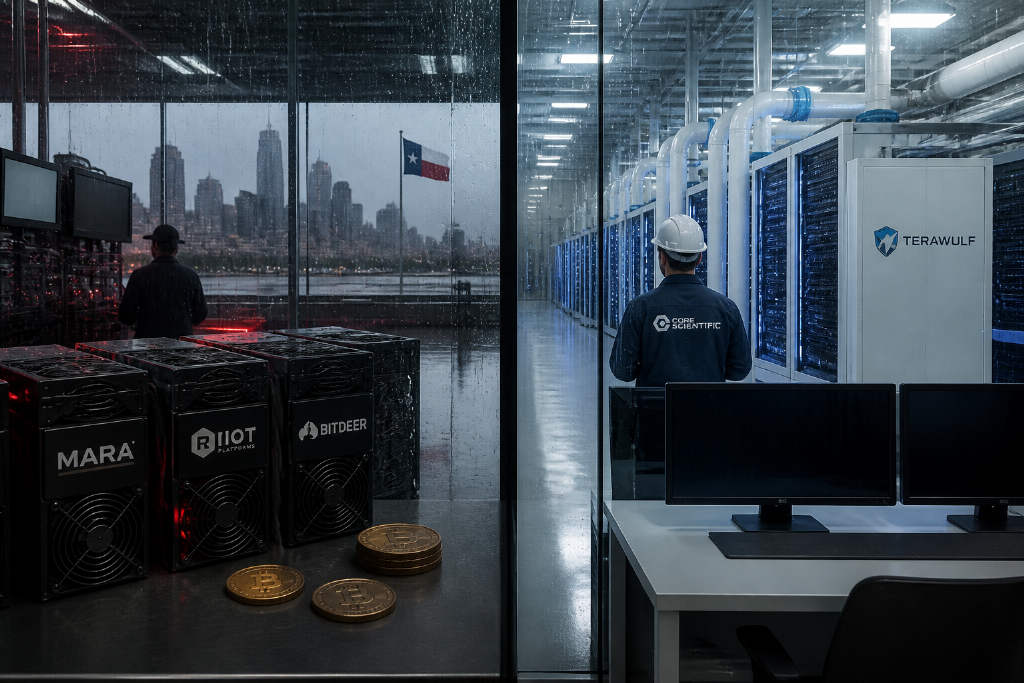
Second-quarter results from public crypto miners showed two businesses running side by side: Bitcoin mining and AI data center leasing.
MARA reported a net loss of $611.3 million for the quarter, including a $343 million unrealized fair-value loss on Bitcoin. Over at Core Scientific, high-density hosting revenue climbed from $10.6 million a year earlier to $136.7 million, making it the company’s largest source of revenue.
The contrast was clear across the earnings reports. Falling Bitcoin prices squeezed mining revenue and reduced the marked value of digital asset holdings, while completed data center delivery started to turn long-term leases into recognized rent. For the sector, the question is no longer whether miners can sign large AI deals. The harder check is how much capacity has actually been delivered, how much lease revenue is flowing into the current quarter, and how much profit remains after construction spending, depreciation and interest expense.
More Bitcoin mined did not automatically mean better earnings
The most direct pressure in the second quarter came from Bitcoin prices.
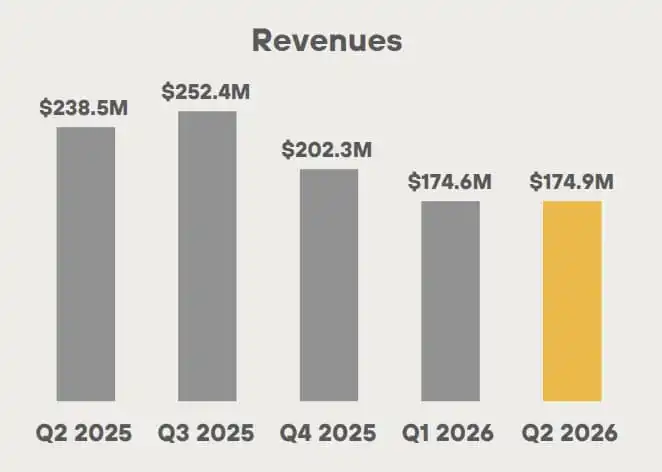
MARA mined 2,422 BTC in the quarter, slightly above 2,358 BTC a year earlier, but revenue still fell 27% year over year to $174.9 million. The company’s $611.3 million net loss included the $343 million unrealized fair-value loss on Bitcoin. Higher production offset only part of the price decline.
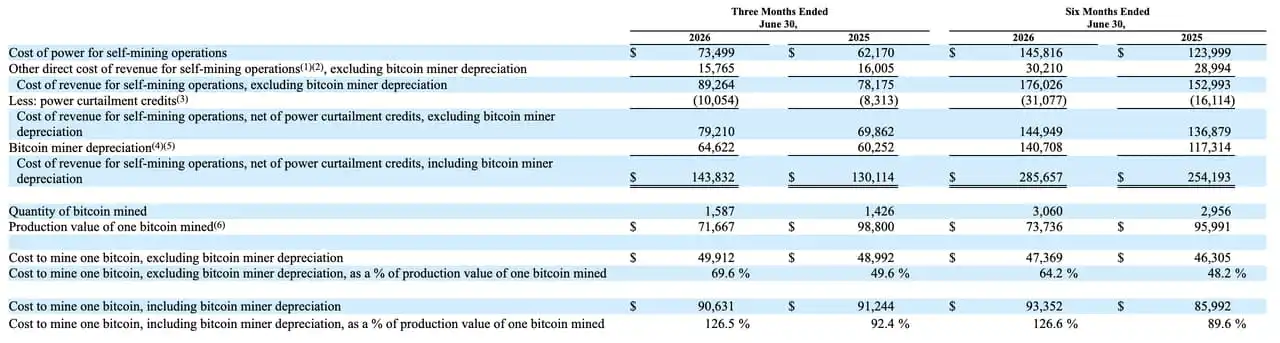
Riot Platforms offered another clear example. The company produced 1,587 BTC in the second quarter, up about 11% from a year ago, but mining revenue dropped from $140.9 million to $113.7 million. The company cited a lower average Bitcoin price and rising network hashrate. Riot’s production value per Bitcoin fell from $98,800 to $71,667, while mining cost per Bitcoin, excluding miner depreciation, rose from $48,992 to $49,912. That pushed cost as a share of production value from 49.6% to 69.6%.
That does not mean mining no longer works as a business model. It does show that scale, machine efficiency and electricity pricing have to line up. American Bitcoin mined about 932 BTC in the quarter, up about 14% sequentially. Mining revenue was about $67 million, up about 8% quarter over quarter. Its mining cost per Bitcoin was about $36,500, and gross margin was close to 50%.
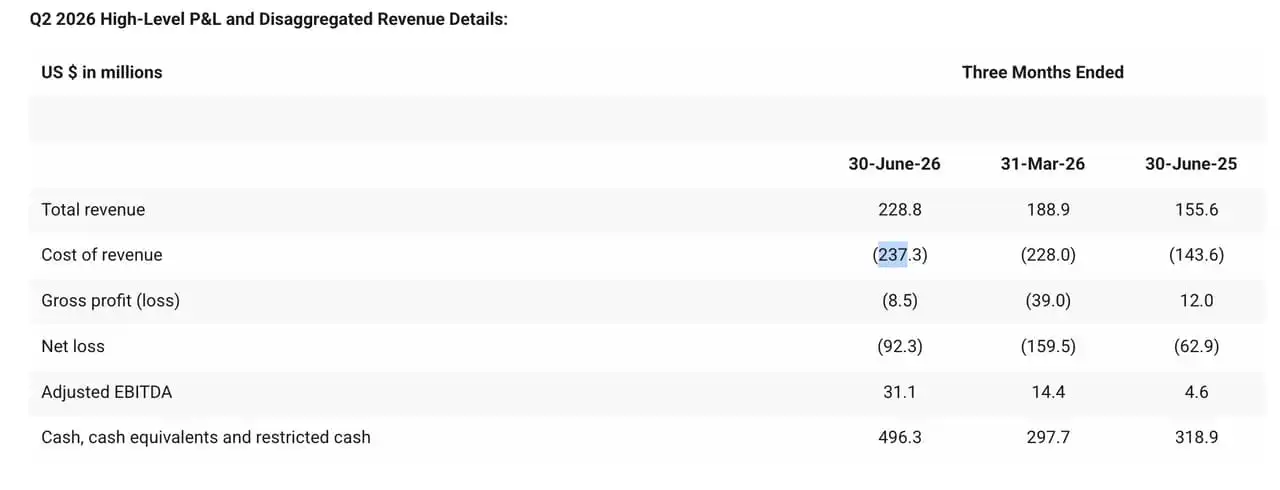
Bitdeer showed a different strain. The company mined 2,694 BTC in the second quarter, up from 565 BTC a year earlier. Total revenue rose 47% to $228.8 million, including $168.4 million from self-mining. But cost of revenue reached $237.3 million, leaving Bitdeer with a gross loss of $8.5 million and a net loss of $92.3 million. Production and revenue expanded quickly, yet electricity, depreciation and expansion costs moved even faster.
AI revenue is showing up, but not at the same stage for every miner
The real shift in the sector is that some miners are moving from selling mined Bitcoin to renting out power and data center space.
Core Scientific has moved the furthest. The company posted $164.2 million in total revenue for the quarter, with $136.7 million from high-density hosting, about 83% of the total. Self-mining revenue was only $21.5 million. A year earlier, hosting revenue was just $10.6 million. Its income base has already shifted from mining to data center hosting.
TeraWulf’s revenue mix also changed sharply. The company recorded $44.73 million in second-quarter revenue, including $31.93 million from HPC leasing, about 71% of the total, and $12.83 million from digital asset revenue. In 2025, by comparison, mining still accounted for 90% of TeraWulf’s $168.5 million annual revenue, about $150 million, although the company had already reported its first HPC leasing revenue of $16.9 million. TeraWulf has said capital allocation and operating focus will center mainly on HPC data centers, and part of its existing mining infrastructure is being converted.
Riot is still in the buildout phase. The company posted $174.2 million in total revenue in the second quarter, up 14% year over year. Data center revenue was $23.2 million, while mining revenue remained $113.7 million. That data center figure included $4.9 million of lease revenue and $18.3 million of customer data hall construction revenue. Both were booked in the quarter, but neither is large enough yet to replace mining.
Cipher Digital offered a reminder that starting construction is not the same as generating HPC revenue. The company posted about $24.84 million in second-quarter revenue, all from Bitcoin mining. Adjusted EBITDA was negative $30 million, and net loss totaled $267 million. Cipher only began delivering the first tranche of capacity for its Black Pearl project in early August and has started billing rent, so that income did not appear in the second-quarter numbers.
Hut 8 increased revenue to $74.9 million from $41.3 million a year earlier, with $72.5 million categorized as compute revenue. But that segment includes ASIC compute, AI cloud and traditional cloud services, so the full $72.5 million cannot be labeled AI revenue. Hut 8 still posted a net loss of $177.1 million for the quarter, including $138.6 million in unrealized losses tied to digital assets.

Big contract values still take time to turn into recognized revenue
One of the easiest mistakes in this transition is to treat total contract value as if it were current revenue.
Core Scientific said leased customer power capacity stood at about 1.1 GW, representing more than $24 billion in potential contract revenue, but recognized hosting revenue in the second quarter was still $136.7 million. TeraWulf signed a 20-year lease with Anthropic after the quarter, with an initial contract value of about $19 billion, yet second-quarter HPC leasing revenue was only $31.9 million. Riot signed a 191 MW data center lease after the quarter with an initial value of about $9.1 billion, while its second-quarter data center revenue was $23.2 million.
Those figures are not contradictory. Total contract value reflects revenue that may be collected over the base lease term. It usually enters financial statements quarter by quarter only after the data halls are built, delivered in phases and put into billing. Delays, changes in construction cost, financing arrangements and customer performance can all affect the pace of recognition.
That leaves three checks for comparing miners’ AI businesses:

- how many contracts have been signed
- how much capacity has been delivered
- how much revenue has been recognized in the quarter
Net income also needs to be read together with accounting items. Core Scientific posted a net loss of $1.1553 billion in the second quarter, mainly due to changes in the fair value of warrants. Cipher reported a $267.5 million net loss, including a $150.5 million fair-value loss on warrants. MARA’s loss was affected by Bitcoin price remeasurement. Bitdeer’s gross loss, by contrast, showed that cost of revenue had already exceeded revenue, which is a different kind of pressure.
Public miners are splitting into three distinct groups
The quarter’s results suggest listed miners can no longer be judged by one uniform standard.
American Bitcoin is still focused on expanding hashrate, raising output and lowering cost per coin. Core Scientific and TeraWulf already have a sizeable share of hosting or HPC revenue showing up in current statements. Riot and Cipher are in the middle, with new projects being delivered gradually.
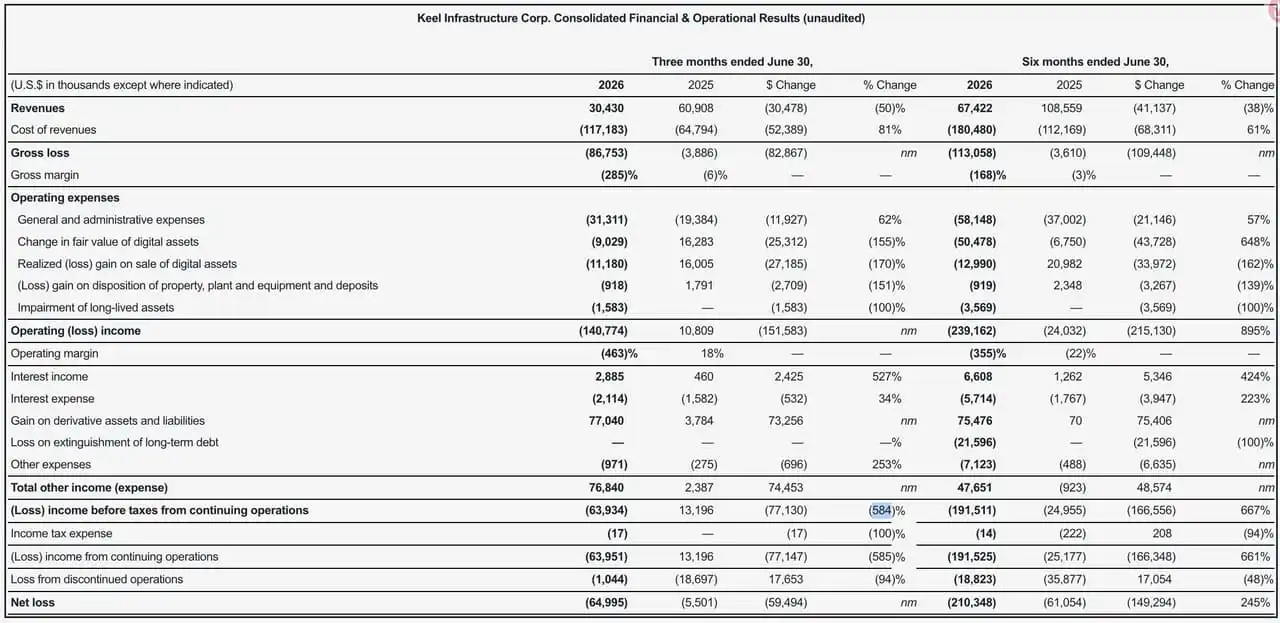
Keel Infrastructure has taken the more complete turn. The company, renamed from Bitfarms, has finished shutting down its U.S. Bitcoin mining business. Second-quarter revenue was about $30.43 million, down 50% year over year, due to lower Bitcoin prices and the closure of cryptocurrency mining operations in the Moses Lake area of the United States in April 2026. Adjusted EBITDA was negative $23.7 million. Keel has chosen to operate as an HPC infrastructure developer, but the new business has not yet built enough revenue to replace mining.
The key divide this quarter was not whether miners were talking about AI. It was how far each had already moved. Some are still relying on more machines and more output. Some are already collecting monthly rent from data halls. Others are passing through the stage where old revenue is fading before new revenue has scaled.
The mining rigs are still running. What will shape the next phase of financial results is who controls stable power, who can deliver data halls on schedule, and who can turn long-term contracts into revenue booked in the current quarter.