
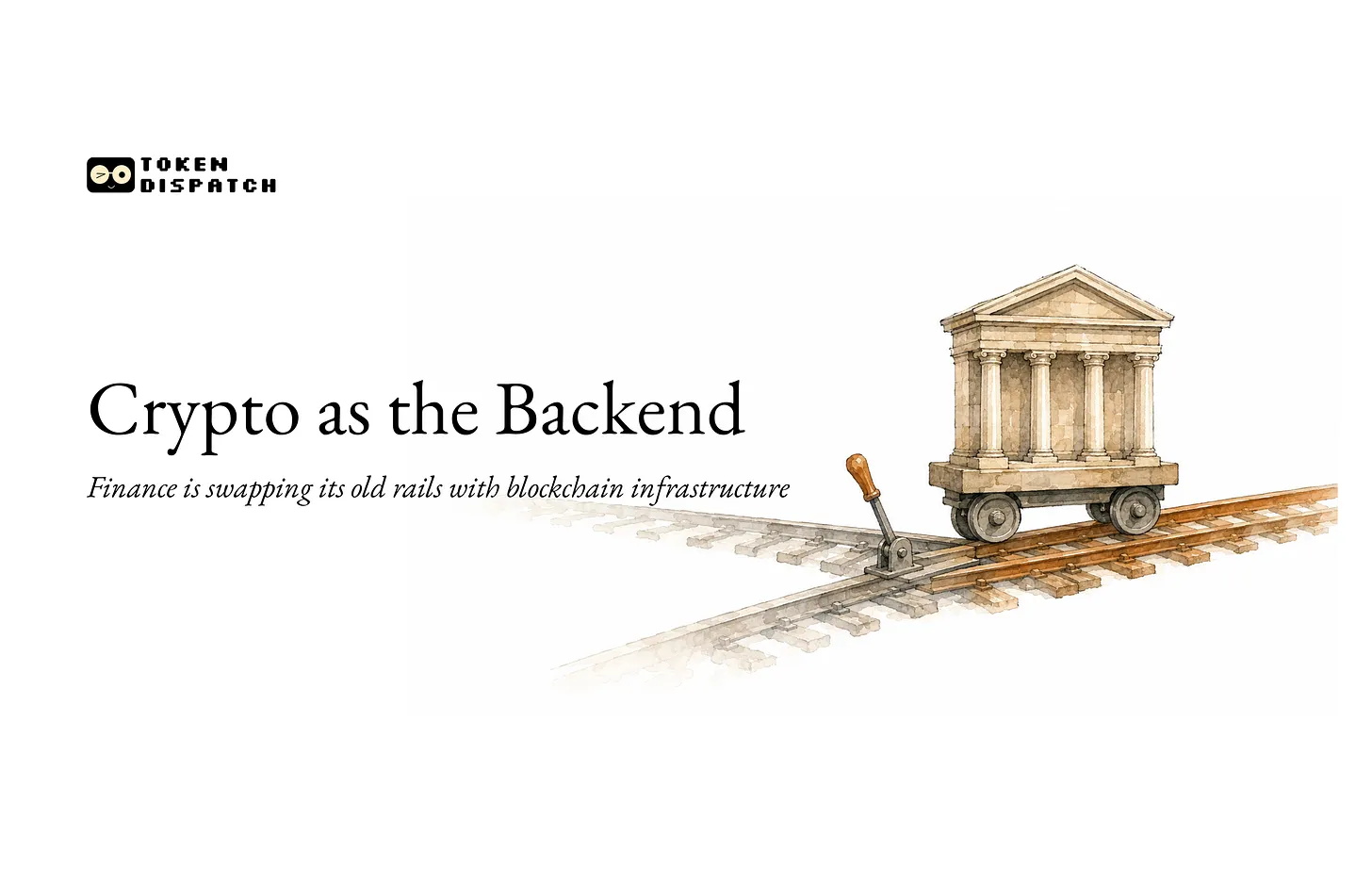
Crypto firms are no longer trying to replace Wall Street. They are charging Wall Street for technology services instead.
Written by Prathik Desai
Translated by Luffy, Foresight News
Last year, one institution processed $47 quadrillion in securities settlement, a figure the article says was more than 35 times global GDP. This month, that institution — the Depository Trust & Clearing Corporation, or DTCC — formally turned on blockchain technology to handle related transactions.
The piece frames the current phase of global finance as an infrastructure upgrade. Clearing operators are not alone. A cross-border messaging network linking more than 10,000 banks worldwide, along with card networks serving 200 million merchants, are also rebuilding the rails that move assets. In this round, blockchain is described as a core component.
Industries that spent years keeping crypto at arm’s length are now moving more quickly to adopt crypto-based back-end rails.
The article examines why traditional finance is accepting crypto infrastructure on the back end and where crypto firms fit in that transition.
The cost of old settlement systems
A Microsoft stock purchase made on the New York Stock Exchange still nominally takes a full trading day before legal ownership is transferred. The article traces that delay to infrastructure designed in the era of paper stock certificates. Markets spent more than 60 years dematerializing shares and speeding up trading workflows, yet the underlying architecture for moving cash and assets still reflects an older setup.
That is not only a convenience issue. Delayed transfers of cash and assets create direct funding costs.
In cross-border banking, for example, most global banks must pre-position funds across countries and currencies so payments can clear across time zones. They rely on local deposits and central bank reserves to complete settlement rather than moving liquidity in real time as business hours change around the world.
Even margin posted by securities traders sits idle and earns nothing. Clearing systems stop on Friday night and resume on Monday. Market participants may keep trading over the weekend, but the rules do not change. The article says the design did not originally aim to create friction, yet everyone now pays what it calls a hidden tax for aging infrastructure even as lower-cost alternatives exist.
Exchanges are responding by extending trading hours. The London Stock Exchange has announced LSE 24, scheduled to begin in the first half of 2027 with 23.5 hours of continuous trading from Monday to Friday. CME launched round-the-clock crypto futures in May. Nasdaq also plans to roll out a 23-hour daily trading service later this year.
Trading windows are getting longer, but post-trade processes still lag. Capital remains tied up, and the burden on traders grows with it.
The article says the hidden cost created by this aging system amounts to more than one-fifth of global GDP.
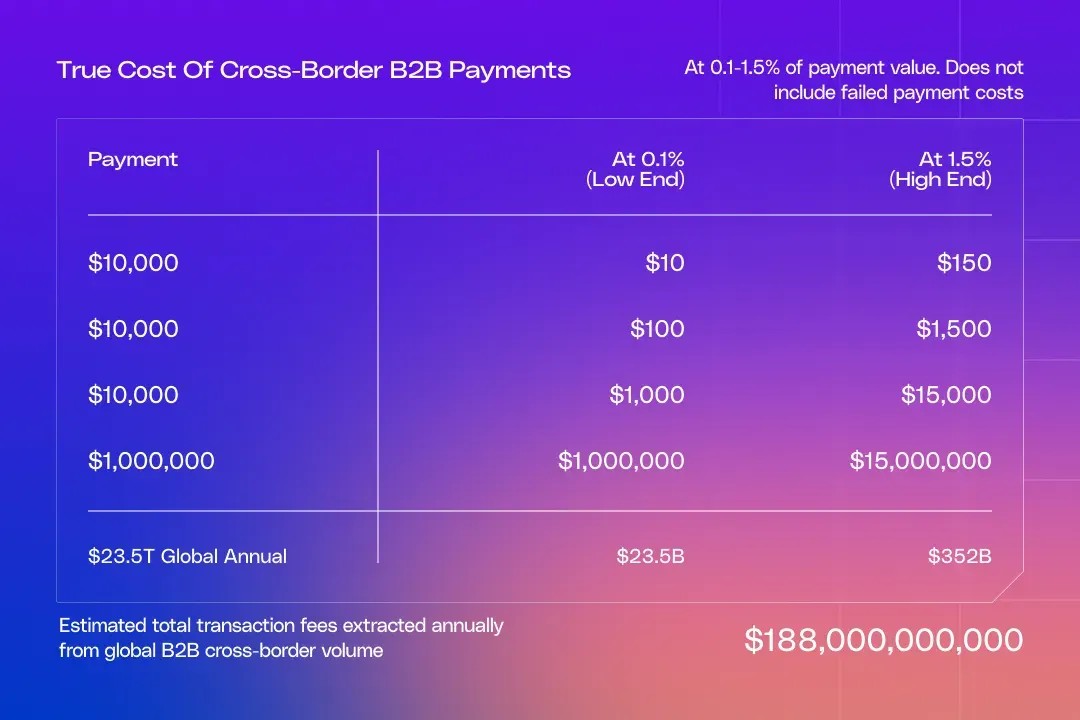
Corporate cross-border payments alone topped $30 trillion last year, generating more than $120 billion in annual transaction costs.
Operators of traditional financial infrastructure are now confronting that problem more directly. In July 2026, the industry took what the piece calls a concrete step by trying to replace old systems with crypto-native rails.
DTCC, SWIFT and Visa are all moving
On July 15, DTCC completed its first live trades in tokenized securities. The assets included tokenized versions of listed equities, U.S. Treasuries and ETFs.
In DTCC’s initial on-chain round, JPMorgan tokenized Invesco QQQ Trust, described here as one of the world’s most liquid ETFs, and posted it as collateral to CME. More than 30 institutions took part, including Goldman Sachs, BlackRock, Vanguard and the New York Stock Exchange. The tokens were used in production for repo transactions, asset pledging, securities lending and the movement of clearing margin.
Only a few months remain before DTCC’s planned October 2026 launch of tokenized services.
The article uses the change to show the economic effect of more efficient systems. In May 2024, the U.S. equity market moved from T+2 to T+1 settlement. Compressing the cycle by a single day reduced required margin held by clearing participants by $3 billion, or 23%, with the three-month average falling from $12.8 billion under T+2 to $9.8 billion.
If one national equity market can free up $3 billion of idle margin by shortening settlement by one day, the article argues, then moving cross-border settlement in stocks, Treasuries, repo and foreign exchange into minutes — while removing weekend constraints — could unlock much more capital.
That is where blockchain comes in, according to the piece. Stablecoin transfers settle in seconds, can cost only a few cents and run all year without closing. Tokenized securities can also update ownership in real time and serve as collateral at the same time, without waiting for markets to reopen on Monday.
The article presents that as the main reason infrastructure operators in traditional finance are willing to adopt crypto rails on the back end. If they do not, competitors with lower costs and faster processing can take clients away.
Crypto infrastructure removes the window in which funds sit idle and raises capital efficiency for customers. A security that settles tomorrow cannot be pledged today. A tokenized security, by contrast, can be posted or lent around the clock within minutes. Whether collateral can move freely determines whether capital works only intermittently or continues generating value.
Nine days before the DTCC test, SWIFT — which the article says connects more than 11,500 financial institutions — announced that 17 banks from six continents, including Citi, HSBC, UBS, Standard Chartered and Mitsubishi UFJ, will pilot tokenized deposits on a new shared ledger.
Tokenized deposits are bank money and are not bound by business hours. Blockchain allows funds to move at night and over weekends while claims remain with licensed banks. For institutions concerned that bank-issued stablecoins may lack Federal Deposit Insurance Corporation protection, the article presents tokenized deposits as an attractive alternative. They offer the convenience of stablecoins while staying inside the current regulatory framework.
Card networks are moving too.
On July 16, Visa crypto head Cuy Sheffield announced a new platform that lets banks issue, move and redeem stablecoins from within their existing money-management systems. The platform hides private keys, gas fees and the underlying public blockchain from clients.
For large incumbents, the attraction of using crypto infrastructure as a back end is that they can pass time and cost savings through their distribution networks to end users. Visa’s network already reaches about 15,000 financial institutions and more than 200 million merchants.
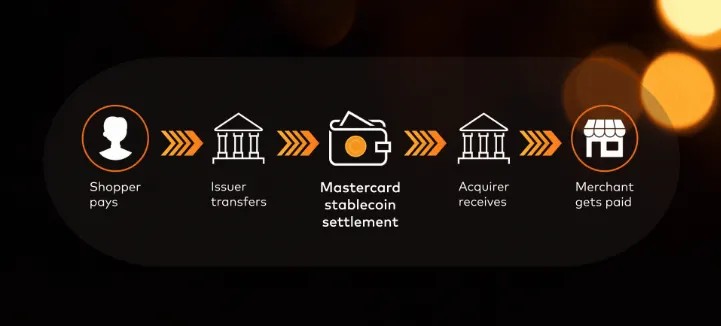
Mastercard, a Visa rival, is also expanding after earlier pilots and limited rollouts. The article says it is broadening stablecoin settlement options for partner banks and supports six regulated stablecoins: Circle’s USDC, Paxos-issued PYUSD, USDG and USDP, Ripple’s RLUSD and SoFiUSD from SoFi. Those stablecoins will run across several major chains, including Arbitrum, Base, Canton, Ethereum, Polygon, Solana, Tempo and XRPL.
Commercial use cases are already in production
Large-scale internal bank deployments are already being cited as proof that the infrastructure can handle commercial workloads. JPMorgan’s Kinexys has processed more than $4 trillion in cumulative volume, with daily transfers above $7 billion, and it continues operating even on holidays when traditional financial markets are closed.
For those still skeptical of crypto infrastructure, the article points to blockchain-based money fund examples. BlackRock’s tokenized Treasury fund BUIDL manages about $2.5 billion and is now accepted by major derivatives venues as margin collateral. Standard Chartered and crypto exchange OKX worked together to build the operating framework.
The practical value, in this telling, is simple: assets can serve as margin while still earning Treasury yield.
If anyone asks why the industry needs crypto-based rails, the article says this is the clearest answer.
Any financial innovation, it argues, should make the flow, storage and growth of money more efficient.
Crypto companies are becoming service providers
Many long-established crypto firms have found a new position in the market through that shift.
Supporters of crypto-native ideas once imagined that the industry would fully replace traditional financial institutions. The article says reality has gone in a different direction. Crypto companies are becoming the infrastructure builders that traditional finance wants to hire.
Several crypto firms worked together on DTCC’s July on-chain transaction set. Chainlink connected networks. Digital Asset’s Canton handled the movement of tokenized Treasuries. Fireblocks and BitGo provided custody. Circle and Ondo helped design supporting service arrangements for the broader working group.
These firms spent a decade building a parallel financial system. Now they are using that work to help incumbent institutions create faster and cheaper infrastructure for moving assets. Their revenue model has changed as well: they are no longer trying to displace Wall Street, but to bill Wall Street for technical services.
The same pattern is appearing elsewhere. On July 16, Ondo Finance, described here as the world’s largest issuer of tokenized stocks, announced a partnership with Japan’s SBI Group to push stock tokenization in Japan. The tokenized equity products will plug into the SBI ecosystem and settle using SBI-issued yen stablecoin JPYSC.
SBI manages more than $250 billion in assets. Building tokenization technology from scratch would be expensive, so firms are choosing to buy mature blockchain technology and pay service providers instead. Ondo currently holds more than 70% of the equity token issuance market, according to the article, and also has a distribution partnership with Clearstream Banking, part of Deutsche Börse Group in Europe. Securitize is playing a similar service role by supporting issuance of BlackRock’s BUIDL fund.
Where value may accumulate next
The article turns to shipping for a comparison. In 1956, truck driver Malcom McLean invented the standardized shipping container. Loading costs fell from $5.86 per ton to $0.16 per ton, and global trade reorganized around containers. The irony, it says, is that shipping lines captured relatively little of the upside. Containers became standardized commodities, competition turned into price wars and the biggest winners were companies that rebuilt their business models around lower-cost, reliable shipping. In this example, Walmart benefited more than Maersk.
Fintech may follow a similar script.
Containers did not reshape logistics on their own; ports, cranes, chassis and customs systems also had to change. In the same way, tokenization will need custody, compliance and interoperability infrastructure to scale. As bank settlement layers become more standardized, the article expects value to concentrate in the surrounding ecosystem. That is the lane firms such as Chainlink, Fireblocks and Digital Asset are targeting.
Tokens themselves and the base public chains may find it difficult to capture a large share of long-term value. Instead, the article says, returns are likely to concentrate in two places.
The first is the platforms that connect to crypto rails. DTCC, SWIFT and Visa can charge service fees for tokenized settlement, tokenized deposits and stablecoin activity much as they do in traditional systems. The larger opportunity, though, may sit in institutions that redesign treasury management around 24/7 atomic settlement, intraday liquidity movements and higher collateral efficiency, then offer uninterrupted working-capital services to the market. BUIDL is presented as one example because the assets can serve as margin while continuing to earn U.S. Treasury income.
After 15 years, the crypto industry has built a parallel financial system with better performance, the article concludes. In that view, builders with longer time horizons should stop reproducing the same end-user financial products and focus on the back end instead. The bigger win for crypto would be to become the infrastructure layer behind finance, making capital cheaper to move and faster to use.