
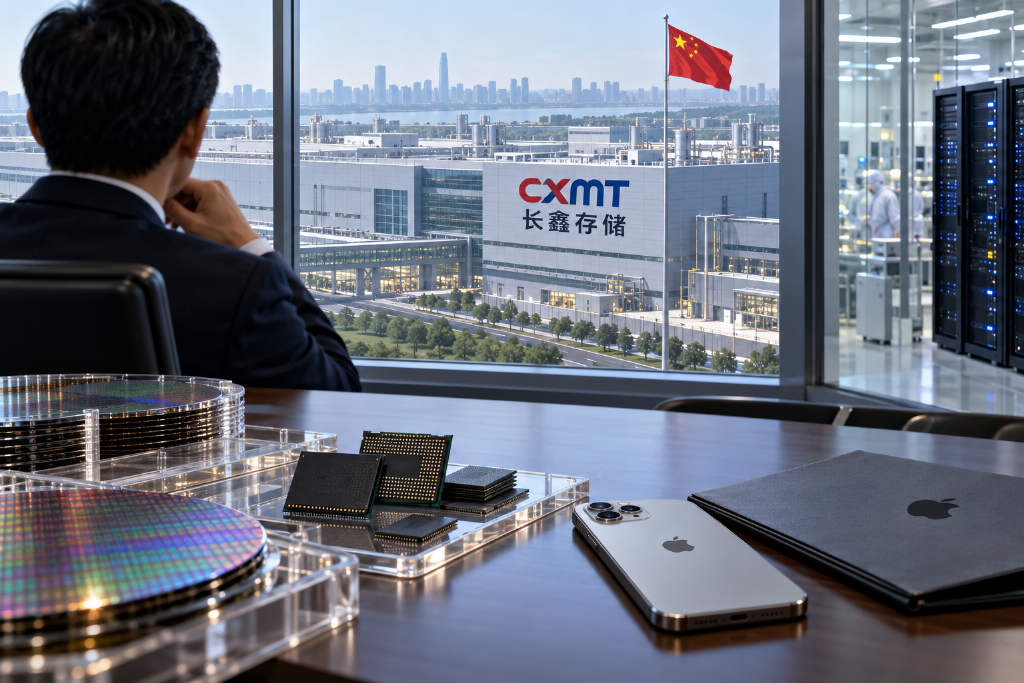
ChangXin Memory Technologies (CXMT) has twice pushed back on Apple’s DRAM pricing approach in less than three months, according to a MarsBit report. The latest case involved CXMT declining to quote for Apple’s DRAM supply demand. In August, Apple had already tried to negotiate down the price of LPDDR5X mobile DRAM from the Chinese memory maker, and those talks also failed.
In consumer electronics supply chains, turning Apple down once is unusual. Doing it twice in a row is rarer still. For more than two decades, accepting Apple’s hard bargaining position has largely been treated as part of the price of entry into the company’s supplier network.
The report points to Apple’s broader pricing posture. In a new round of negotiations in 2026, Apple asked Samsung Display and LG Display to cut the supply price of OLED panels for the iPhone 18 Pro series to $70. That compares with a previous procurement price of about $110 to $120 for the iPhone 17 Pro Max panel.
Even so, many suppliers still want access to Apple’s chain because a deal can mean large orders over several years and a strong endorsement as a high-end supplier. What is changing, the article argues, is the foundation of Apple’s leverage.
It cites economic historian Chris Miller’s book Chip War, which argues that in the computing era, control over chip capacity creates a new form of power. In DRAM, that logic is now visible in plain sight. Memory is no longer just a line item on a bill of materials. It has become a bargaining chip. That, in the article’s view, is why CXMT now has room to say no to Apple.
Why Apple came back, and why CXMT said no again
Apple’s two contacts with CXMT in the second half of this year were not identical in process, but the underlying goal was the same. Apple wanted a lower quote from CXMT than it could get elsewhere.
According to Wccftech and several supply-chain media outlets cited in the report, Apple’s target price was below the levels offered by Samsung, SK hynix, and Micron. CXMT’s response became firmer over time.
In August, CXMT told Apple that its quote could not be lower than those of Korean suppliers, and that some models using its own process technology would be priced even higher. That was still a rejection with some room left for discussion.
This time, the company shut the quotation channel entirely. Around the same time, CXMT also turned away a DDR5 memory order from a Taiwan-funded server manufacturer, the report said.
Why did Apple return for another inquiry after the August talks had already gone nowhere? The article gives two reasons.
First, Apple’s supplier evaluation process is long-term by design. One failed negotiation does not mean it stops testing a potential supplier.
Second, AI servers continue to pull in global DRAM capacity, and memory prices have kept rising. Samsung and SK hynix have both raised contract prices. The report cites The Wall Street Journal as saying that memory and storage chip prices have risen threefold since Google, Microsoft, Meta, and Amazon announced major increases in capital spending budgets last year.
The article also says former Apple CEO Tim Cook once described the current supply-demand strain in memory and storage chips as “a once-in-a-century flood.” In that setting, it makes sense for Apple to keep all qualified memory suppliers on its evaluation list and to approach CXMT more than once.
There may also be a tactical reason. South Korean semiconductor outlet Digital Daily said Apple wanted a lower LPDDR5X quote from CXMT than from Samsung and SK hynix not only to control iPhone costs, but also to use that lower number as leverage in negotiations with Korean memory makers.
The report says that view is not without support. In late July, during what it describes as Tim Cook’s final earnings call appearance as Apple CEO, he said the DRAM market was mainly controlled by three suppliers and that having more suppliers could help improve supply and have a positive effect on product pricing.
That kind of strategy is familiar: let suppliers compete on price, then take the lowest offer. It is a classic expression of bargaining power for a company like Apple. This time, though, CXMT did not go along.
Still, refusing to quote does not mean CXMT has ruled out joining Apple’s supply chain forever, and it does not mean the Chinese company now controls the relationship. The article says both sides could return to the table later, depending on how quickly CXMT expands capacity and advances its technology.
The old Apple supply-chain playbook meets the AI cycle
The report places the standoff in a longer industrial cycle.
In 2005, Cook became Apple’s chief operating officer and moved away from building Apple-owned factories. Instead, the company built a global supplier network. Apple would pay for expensive dedicated equipment and place it inside supplier plants, helping partners avoid heavy upfront capital spending. But Apple kept ownership of the equipment, and those lines had to prioritize Apple orders. The article says the industry came to call this the “Apple Bank model.”
Then came 2007 and the first iPhone. The smartphone supercycle began, and Apple’s supply chain became a major opportunity for electronics manufacturers.
In 2011, Luxshare Precision entered Apple’s supply chain by acquiring Kunshan Liantao. That year, the company posted revenue of 2.556 billion yuan and net profit of 257 million yuan. Ten years after joining Apple’s chain, its annual revenue had reached 153.946 billion yuan and net profit had climbed to 7.071 billion yuan. The report notes that 2011 was also the year Cook formally became Apple CEO.
Lens Technology and Goertek also saw major gains in revenue and profit after entering Apple’s supply chain. Together with Luxshare, they came to be seen as three of the most prominent Chinese Apple suppliers and as examples of China’s rise in higher-value core component manufacturing.
But the environment has changed. In 2026, smartphones are no longer the growth market they once were. IDC data cited in the article show global smartphone shipments at 276.3 million units in the second quarter, down 7.4% year over year. IDC also expects the consumer replacement cycle to stretch beyond 42 months this year, a record high, compared with about 24 months in 2021.
The new main storyline is AI. According to forecasts from IDC and other institutions cited in the report, the global smartphone market will reach $613 billion this year, while total AI spending will hit $2.67 trillion, up about 49.5%, and rise further to $3.63 trillion in 2027.
In the previous cycle, DRAM was essential for smartphones but never the headline feature. Now, the article says, DRAM has become a strategic resource because even the strongest GPU for large models cannot run without memory.
Where CXMT’s confidence comes from
The article argues that CXMT has been one of the beneficiaries of the AI memory cycle.
Based on the company’s recent earnings guidance, CXMT expects revenue of about 265 billion yuan to 270 billion yuan in the first three quarters of 2026, with net profit of about 131 billion yuan to 132.5 billion yuan.
The comparison with Apple-chain suppliers is meant to show the scale of the shift. Luxshare’s net profit grew about 27.5 times in the first decade after entering Apple’s supply chain, already a striking number. But CXMT’s profit swing over the past two years is much larger. In the first three quarters of this year, net profit is expected to be at least 130 billion yuan. In the same period last year, the company was still losing 5.28 billion yuan.
More important, the report says, CXMT’s current earnings growth does not depend on Apple or other overseas companies. About 90% of its capacity is now used to supply domestic customers such as Huawei, Xiaomi, and Lenovo. Xiaomi’s in-house Xuanjie 03 chip is said to use CXMT’s LPDDR6, described in the article as the world’s first commercial deployment of that product.
Put simply, whether CXMT enters Apple’s supply chain or not does not determine its current performance. That is why the article frames the company’s two rejections as a refusal to play by the old rules.
When the next round could come
The next round between CXMT and Apple may not arrive soon, but the variables are building.
Market research firm Yole estimates that meeting China’s domestic DRAM demand alone is a ten-year project. On that view, the two sides may have to wait a long time before they meet again in a serious way.
Capacity expansion, however, is moving ahead. In September, CXMT completed what the article describes as the largest IPO of the year on Shanghai’s STAR Market, then announced expansion plans. The report says capital is now being converted into catch-up speed.
According to analysis and exclusive data from Citrini Research cited in the article, if current projects stay on schedule, CXMT’s monthly DRAM wafer capacity will reach about 350,000 wafers by the end of 2026, putting it close to Micron, one of the world’s three major memory makers.
Other market information cited in the report says monthly capacity could rise from about 320,000 wafers now to 420,000 in 2027, with a longer-term target above 500,000. The faster that ramp happens, the sooner domestic demand can be met and the sooner Apple and CXMT may find themselves back at the negotiating table.
Another variable sits in the United States.
In June, media reports said Apple was actively lobbying U.S. Commerce Department officials and senior White House officials over the purchase of CXMT DRAM. CXMT is not currently on the U.S. Commerce Department’s Entity List, so private U.S. companies are not barred from buying its products at this stage.
According to the article, Apple’s goal is to secure written confirmation or assurances from the U.S. government that CXMT will not be added to the Entity List in the future. That, in the report’s reading, shows Apple does need CXMT. Well-known Apple analyst Ming-Chi Kuo has also said publicly that Apple’s pressure has moved beyond “surging memory prices” to a widening “supply gap.”
CXMT, for its part, may also need Apple in the future. A Citi research note cited in the article says a vote of confidence from Apple could help shift CXMT’s market image from “China’s domestic substitution” to “a credible global No. 4 DRAM manufacturer.”
Both sides have something the other wants, so a second round looks more like a matter of time than a remote possibility. Even then, the terms of that meeting may not be decided by either side alone.
The article closes with a reminder that CXMT’s rise is tied to the current AI memory supercycle. On a recent earnings call, an SK hynix executive said “customer demand is twice the level of supply.” If that balance changes and AI memory loses some of its current strength, the formula that worked for CXMT in round one may not carry over cleanly into round two.
For now, though, these two small wins have given the broader contest an opening.
The original article was published by the WeChat public account Xinghai Qingbaoju (ID: junwu2333) and written by Xinghai Laoju.



