
Changxin Technology is set to list on Shanghai’s STAR Market, becoming the board’s largest IPO. The company priced its offering at RMB 8.66 per share. Based on a post-offering share count of 66.881 billion shares before any over-allotment option is exercised, that gives it an implied market capitalization of RMB 579.188 billion.
The real debate starts above that number. Northeast Securities analyst Li Jiu laid out three independent ways to value the company and said the results converge at RMB 3.2 trillion to RMB 5.7 trillion after excluding minority interests. On the same day, Nomura initiated coverage with a Buy rating and a RMB 116 target price, implying about 1,239% upside from the IPO price and a market value of roughly RMB 7.76 trillion.
Why the valuation gap is so wide
The difference between the two firms comes down to two assumptions: where CXMT’s long-term DRAM market share tops out, and what kind of growth premium the market should attach to that trajectory.
Northeast Securities uses a base case of 17% long-term market share. Nomura is looking at a much bigger share opportunity and a richer valuation multiple. That is how one framework lands at RMB 3.2 trillion to RMB 5.7 trillion and the other reaches roughly RMB 7.76 trillion.
According to the source article, the higher-end numbers are not built on sentiment alone. CXMT stands out in China’s A-share market as a pure-play DRAM IDM with in-house design and manufacturing capabilities. The company is selling DDR4/5 and LPDDR4X/5/5X products and has already entered supply chains tied to Alibaba, Tencent, ByteDance and major smartphone brands. Omdia data cited in the report shows CXMT held 7.67% of the global market in the fourth quarter of 2025, ranking No. 1 in China and No. 4 worldwide.
Approach one: market-share parity points to RMB 3.49 trillion attributable equity value
The first method asks a simple question: how much market value is assigned to each 1% of forward DRAM share in globally listed peers?
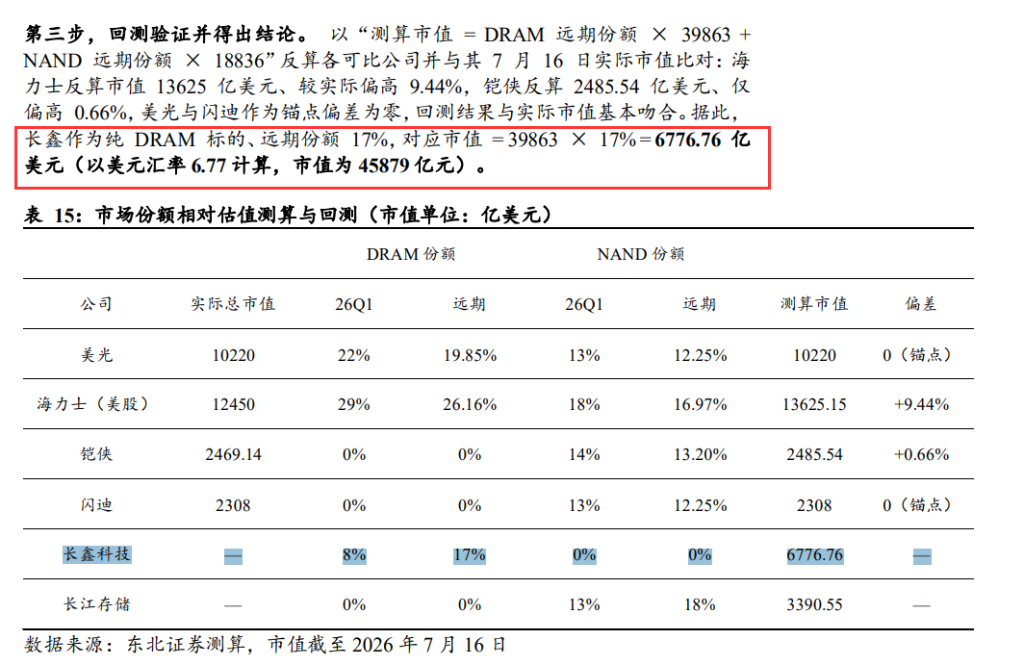
Northeast Securities starts with Micron and Sandisk, noting that both have a 13% NAND share. By subtracting Sandisk’s market capitalization from Micron’s, the report isolates the value of Micron’s DRAM business: $1.022 trillion minus $230.8 billion equals $791.2 billion. Dividing that by Micron’s 19.85% forward DRAM share produces an implied value of about $39.86 billion for each 1% of forward DRAM share.
Applying that metric to CXMT and assuming a 17% long-term share results in a market capitalization of about $677.676 billion. Using an exchange rate of 6.77, that converts to roughly RMB 4.58 trillion. After deducting minority interests of about 24%, the attributable equity value comes to around RMB 3.49 trillion.
The report also back-tested the method. On the same framework, the implied value for SK Hynix came in 9.44% above the actual market capitalization, while Kioxia was only 0.66% above. The report said those results are broadly consistent with real market values.
Approach two: earnings build-up and PE multiple imply RMB 2.85 trillion to RMB 4.27 trillion
The second method works from the company’s own earnings power rather than external market anchors.
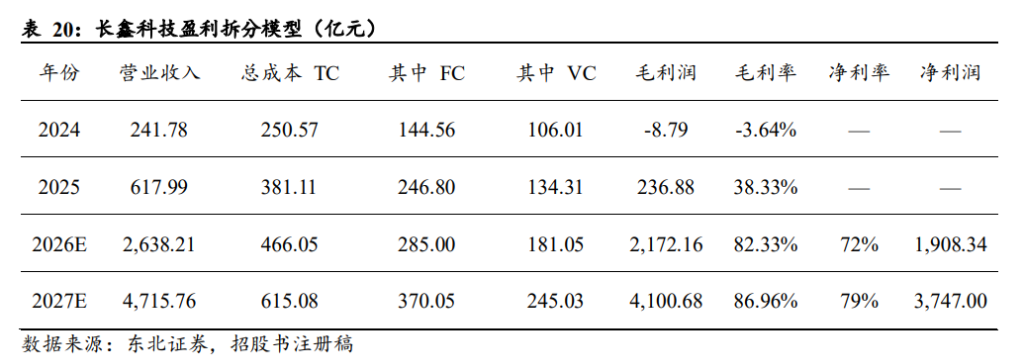
Northeast Securities said memory makers have a highly standardized cost structure. Fixed costs are dominated by depreciation and are tied to capital spending, while variable costs move roughly in line with shipment volume. Because the prospectus did not disclose actual wafer capacity, the report used gross fixed assets as a proxy for capacity, then estimated sales volume through utilization and sell-through assumptions before combining that with ASP assumptions to model revenue.
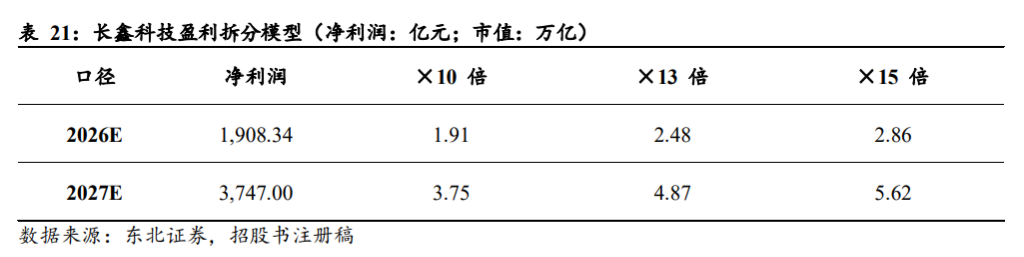
That leads to a full earnings build-up: revenue equals capacity times utilization times sell-through times ASP, while costs are split into depreciation and variable costs. On this basis, the report forecasts 2027 revenue of RMB 471.6 billion, gross margin of 86.96%, and net profit of RMB 374.7 billion on a total basis.
Assuming minority interests remain at 24%, attributable net profit would be about RMB 284.8 billion. For valuation, Northeast Securities noted that Micron and SK Hynix trade at 7.51x and 7.94x 2027 PE, respectively. Because CXMT is still in a rapid share-gain phase and its long-term share is projected at around 30%, the report assigns a growth premium and values the company at 10x to 15x PE. That produces a market capitalization of roughly RMB 2.85 trillion to RMB 4.27 trillion on an attributable basis.
Approach three: capacity-based comparison yields RMB 3.22 trillion to RMB 3.99 trillion
The third method compares enterprise value per unit of monthly wafer capacity.
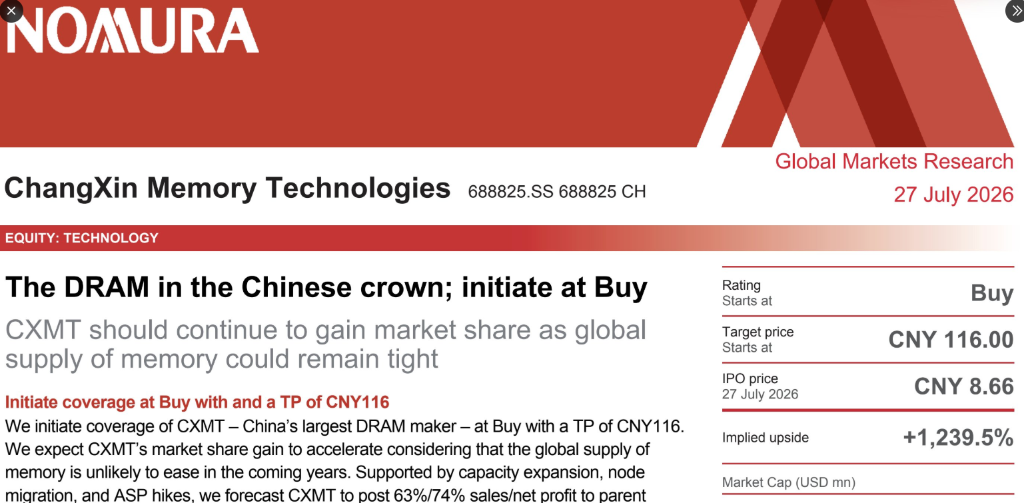
The report uses overseas memory makers as the reference set and divides their market capitalization by monthly capacity to estimate value per 10,000 wafers per month. Among the three major original manufacturers, the range is concentrated between $15.8 billion and $19.8 billion. SK Hynix stands at $16.045 billion, Micron at $19.780 billion, and Samsung at $15.891 billion per 10,000 wafers of monthly capacity.
Assuming CXMT reaches 450,000 wafers per month in 2027, the report arrives at two scenarios. In the optimistic case, using the three majors’ average of $17.2 billion per 10,000 wafers, the implied market capitalization is RMB 5.2518 trillion. In the neutral case, using a broader peer average including Taiwanese companies at $13.9 billion per 10,000 wafers, the result is RMB 4.2327 trillion. After deducting minority interests, attributable equity value comes to around RMB 3.22 trillion to RMB 3.99 trillion.
Three methods, one conclusion: RMB 3.2 trillion to RMB 5.7 trillion
Northeast Securities said minority interests are a critical adjustment item in CXMT’s case. In 2025, minority interest profit accounted for 73.76%, far above Samsung, SK Hynix, and Micron, each of which was below 1%.
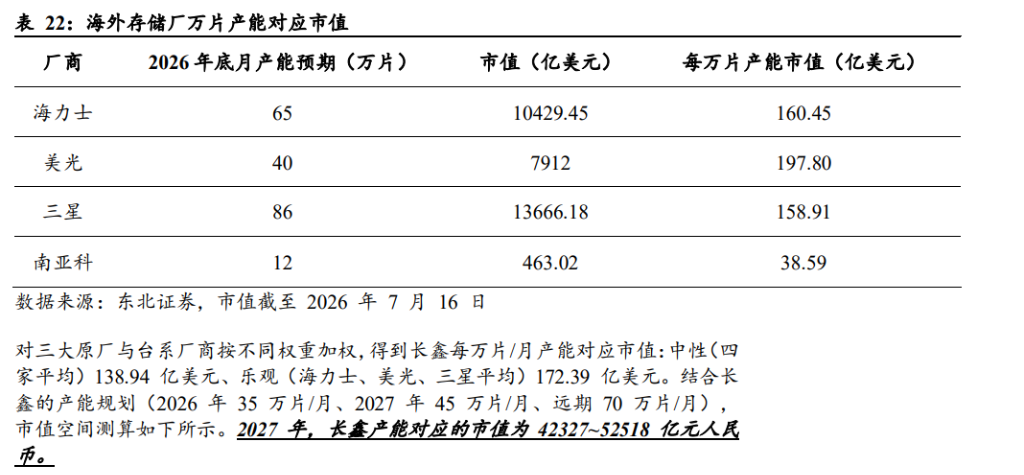
Assuming the ratio remains at 24% in 2026 and 2027, the three approaches lead to a fair valuation range of RMB 3.2 trillion to RMB 5.7 trillion after stripping out that effect.
The source article notes that while the data inputs and logic chains differ across the three methods, the attributable-equity outcomes all cluster around RMB 3 trillion to RMB 4.3 trillion. That convergence, in the report’s view, suggests the pricing is internally consistent under the current share and capacity assumptions.
Nomura: RMB 116 target price and roughly RMB 7.76 trillion market cap
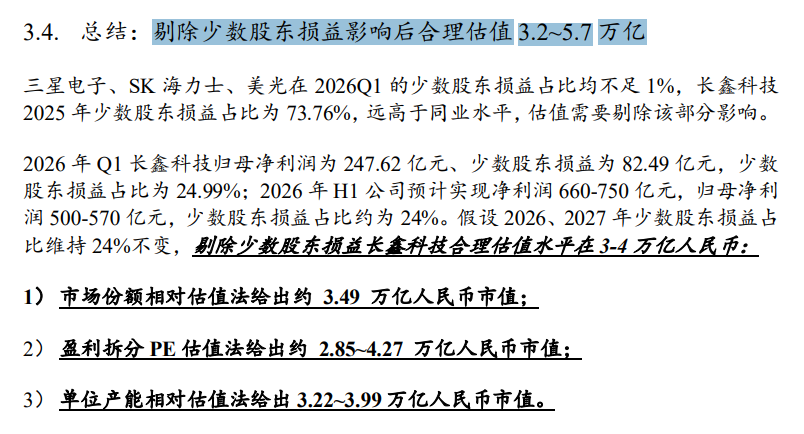
Nomura initiated coverage on July 27 with a Buy rating and a RMB 116 target price.
Against the IPO price of RMB 8.66, that target implies 1,239.5% upside and a market capitalization of about RMB 7.76 trillion. The article says Nomura’s valuation is based on roughly 20x PE, about double Micron’s current valuation of around 10x and more than double SK Hynix’s current level.
That target sits well above Northeast Securities’ upper bound of RMB 5.7 trillion. The roughly RMB 2 trillion gap reflects different views on CXMT’s eventual market-share ceiling and on the growth premium it deserves.
Nomura’s case rests on three calls
Nomura’s 20x PE framework is built on three judgments.
First, it expects structural tightness on the supply side to last for years. Its core view is that global memory supply is unlikely to become loose over the next several years. Samsung, SK Hynix, and Micron have shifted a large share of capital spending toward HBM and advanced process nodes, which structurally limits new supply for commodity DRAM. In that setup, the commodity DRAM market where CXMT operates stays undersupplied for an extended period rather than reverting to the old memory cycle pattern.
Second, Nomura argues that CXMT’s market-share gains should accelerate rather than move in a straight line. As capacity expands and process technology migrates from the fourth generation to the fifth, the firm expects CXMT to gain share faster than the market currently assumes. Starting from roughly 8% share today, the implied long-term share in Nomura’s model is clearly well above Northeast Securities’ 17% ceiling. Back-solving from the RMB 7.76 trillion target market value suggests a share opportunity in the 25% to 30% range, or possibly higher.
Third, Nomura ties the stock to both import substitution and AI-driven demand. It sees CXMT not only as a memory-cycle name but also as a domestic substitution story. Chinese cloud providers and smartphone manufacturers are increasingly willing to source domestic DRAM, creating additional demand outside the global cycle. At the same time, AI servers are driving exponential growth in DRAM demand, and DRAM content per server is nearly 80 times that of a smartphone. Nomura argues that this shift in demand mix should keep ASPs on a higher long-term base and justify a premium valuation relative to overseas peers rather than a discount.
In the article’s phrasing, Nomura does not view 2026 as a peak. It views it as a starting point.
Forecasts and market data behind the more aggressive model
Nomura forecasts sales and attributable net profit growth of 63% and 74%, respectively. The drivers it cites are capacity expansion from 270,000 wafers per month in 2025 to 450,000 in 2027, higher value per wafer as process migration advances, and continued DRAM price gains under a tighter supply backdrop.
The article says Nomura’s earnings forecast is more aggressive than Northeast Securities in absolute terms, and the 20x PE assumption magnifies the valuation outcome even further.
Supply-demand data is presented as another supporting factor. Global commodity DRAM capacity estimates still show a gap in 2027. DRAM contract prices in the first quarter of 2026 jumped 93% to 98% quarter on quarter, well above earlier expectations. CXMT’s gross margin reached 79.16% in the first quarter of 2026, while attributable net profit for the quarter came in at RMB 24.762 billion.
As the source article puts it, the height of the price cycle is changing the inputs across all valuation models in real time.
From China’s first self-produced 8Gb DDR4 to global No. 4 in seven years
The article traces the company’s rise back to 2019, when Changxin Technology’s predecessor, Ruili Integrated, launched mainland China’s first self-produced 8Gb DDR4 to reach mass production. That marked a breakthrough from zero to one for domestic DRAM.
Seven years later, the company ranks No. 1 in China and No. 4 globally. Omdia data cited in the article shows a 7.67% global share in the fourth quarter of 2025.
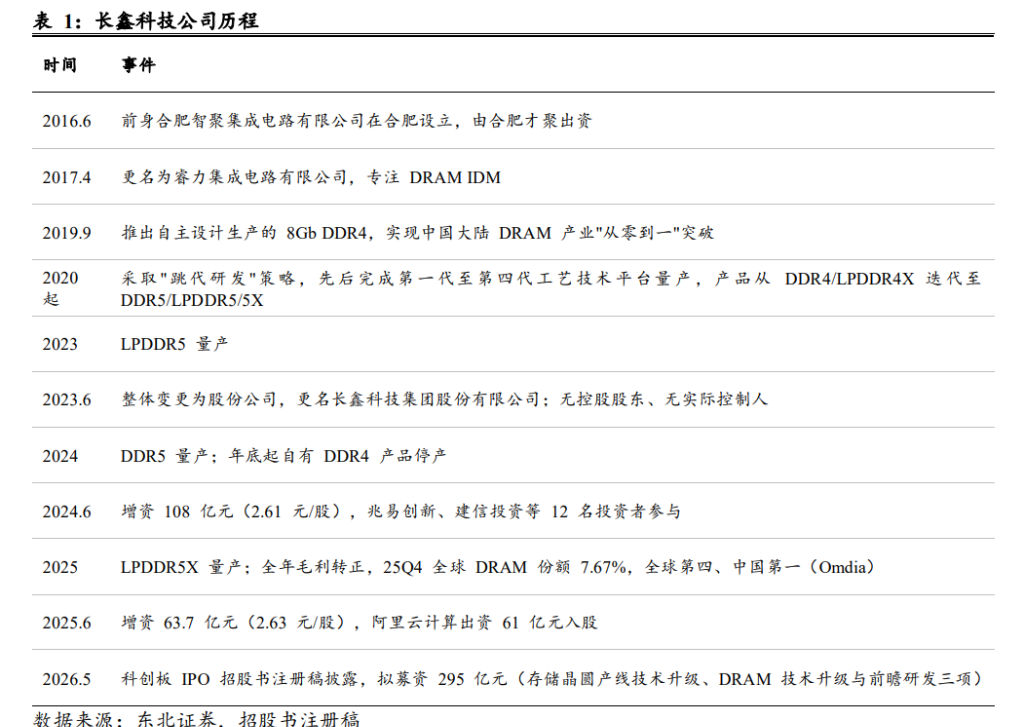
Its lineup now spans DDR4/5 and LPDDR4X/5/5X. At the end of 2024, the company stopped producing its own DDR4 and shifted capacity fully toward higher-value products such as DDR5 and LPDDR5/5X. Customers include Alibaba, Tencent, ByteDance and major smartphone supply chains.
On manufacturing capacity, the company operates three 12-inch wafer fabs, two in Hefei and one in Beijing. Northeast Securities expects total capacity to rise from 270,000 wafers per month in 2025 to 450,000 in 2027, lifting its global share from 14% to 17%.
Profit inflection point and the main risks flagged by the report
The source article describes CXMT’s financial path as typical for a capital-intensive memory maker: fixed costs are front-loaded during downcycles and produce losses, while profits expand quickly once pricing turns.
- 2025: attributable net profit swung from a loss of RMB 16.340 billion to a profit of RMB 1.875 billion, while blended gross margin rose to 40.99%, roughly in line with Samsung’s 39.38%.
- Q1 2026: quarterly revenue reached RMB 50.8 billion, up 719% year on year; gross margin was 79.16%; attributable net profit was RMB 24.762 billion.
- First half of 2026: management guided for revenue of RMB 110 billion to RMB 120 billion and attributable net profit of RMB 50 billion to RMB 57 billion.
The main driver behind the earnings surge is price. TrendForce’s latest survey in June 2026 showed commodity DRAM contract prices in the first quarter rose about 93% to 98% from the previous quarter, far above the earlier forecast range of only double-digit gains.
Northeast Securities also listed four major risks:
- Demand may fall short of expectations if AI server construction slows or consumer electronics recovery weakens.
- Prices may enter another cyclical downturn; in 2022 and 2023, DRAM prices experienced a deep slide of as much as 50% from prior-cycle levels.
- Capacity expansion and technology upgrades may miss expectations, especially if development of the fifth-generation process platform lags.
- International trade friction and supply-chain constraints may intensify if geopolitical tensions rise.