

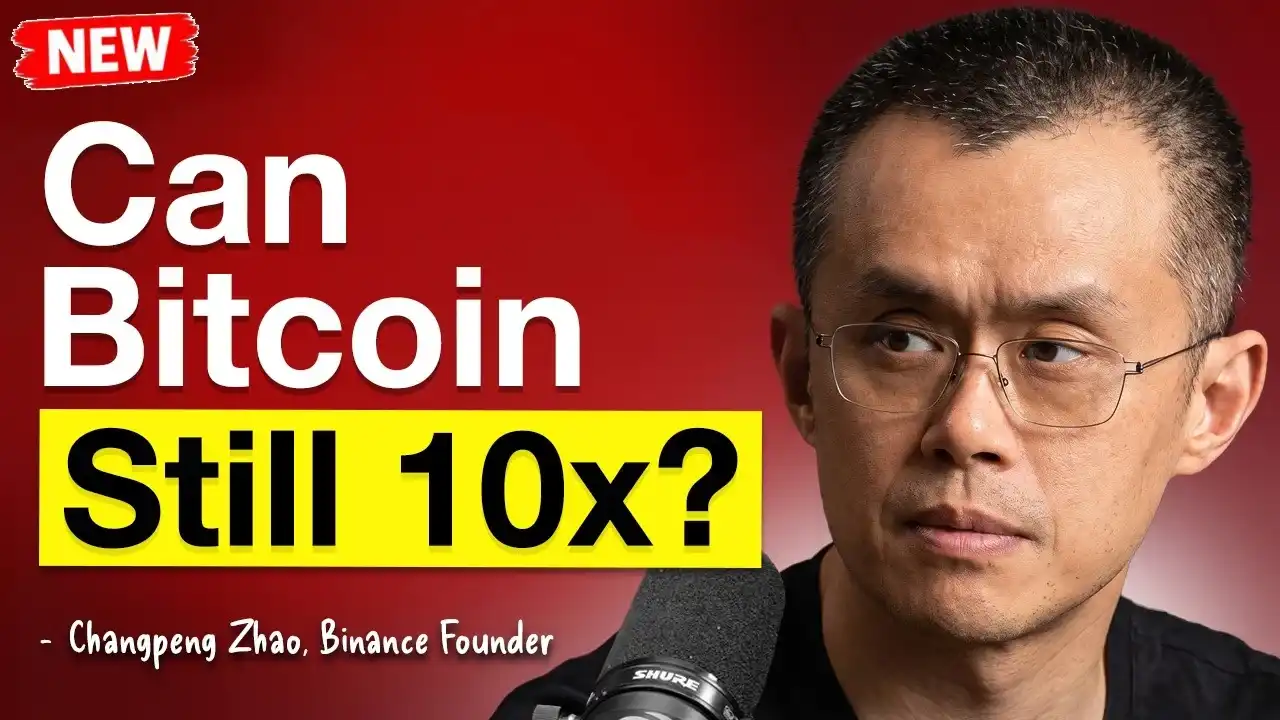
Binance founder Changpeng Zhao, or CZ, said Bitcoin reaching $1 million would be "a good thing" and would likely take less than 25 years, though he said utility matters more than the price target itself. In an interview on the When Shift Happens podcast, Zhao said Bitcoin still needs to scale as a payment tool and become part of retirement allocations and reserve assets.
Price matters, but adoption matters more
Asked what would need to happen for the next 25 years to be defined as a "Bitcoin century," Zhao said a $1 million Bitcoin would help, but added that the larger milestone would be broad real-world use. He said Bitcoin payments need to happen at scale and that the asset needs to become part of retirement systems and reserve holdings.
Zhao also said people tend to overestimate change in one year and underestimate change over 10 years. He argued that major infrastructure will be built over the coming decade. In his view, traditional finance has changed its stance toward Bitcoin dramatically over the last two years, while tokenized stocks have surged in just the last few months. He described the current moment as the best time in history, with opportunity directly in front of the market.
Tokenization and Bitcoin are complementary
Zhao said tokenization and Bitcoin should not be treated as rivals. Bitcoin itself is not the chain where tokenized assets are being issued today, he said, but activity on other blockchains still helps the broader crypto ecosystem. His view was simple: what is good for Bitcoin is generally good for the rest of the sector, and the reverse can also hold.
He used the example of Asian investors trying to buy US stocks. Opening a brokerage account can be difficult, and time-zone differences make trading harder. If those stocks are tokenized, access could open up through crypto platforms. Zhao said that process could also give those users Bitcoin exposure they did not previously have, creating a compounding effect over time. He called crypto an ecosystem rather than a zero-sum market and said Bitcoin has evolved from an individual technology into an institutional asset, with the potential to become a sovereign strategic holding.
Bitcoin does not determine the strength of governments
On whether Bitcoin ultimately weakens governments or strengthens the ones that adopt it early, Zhao said Bitcoin itself does neither. The outcome, he said, depends on what governments choose to do.
He argued that weaker governments have at times produced some of the strongest economies. Using the US as an example, he said the country’s four-year election cycle and friction between political parties may look inefficient, but can leave more room for industries to grow. He contrasted that with former US Securities and Exchange Commission Chair Gary Gensler, who he said tried to pull everything under one roof and ended up stopping growth.
Zhao added that Bitcoin is decentralized by design and gives individuals more sovereignty, but he also said its privacy is "a bit flawed" because on-chain transactions are easy to trace. Technology does not decide how much power a government should have, he said. Governments do. To make that point, he said taxing every transaction at 36% would still mean 36% of zero is zero, and in practice would leave authorities with no tax revenue at all.
Governments are paying closer attention, but frameworks remain limited
Zhao said most countries are now taking crypto relatively seriously, but only a small number have built formal regulatory frameworks. In his telling, many leaders are older, slower to accept new technology, and more exposed to negative coverage from traditional media, which leaves them cautious.
Even so, he said the direction of travel is clear. Zhao said he has met leaders around the world and that none of them deny crypto is a new technology or deny that adoption is necessary. Asked whether those officials are simply following the trend or are actually thinking about their countries’ futures, Zhao said nearly everyone he meets falls into the second camp.
He did add a caveat. Some countries, he said, are acting only because they feel they have to. In those cases, the regulatory structure is often restrictive, more of a public-relations exercise than a working framework, with licenses delayed and little actual implementation. Countries that actively invite him, he said, are usually already crypto-friendly.
His advice to governments: framework, reserves, stablecoins, tokenization
If he were advising a major government today, Zhao said there are four areas it should consider.
- Build a crypto regulatory framework and make sure it can be revised and updated over time.
- Create a strategic crypto reserve, which he said will matter over the long run.
- Issue a domestic stablecoin and move the national currency on-chain to capture liquidity.
- Push tokenized assets beyond stocks to include rare earths, real estate, cultural and art assets, and intellectual property.
He said many countries already see tokenization as a way to attract capital.
UAE leads in Zhao’s view; US is moving through stablecoins and the CFTC
Asked which countries are moving fastest, Zhao said different jurisdictions are advancing in different areas. He said the United Arab Emirates is the most likely leader on regulation, adding that Abu Dhabi Global Market, or ADGM, has granted binance.com what he described as an almost full-product global license.
In the US, Zhao said policy attention is centered on stablecoins, while the Commodity Futures Trading Commission, or CFTC, is moving quickly at the federal level on futures and derivatives licensing. He called that good for the industry. He also said Japan is fairly forward-looking, Hong Kong is moving quickly, and Singapore is more conservative. Pakistan, Kazakhstan, and Kyrgyzstan are also moving fast, he added, and said he would visit the first two countries the following week.
Zhao says Bitcoin will surpass gold
On whether Bitcoin could become more important than gold if countries begin treating it as a strategic reserve asset, Zhao was unequivocal. "Definitely," he said.
He acknowledged that large countries will need years to shift because they already have established valuation systems and holding mechanisms for gold. But he said the transition is inevitable and argued that Bitcoin is a better asset than gold. He noted that Peter Schiff would disagree and said the two have debated the issue before. Still, Zhao said Bitcoin and gold are now separated by only about a 10x gap, and that the change could come as soon as the next bull market.
A market-cap approach to sovereign crypto reserves
If asked to design a national crypto reserve portfolio, Zhao said his answer would be straightforward, and by his own description, a little self-interested. He said governments could take the top five cryptocurrencies by market capitalization, remove dollar stablecoins they may already hold, and allocate by market-cap weight.
That approach, he said, is the simplest and the most market-driven. In most cases, Bitcoin would account for more than half of the portfolio, Ether would make up around 10% to 20%, and BNB would also be included.
He used that point to argue again for a multi-chain market. If the industry had only Bitcoin, he said, growth would be slower. Other chains, including Ethereum and BNB Chain, help expand Bitcoin as well.
AI agents will likely start with stablecoins
Asked what kind of money billions of AI agents might use if they one day buy, sell, negotiate, and transact automatically, Zhao said the answer will be crypto.
He said the most likely path starts with stablecoins. Once systems can receive stablecoins, adding Bitcoin becomes easy, and from there usage could extend to BNB, Ether, Solana, and other crypto assets. Zhao also said some top AI companies may want to issue their own tokens and that he has spoken with several leading AI companies about how token issuance could work.
He tied that possibility to the cost of compute infrastructure. Building data centers is extremely capital intensive, he said. About $30 billion to $50 billion is needed for 1 gigawatt of computing power, and some companies want to build hundreds of gigawatts over the next few years, implying spending in the trillions of dollars. In that environment, Zhao said, a "data center token" that shares revenue with holders is not out of the question.
Trading may come before payments for AI
The host also asked whether AI will first help people make payments or first trade on their behalf. Based on Zhao’s conversations with top AI companies, payments are not the immediate priority. Those companies, he said, are focused first on making agents smarter and better at finding the best deals.
Trading may arrive sooner because speed matters more there, and AI is better suited to placing orders quickly. Zhao’s expectation is that Bitcoin will continue to function as savings, while stablecoins and other crypto assets handle machine-to-machine commerce and trading.
Over time, he added, once payment rails are in place, people may spend the crypto they already hold directly instead of converting into stablecoins first. Speaking for himself, Zhao said he holds BNB and some Bitcoin, and usually spends BNB through the Binance Card without paying much attention to the exchange rate at that moment.
What he wants to contribute
Asked what contribution he hopes to leave behind in a future "Bitcoin century," Zhao said he does not really know.
His mindset, he said, has always been to do his best: contribute a little when he can do a little, and contribute more when he can do more. He said he believes he has done what he could so far and intends to keep doing that.