


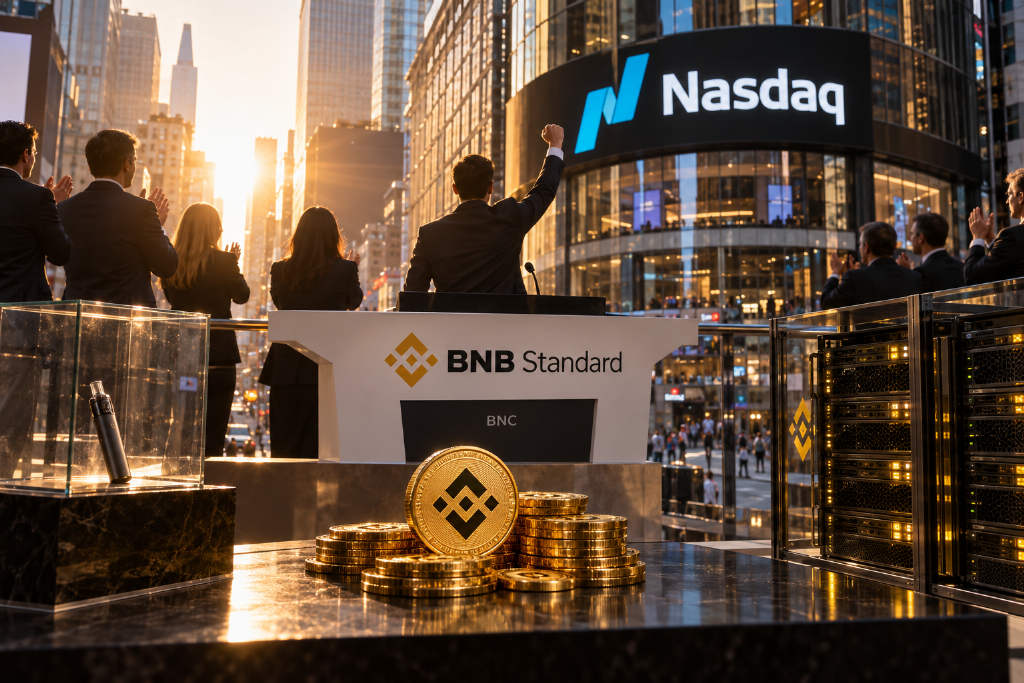
Changpeng Zhao, better known as CZ, appeared at Nasdaq on Oct. 26 with the management team of BNB Standard, the company trading under the ticker BNC, for a bell-ringing ceremony. The appearance put fresh attention on a company that has spent the past year moving from a high-profile treasury trade into a more complicated restructuring story shaped by a stock pullback, governance disputes and a board overhaul.

How BNC got here
The company’s current form traces back to July 2025, when it was still a U.S.-listed e-cigarette business. Backed by YZi Labs, it announced an approximately $500 million financing plan with 10X Capital and said it would pivot into a BNB treasury company. Its ticker changed from VAPE to BNC, and it quickly became one of the standout names in the crypto-equity wave.
That momentum did not hold. While BNC faded from the center of market attention, a fight over control of the company was building in the background.
As the stock retreated from its highs, tensions between YZi Labs and 10X Capital, which was responsible for asset management, became public. According to SEC filings cited in the source article, the two sides had signed a 20-year asset management agreement with an annual management fee of 1.75%.
YZi Labs argued that the fee structure was too high and said the company had governance problems. It also accused the prior management team of considering a shift away from the BNB treasury strategy toward other assets including SOL. The dispute escalated and turned into a battle for board control.
In May 2026, BNC sued 10X Capital, asking the court to declare the asset management agreement invalid and to recover related fees.
A turning point came in June 2026. BNC and YZi Labs reached a governance cooperation agreement, and three people joined the board, including YZi Labs head Ella Zhang and former investment partner Alex Odagiu. Odagiu later took over as CEO, the company rebranded as BNB Standard, and it said it planned to operate validator nodes on BNB Chain. That marked a shift from simply holding BNB to taking a more active role in the ecosystem.
After moving through the crypto-equity boom, governance conflict and management reshuffling, BNC entered a new phase in October. The Nasdaq ceremony on Oct. 26 became the latest marker in that transition.

Who is Alex Odagiu
Alex Odagiu has been one of the central figures in BNC’s governance reset.
He graduated from the University of St Andrews in the U.K. and worked earlier in Goldman Sachs’ investment banking division before moving to the technology investment firm LetterOne. In 2021, he joined Binance Labs when the investment team had about five people. He rose from investment manager and became an investment partner at YZi Labs in 2025.
During five years at YZi Labs, Odagiu focused on token, equity and strategic investments. The source article says he was involved in investments tied to Aptos, Mysten Labs, the developer behind Sui, as well as Canton, Hemi and Concrete, spanning DeFi, real-world assets, stablecoins and blockchain infrastructure.
He also served for 10 consecutive seasons as a mentor and judge for the BNB Chain MVB accelerator, helped advance investments in ecosystem projects including Avalon and Aspecta, and took part in YZi Labs’ EASY Residency startup incubation program.
His connection with BNC did not begin this year. The article says he was already involved in governance discussions around the company in 2025 and was recommended by YZi Labs as interim CEO near the end of that year, though the then-board did not support the move. Only after the June 2026 governance agreement did he join the board and become interim president, before formally taking over as CEO in October.
That means nearly a year passed between his early involvement in BNC governance and his formal appointment to run the company. His previous work centered on investing and incubation. Now he is responsible for operating a listed company and delivering shareholder returns.
What BNC says it wants to do next
When Odagiu formally became CEO on Oct. 19, he laid out two goals: increase the amount of BNB backing each share, and build real operating businesses on BNB Chain, starting with validator node operations.

On the treasury side, BNC used a familiar crypto-equity playbook last year. It sold stock to institutional investors and used the proceeds to buy BNB. In August 2025, the company completed an approximately $500 million private placement and then built a reserve of more than 510,000 BNB, making it the largest publicly listed corporate holder of BNB, according to the source article.
The second question is how to make those BNB holdings generate income. BNC’s answer is to run BNB Chain validator nodes. Under the company’s plan, professional infrastructure service providers will handle node operations, while the BNB itself will remain with qualified custodians.
This is different from simply delegating BNB to outside validators. BNC plans to operate its own nodes, which would allow it to earn staking rewards on its own holdings, attract delegated stake from other token holders and collect commissions from those delegated rewards.
Validator rewards on BNB Chain mainly come from network transaction fees rather than ongoing BNB issuance. That means node economics depend on fee generation on-chain, the amount of delegated stake a validator attracts and block production performance. If application usage and transaction activity on BNB Chain continue to grow, BNC’s validator business could benefit as well.
Using the current reference staking yield on BNB Chain of about 0.6% to 1%, the article estimates that if BNC were to stake its entire existing reserve, it could theoretically earn an additional 3,000 to 5,200 BNB per year. At the current token price cited in the source, that would equal roughly $2.3 million to $3.8 million.
What this could mean for the BNB ecosystem
The source argues that the value of crypto treasury companies to a public blockchain may go beyond creating buy pressure for the token. It points to Forward Industries, a Solana treasury company, as a reference case. That company not only holds SOL and runs validator nodes, but has also started investing directly in projects built on Solana.
In May 2026, Forward Industries and RockawayX co-led the $5 million Series A financing of OnRe, an on-chain reinsurance project on Solana, and committed up to $25 million in liquidity support. Rather than stopping at buying SOL, that capital went into a specific application in the Solana ecosystem. The article says that structure can both create a return opportunity for the company and supply funding needed by on-chain financial products.

That example suggests a broader model. A listed treasury company can raise capital in public markets and then channel those resources back into a blockchain through staking, infrastructure and ecosystem investment.
Seen that way, the crypto-equity model is shifting from one-way ownership of digital assets toward a two-way relationship between listed companies and public-chain ecosystems. The chain can create asset value and operating opportunities for the company, while the company can use its financing capacity, capital and business resources to support ecosystem development.
BNC already has a large BNB reserve, and Odagiu brings years of investment experience from YZi Labs and familiarity with the BNB Chain ecosystem. The source article says BNC could become an important participant linking traditional capital markets with BNB Chain.
A changing crypto-equity playbook
Looking back over the past year, the first phase of the crypto-equity boom focused on raising money to buy tokens. Now, companies in the sector are testing staking, validator operations and ecosystem investment. The playbook is changing.
The article says MicroStrategy showed that traditional capital markets can become a major funding source for crypto assets. A newer group of crypto treasury companies is now exploring how those assets can produce recurring income and, in some cases, help drive the development of the underlying blockchain ecosystem.
In that framework, a listed company is no longer only a holder of crypto assets. It can also become a bridge between traditional capital and the on-chain economy.
