



Diffusion Intelligence has released Clover-35B-A3B-Preview, a new diffusion language model positioned for agent-style workloads including code generation, web interaction, tool calling and HTML creation.

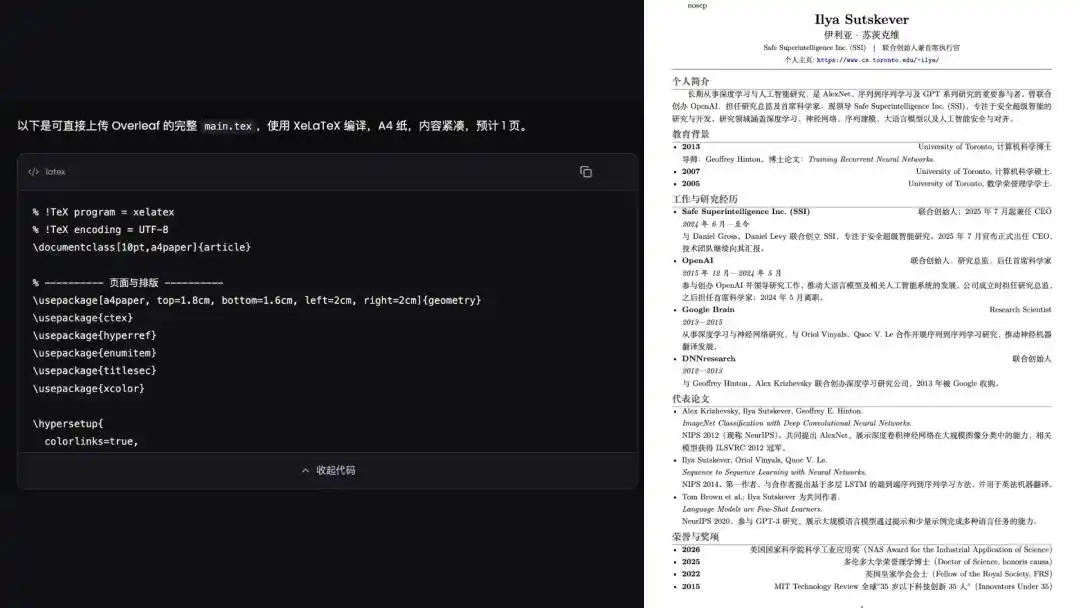
In the demonstrations described in the source article, the model behaves much like a conventional large language model from a user standpoint. Speed, though, is the first thing emphasized. In one example, Clover spent about one second thinking and then took roughly four to five seconds to produce an interactive solar system simulator. In another, it turned a batch of resume information into LaTeX resume code in about ten seconds.
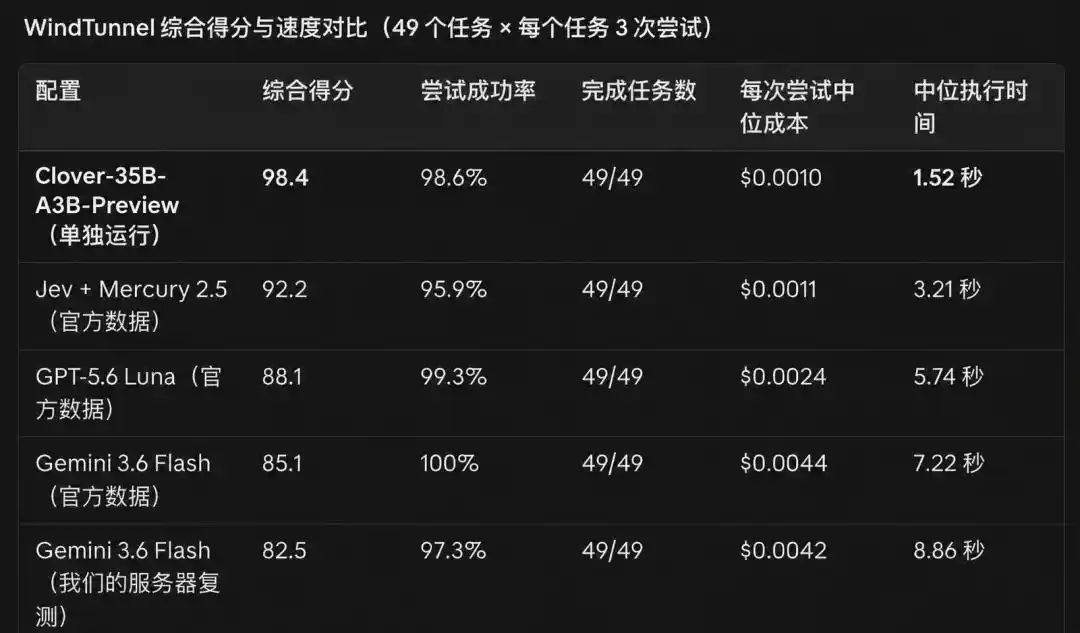
WindTunnel results put Clover ahead of the Jev + Mercury 2.5 setup on speed
Diffusion Intelligence shared benchmark data from WindTunnel, a web-agent evaluation covering 49 tasks, with each task attempted three times. Clover recorded a median execution time of 1.52 seconds. The Jev + Mercury 2.5 combination came in at 3.21 seconds, meaning Clover used less than half the time.
Reported success rates were also slightly higher for Clover at 98.6%, versus 95.9% for Jev + Mercury 2.5. The source article also says Clover was several times faster than Gemini in the same table.
35 billion parameters with an MoE design
Clover-35B-A3B-Preview uses a mixture-of-experts architecture, with 35 billion total parameters and about 3 billion parameters activated per token. The model also supports a thinking mode.
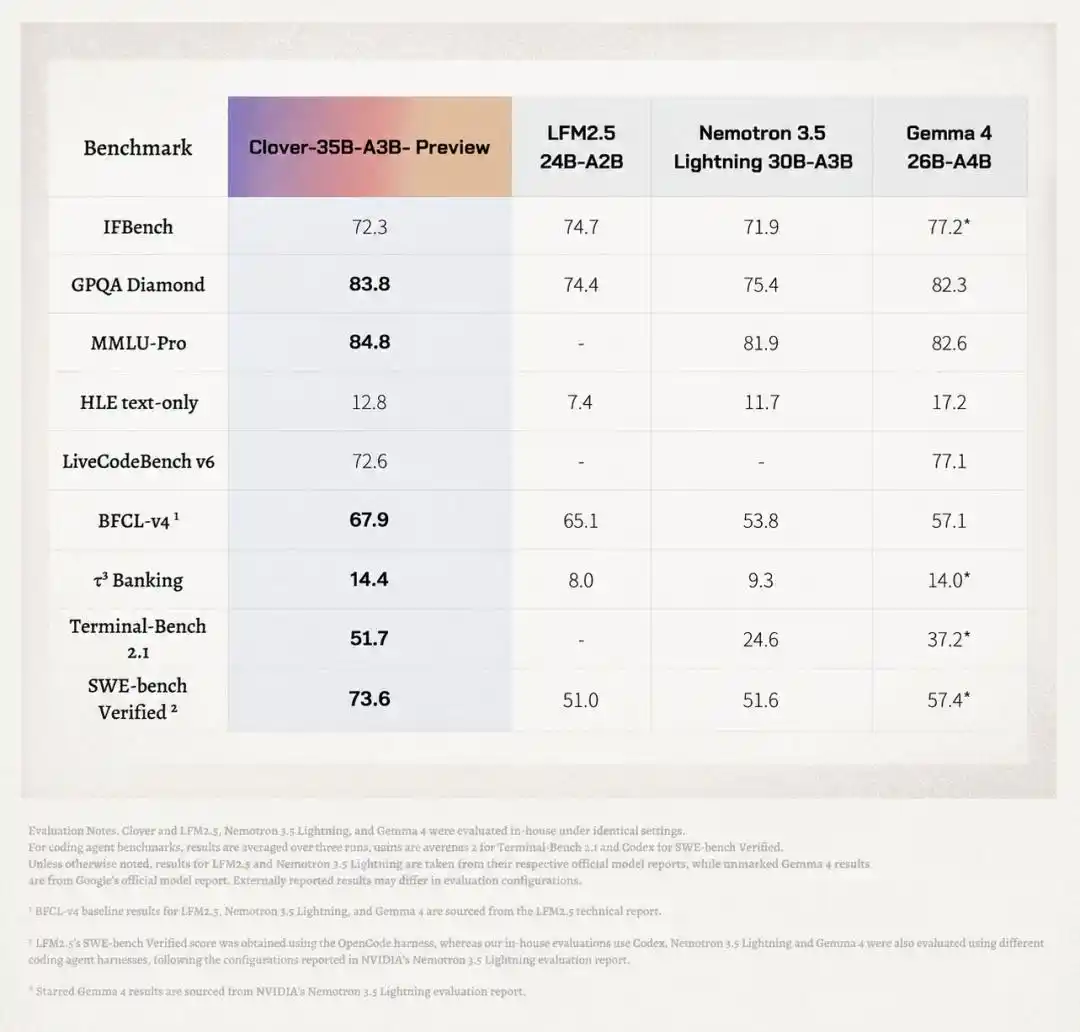
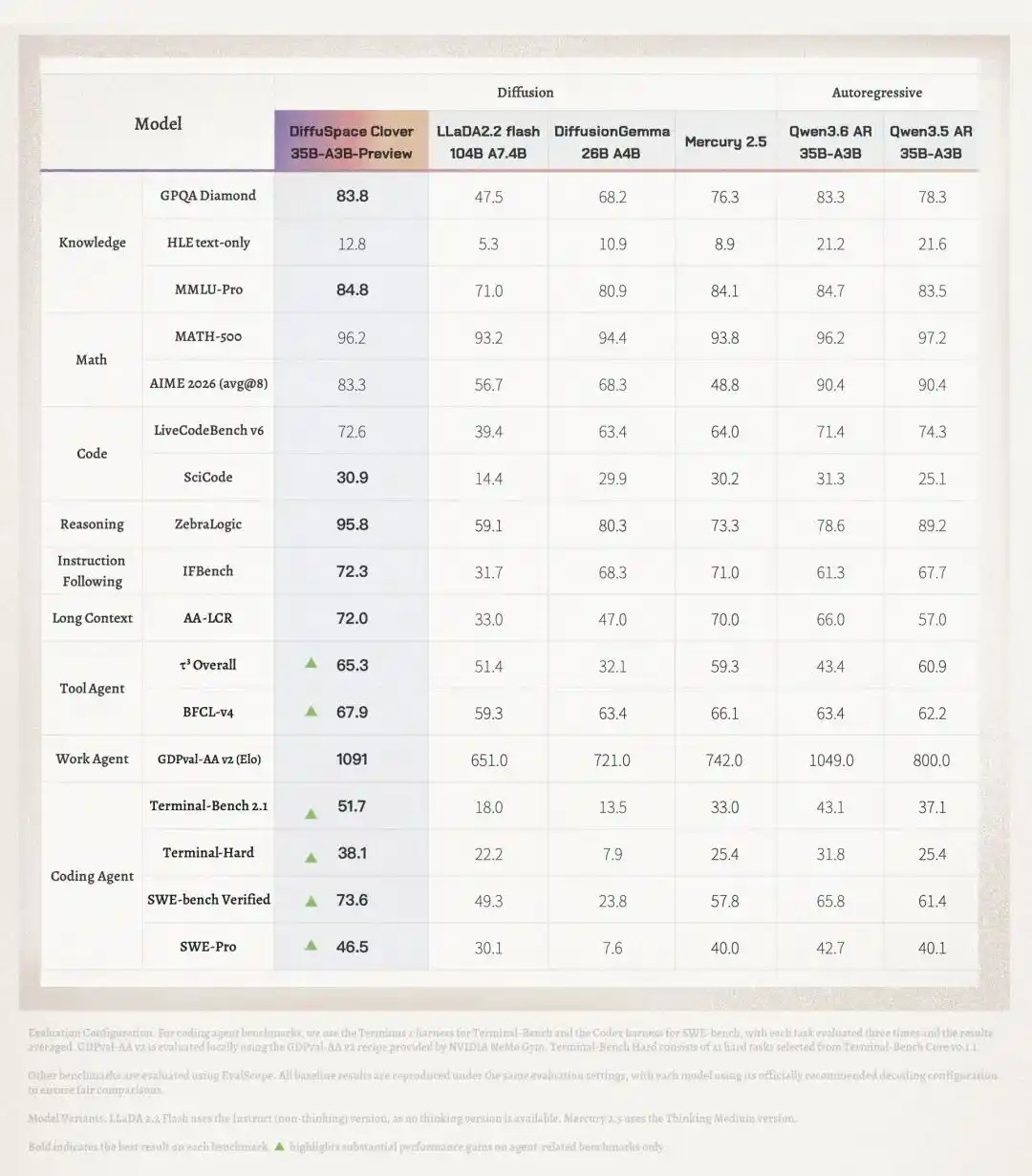
The release extends the team’s diffusion language model line from the earlier Dream 7B, which had 7 billion parameters, to a 35 billion-parameter scale. According to the article, the team argues that the larger parameter count did not slow Clover down and that the model outperformed autoregressive models in same-size comparisons.
Official demos focused on multi-step agent execution
Beyond interactive pages and code generation, the official demos highlighted more complex tasks and WebUI generation.
According to the article, Clover can use WebMCP to handle six tasks in sequence, covering invoice issuance, course registration, amount aggregation, event status checks, customer information queries and invoice information queries. The article says a comparison video showed Clover not only completing the tasks but also pulling clearly ahead of Gemini 3.6 Flash on execution speed.
In an online shopping scenario, Clover was also shown finding a T-shirt that matched a requested style in black and size L, adding it to the cart, filling in guest information and completing a test checkout flow.
The source article singles out this ability to manage continuous tasks as one of the more important parts of the release. Diffusion language models have long had theoretical speed advantages from parallel generation, but their performance on agent tasks has not always been stable. The article points to issues such as malformed tool calls and repeated attempts at the same step without adjusting actions based on returned results. Clover’s progress, as presented, lies in carrying out tool calls, reading feedback and continuing execution until the task is done.
Tool-use and coding benchmark scores
On the benchmark side, the team reported scores of 65.3 on τ³ Overall and 67.9 on BFCL-v4, both tied to tool-use capability.
The article’s author also asked Clover to generate a personal agent web interface, which took a little over ten seconds from start to finish.
For coding-related evaluations, Clover scored 73.6 on SWE-bench Verified, which measures the ability to solve issues in real code repositories, and 51.7 on Terminal-Bench 2.1, which measures terminal task execution.
Taken together, the release frames Clover as more than a text generator. The model is being presented as a diffusion language model that can move from interface generation to tool use, business-process completion and coding benchmarks inside a broader agent workflow.

How a diffusion language model differs from an autoregressive one
The source article also explains the mechanics behind diffusion language models. A standard autoregressive language model predicts the next token from prior context, then repeats the process token by token in sequence.
A diffusion language model uses a different generation path. It allows multiple positions to update at the same time and then refines them over several rounds until the output takes shape. In the article’s description, diffusion denoising can be understood as gradually restoring masked or perturbed content into text that fits the context.
Clover specifically uses block diffusion. It splits the content to be generated into blocks, advances block by block, and updates multiple positions within each block in parallel while letting them reference one another. That gives each round of computation a chance to move several positions forward at once, reducing the wait associated with one-by-one generation.
That does not mean one round is enough. Diffusion models usually need multiple denoising rounds before the result settles. Too few rounds can leave the content under-refined, while more rounds raise compute costs. In code and agent tasks, context also keeps growing. Earlier instructions, completed actions and tool outputs can all affect the next step, which turns history retention and retrieval into an efficiency issue.
Clover’s design changes target memory and current generation separately
To address that, Clover separates the roles of historical memory and current generation.
According to the article, the model rebuilds a Gated Delta Network, or GDN, around block diffusion. Previously generated context is compressed into a continuously updated state that later steps can read. The current block being generated uses bidirectional attention so tokens inside the block can reference one another.
At the same time, Clover treats the readout from historical memory as an independent information unit and feeds it into attention alongside the current token. That lets the model learn how to balance prior context against current content. The article also says Clover uses learnable block-size calibration to reduce the dilution of historical information as blocks get larger.
The stated goal of these changes is to better align parallel generation, historical context use and computational efficiency. In the team’s framing, that is what helps push diffusion language models deeper into code and agent tasks.
Why diffusion language models have drawn attention
The article says diffusion language models have attracted attention over the past two years mainly because of two potential advantages over autoregressive models.

- First, they can generate multiple positions at once, which may reduce the serial delay that comes with token-by-token generation. That matters in agent settings where code generation and tool use happen repeatedly.
- Second, earlier and later content can reference each other during generation. Under a bidirectional modeling design, multiple positions can adjust together through iteration, offering another way to handle dependencies across content. Clover’s within-block interaction is one implementation of that idea.
The article points to several efforts across academia and industry. It mentions ELF, which He Kaiming participated in this year and which explores language generation in continuous embedding space; Google’s DiffusionGemma, which explores parallel text generation; and research by major Chinese companies on diffusion language models for coding tasks. Methods differ, but the shared direction is to turn an alternative generation process into usable capability and efficiency.
From DiffuSeq to Dream 7B and now Clover
The team behind Clover is Diffusion Intelligence. The article says the company was co-founded by University of Hong Kong professor Kong Lingpeng and his PhD students Gong Shansan and Ye Jiacheng. Their work on diffusion language models dates back to 2022.
That year, the team introduced DiffuSeq, a project focused on sequence-to-sequence text generation with diffusion models: given one piece of text, generate another under specified conditions. One of the central challenges at the time was adapting diffusion methods, which were stronger on continuous signals such as images, to discrete natural language.
In April 2025, core team members were involved in launching Dream 7B, pushing the research line to a 7 billion-parameter language model. Based on results released at the time, the article says Dream 7B delivered performance comparable to autoregressive models of similar size on general, math and coding tasks, while also showing planning ability and flexibility in generation order.
With Clover, the model scale has increased again, and coding, tool use and continuous task execution have become the main showcase items. The path described in the article runs from early work on how to generate text to a newer focus on how to complete complex tasks correctly and quickly.
Next steps include multimodal work and edge deployment
The article says the team is now extending its work toward multimodal systems and edge-side deployment. Clover is expected to get a multimodal version, and the team is working on combining diffusion language models with multimodal understanding and action generation while continuing adaptation and validation for edge scenarios.
Its cooperation with Acrab is described as work on system adaptation and hardware-software co-validation for edge-side use cases. According to the team’s plan, the next steps also include exploring larger-scale models, improving stability on long-horizon tasks, and pushing edge applications through inference optimization, quantization and deployment adaptation.
The source article was published by MarsBit and credited to the WeChat account QbitAI, with the byline "关注前沿科技".