


SK Hynix released its fiscal 2026 third-quarter earnings early on Oct. 28 Beijing time, and the market focus quickly moved beyond the headline figures. Revenue and operating profit both beat Bloomberg consensus estimates, but the more important signals came from pricing, shipment guidance, and the company’s first quantified disclosure on long-term contract coverage.
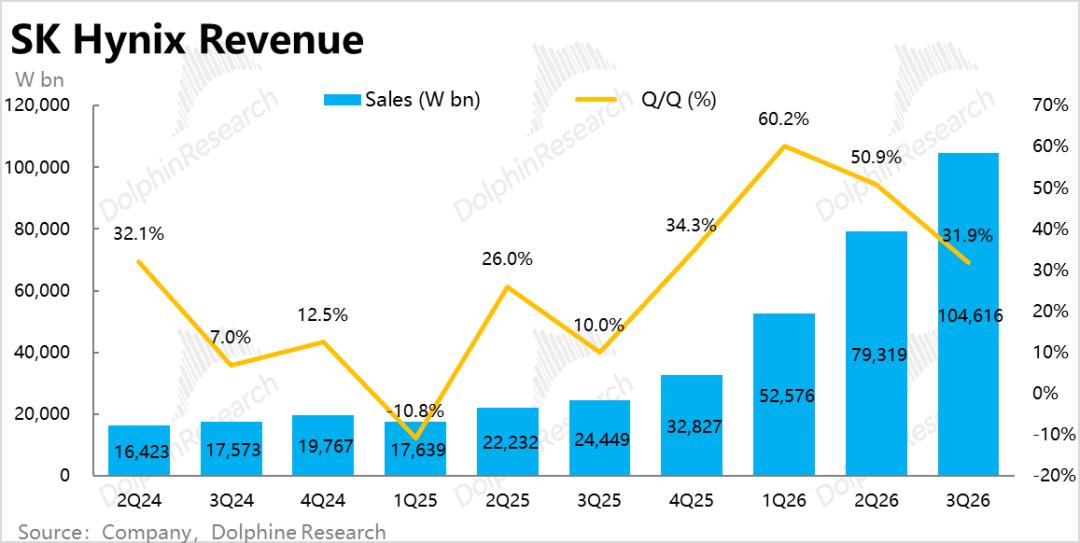
Revenue for the quarter reached KRW 104.6 trillion, up 32% from the previous quarter and about 6% above Bloomberg consensus of KRW 99.0 trillion. Even so, the quarter-on-quarter growth rate slowed from 51% in 2Q to 32%, showing that the price-led surge in sales is still decelerating on a sequential basis.
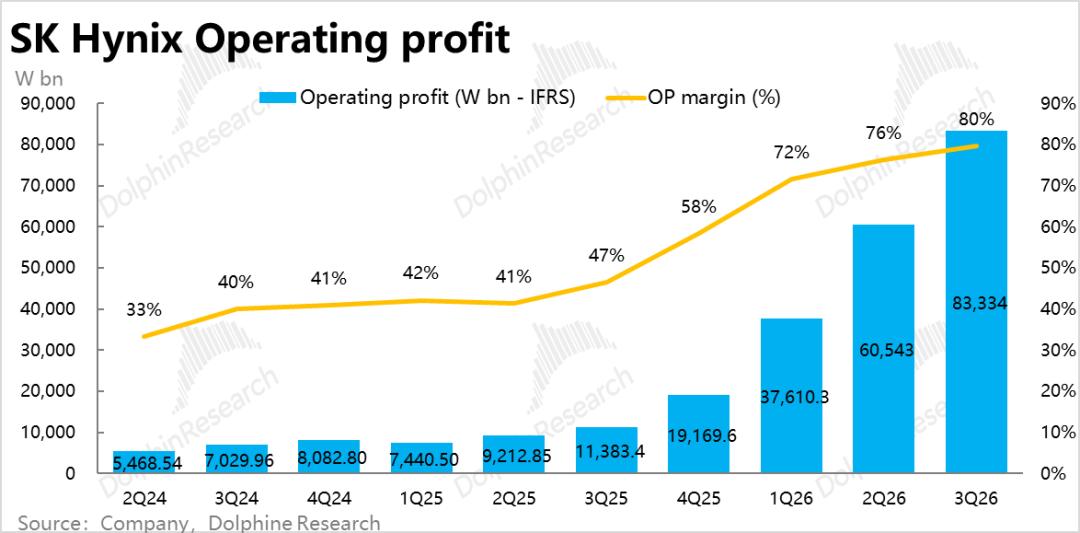
Operating profit came in at KRW 83.3 trillion, up 38% quarter over quarter and above consensus of KRW 77.5 trillion. Operating margin improved by about 3.4 percentage points from the prior quarter as product prices kept rising. Net profit was KRW 39.8 trillion, well below consensus of roughly KRW 60 trillion, which the source article attributed to foreign-exchange-related losses from won appreciation and losses tied to investment assets. Those were described as non-operating factors.
Headline results beat consensus, but growth slowed from the prior quarter
On the surface, the quarter looked solid. The company beat consensus on the two core operating metrics, revenue and operating profit. Still, for investors who had already positioned for a strong print, the overall numbers were not a major surprise. The bigger question was whether memory pricing could stay firm, whether shipments could accelerate enough to support growth, and whether supply-demand tightness remained intact.
DRAM shipments met expectations while ASP outperformed
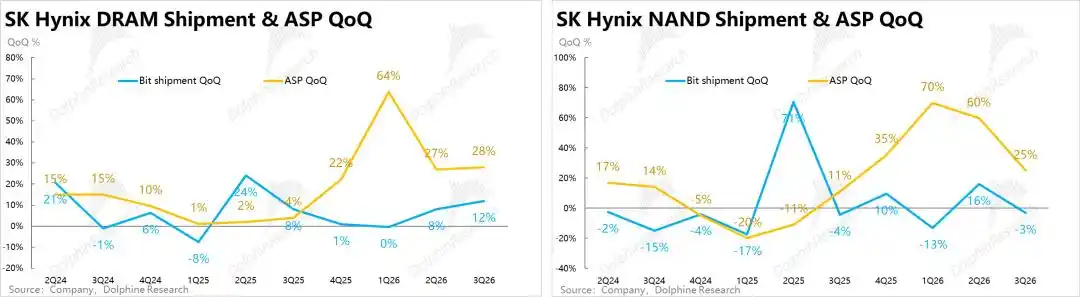
In DRAM, shipments rose about 10% quarter over quarter, broadly in line with company guidance and market expectations. The standout was pricing. DRAM ASP increased by the high-20% range from the previous quarter, above consensus and slightly ahead of some large-bank forecasts.
Compared with the roughly 30% increase in 2Q, the latest gain represented only a modest slowdown. The source article said the market is likely to read that as a sign that the supply gap remains tight, easing concerns that the pace of memory price increases had already started to fade too quickly.
The article also noted that the ASP shown in SK Hynix’s financial statements reflects contract prices agreed with customers earlier, and those prices are typically well below spot market levels. In that sense, the increase says more about newly delivered contract prices narrowing the gap with market prices. A higher HBM4 mix also contributed to ASP through product mix effects.
NAND shipments slipped, but pricing also beat expectations
For NAND, shipments declined slightly from the previous quarter, missing consensus that had pointed to about 3% growth. ASP, however, rose by the mid-20% range, well above the roughly 18% increase expected by the market. The article said the pricing logic behind NAND looked similar to DRAM.
SK Hynix explained the weaker shipment figure by saying it had deliberately concentrated sales on higher-value products such as 321-layer enterprise SSDs. That shift also helped NAND ASP because SSDs made up a larger share of the mix. The article added that negative NAND shipment growth is not unusual historically, so the miss was not treated as a major shock.
Gross margin rose again as expenses were diluted by faster revenue growth
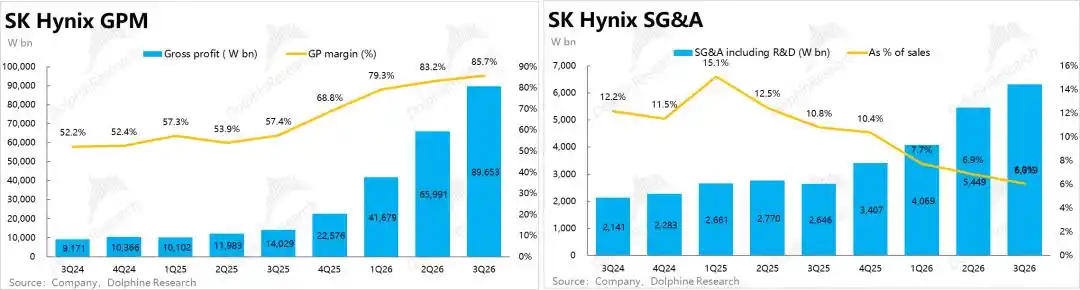
Profitability improved further. Gross margin reached 85.7%, up about 2.5 percentage points from the prior quarter and above consensus of 84.6%, helped by stronger-than-expected product pricing.
Operating expenses totaled KRW 6.3 trillion. That was up 139% year over year, but revenue grew faster, which kept pushing the expense ratio lower. The ratio narrowed by another 0.9 percentage points in the quarter. Higher gross margin and a lower expense ratio together lifted operating margin again.
Fourth-quarter guidance points to a sharp acceleration in DRAM shipments
Guidance was one of the most closely watched parts of the release. SK Hynix said fourth-quarter fiscal 2026 DRAM shipments are expected to grow in the mid-20% range quarter over quarter, a sharp jump from the roughly 10% pace seen in prior periods and well ahead of expectations. NAND shipment guidance was for growth in the mid-single digits, broadly in line with consensus of 5.7%.
The company attributed the DRAM acceleration to capacity expansion at the new 1c node and the ramp of M15X, which is expected to reach full capacity by year-end. The source article said that matters for the medium-term earnings profile. Until now, most of SK Hynix’s earnings growth had come from price increases. If pricing starts to cool later, higher shipment volume could take over as the next driver and help sustain sales growth in the 30% to 40% range.
Capex may accelerate in 4Q, with a larger increase expected in 2027
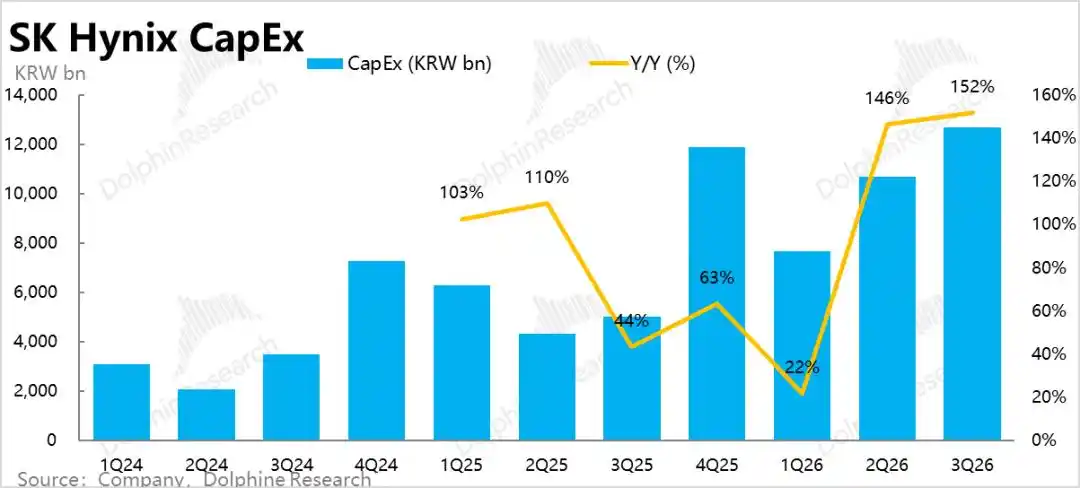
Cash paid for property, plant and equipment was KRW 12.7 trillion in the quarter, up 19% from the previous quarter and slightly below Bloomberg consensus of KRW 13.1 trillion. Based on the company’s July guidance that 2026 investment would land in the high-KRW-40-trillion range, the article inferred that fourth-quarter capex could reach roughly KRW 16 trillion to KRW 18 trillion, marking a visible acceleration.
SK Hynix also expects capex to increase significantly in 2027. The spending will go to three areas: equipment for advanced process technology, the Yongin Y1 ramp, and domestic and overseas infrastructure. The article said that matches its own expectation that capacity growth will begin to pick up clearly in 2027.
Shareholder returns for fiscal 2026 are set at about KRW 100 trillion
SK Hynix said total shareholder returns for fiscal 2026 will be about KRW 100 trillion, including the year-end dividend. Cash dividends will be no less than KRW 30 trillion, while buybacks and cancellations will be no less than KRW 60 trillion. Together, that equals 50% of annual free cash flow.
During the third quarter, the company decided on two distributions: a cash dividend of KRW 14 trillion, and a new KRW 20 trillion buyback. Of that buyback, about KRW 10 trillion is for shareholder returns and will be fully canceled, while another roughly KRW 10 trillion is for employee compensation and is not counted as shareholder return.
Using the roughly KRW 100 trillion full-year payout figure, the source article estimated a shareholder return yield of about 7% for the U.S.-listed shares and 10% for the Korean shares because of the discount in the local market.
Long-term contracts now cover more than half of 2027 and 2028 capacity
Another major update came from long-term agreements. SK Hynix disclosed that signed long-term contracts now cover more than 50% of total capacity for both 2027 and 2028. The number of major customers under contract has reached 14, up from about 10 in July. The standard contract term is five years, with some customers discussing extensions. Pricing moves within agreed ranges and can fluctuate with market conditions.
The article said the market had previously viewed SK Hynix as having relatively low long-term contract coverage. This disclosure changes that view and improves both earnings visibility and downside protection. The company plans to keep long-term contract coverage at a similar level over the medium to long term, while leaving the rest of capacity flexible so it can still capture part of any upside in market pricing.
Revenue mix keeps shifting toward servers and data center demand
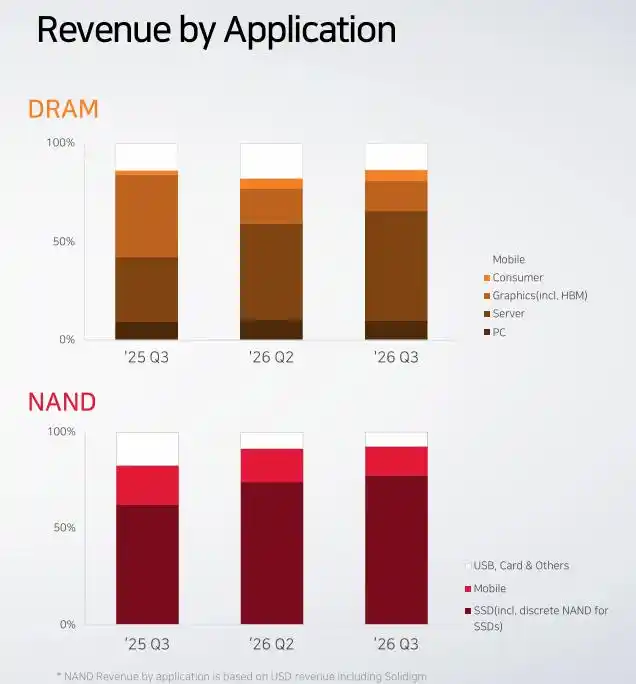
End-market mix shows a deeper reliance on AI servers and XPU makers’ capital spending. In DRAM, the server share of revenue rose from about 30% a year ago to around 50% in the second quarter, then moved above 50% in the latest quarter. Including graphics products with HBM, data-center-related business now accounts for roughly 70% of DRAM revenue. Smartphones and PCs together make up only about 20%.
NAND is moving in the same direction. Enterprise-focused SSDs accounted for about 60% of NAND revenue a year ago and have now climbed to nearly 80%.
Dolphin Research: pricing, shipments, and contract coverage all point to tight supply
According to Dolphin Research, the report did not contain a major surprise in aggregate numbers. The incremental information was concentrated in three areas: stronger-than-expected product pricing, a sharp acceleration in next-quarter shipments, and the first quantified disclosure showing long-term contracts cover more than half of future capacity. Taken together, those signals point to still-tight supply and demand and support near- to medium-term earnings visibility. The real debate, the article said, is how long the cycle can last.
The article described the earnings message as broadly constructive. Pricing beat expectations and broke the prior pattern of sequentially slowing gains, which helps ease concerns that memory makers may be losing pricing power. Shipment growth moving from around 10% to more than 20% also means revenue can keep expanding through volume even if price increases narrow later.
At the same time, the article argued that volume growth does not deliver the same earnings leverage as price growth. As the comparison base rises, earnings growth for memory makers will inevitably normalize. Once the fastest phase of the upcycle passes, the central question becomes how much longer the rally can continue.
Three issues shaping the cycle: pricing, duration, and long-term contracts
On pricing durability, the article cited TrendForce as expecting conventional DRAM contract prices in 4Q26 to rise 10% to 15% quarter over quarter, with NAND up 15% to 20%. Most major institutions expect price increases to continue into the second half of 2027, while views on 2028 are more divided. SK Hynix’s own demand outlook in this earnings release was described as clearly more optimistic.
On cycle length, the article said the company’s signal is also more upbeat than its own base case. SK Hynix expects “servable demand” in 2027 to grow in the mid-20% range for DRAM and the high-10% range for NAND. That measure already reflects actual supply conditions and roughly corresponds to supply growth, close to the article’s own estimate of about 24% supply growth in 2027.
The more important structural signal came from HBM. Customer demand for HBM is now more than double the company’s current supply, according to the article, matching its own view that HBM supply-demand conditions are even tighter. Including volumes still under negotiation, DRAM and HBM capacity before 2029 is effectively sold out. Based on that, the company believes undersupply could last until 2030.
There is another side to that story. SK Hynix also expects capex to rise significantly in 2027, which fits the article’s view that capacity growth will begin to ramp meaningfully from that year. New supply could be released in a concentrated way across 2027 and 2028, which is why the article remains more cautious on 2028.
On long-term contracts, the article said SK Hynix has moved from locking in relatively little volume to covering more than half of future capacity. That raises the earnings floor for 2027 and 2028 and shifts the company’s earnings profile away from pure upside elasticity and more toward certainty. At the same time, long-term contracts can limit upside in pricing, and the company did not disclose deposit size or the exact pricing bands, leaving the degree of downside protection still open to observation.
Better earnings do not automatically mean stronger share performance
The article also warned that improving earnings in the near term do not necessarily translate into better stock performance. Memory shares have pulled back sharply in recent weeks, and the trigger has come mainly from macro factors rather than industry fundamentals.
Among the factors cited were reports that annualized revenue growth at leading frontier model developers has fallen short of expectations, widening credit default swap spreads for new cloud providers such as Neo-Cloud, tighter overall risk appetite, and growing doubts about the durability of AI capex. The article argued that those valuation and sentiment pressures may matter more for share prices than the relatively solid earnings outlook of memory makers.
It also said SK Hynix’s faster-than-expected capacity ramp is positive for near-term earnings, but it may also imply that industry supply growth is running ahead of prior assumptions. That could bring forward the point at which the market shifts from shortage to balance.
CXMT’s 4F² product and SK Hynix’s own technology path
The article linked that concern to the recent selloff in memory stocks after CXMT said it would launch a 4F² product. Its view is that CXMT’s 4F² is unlikely to enter mass production before the second half of 2027 at the earliest, and it may not make it into the supply chains of customers such as NVIDIA because of geopolitical factors. On that basis, the article said the product is unlikely to have much effect on the short-term earnings of the three major memory makers.
On the earnings call, SK Hynix said its own path is to use EUV to extend the current 6F² platform as much as possible before moving to 4F² or 3D DRAM. The company said any new structure must clear hurdles in yield, reliability, cost, and customer qualification one by one, and that the timing of R&D is not the same as the timing of commercialization.

Even so, the article said the market remains concerned that Chinese manufacturers could release more incremental capacity than expected, speeding up the move toward balance and putting pressure on valuations.
Earnings forecast revisions after the quarter
After the results, Dolphin Research said it raised its fourth-quarter shipment forecast based on company guidance and also lifted its shipment expectations for 2027 and 2028, mainly because of higher bit output per wafer.
It also slightly increased its 2027 ASP growth assumption because tight supply-demand conditions now appear more durable. For 2028, however, it kept its price assumptions unchanged, citing faster-than-expected industry supply expansion and the potential effect of CXMT’s 4F². After those changes, the article said it now expects SK Hynix to post net profit of about KRW 419 trillion in 2028, or roughly $310 billion, about 20% above its previous forecast.
On valuation, the article concluded that sentiment and industry beta may matter more for the stock than company-specific earnings. It said investors looking for clearer signals can watch future updates to Anthropic’s ARR growth and whether cloud companies due to report earnings continue to raise capex guidance.
The source article was published by the WeChat account Dolphin Research (ID: haituntouyan) and written by Dolphin Jun.