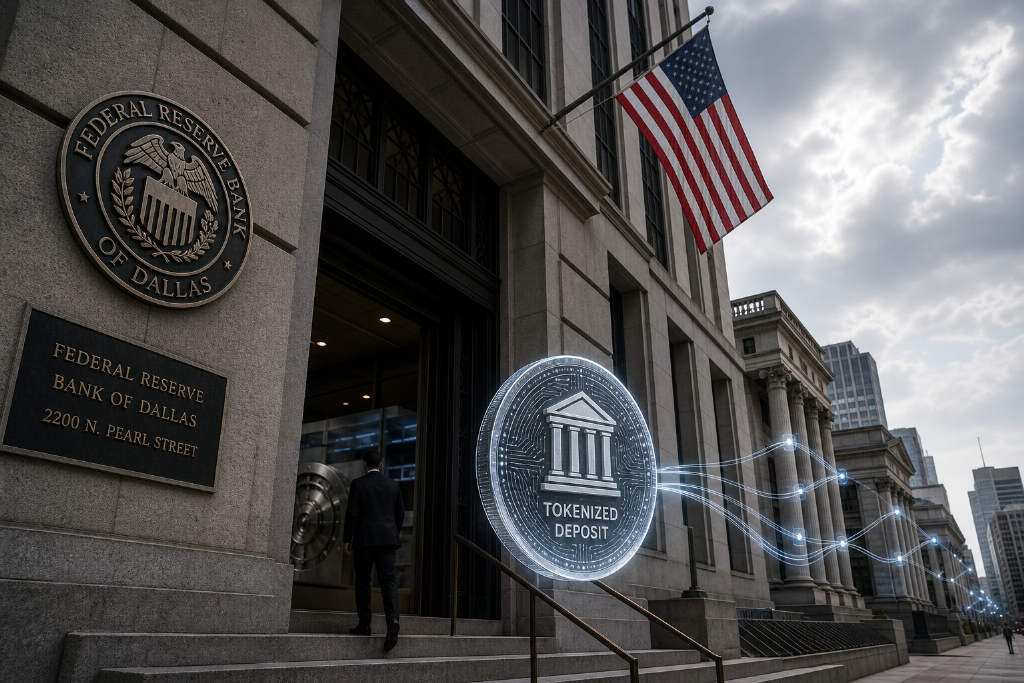
Dallas Fed says tokenized deposits could weaken banks’ lending capacity

Dallas Fed says tokenized deposits could weaken banks’ lending capacity

N
News Editor
2026-08-26 16:47:00
A report released by the Federal Reserve Bank of Dallas on Aug. 27 said widespread adoption of tokenized deposits could make bank funding more sensitive to interest rates, speed up the movement of money across banks, and weaken banks’ liquidity and maturity transformation functions. The report distinguished tokenized deposits from stablecoins such as USDT and USDC, noting that tokenized deposits are typically issued by regulated banks and can pay interest. It said technologies including blockchain-based instant settlement, smart contracts, and agentic AI may make it easier for customers to move funds quickly in search of higher yields, reducing the stickiness of traditional deposits. According to the Dallas Fed’s estimates, a 10% increase in deposit rate sensitivity could reduce banks’ ability to bear interest-rate risk by about $700 billion on a 10-year equivalent basis, while a 10% shortening in the weighted average maturity of deposits could cut the banking system’s maturity transformation capacity by roughly $580 billion. The report added that banks seeking to maintain current lending volumes may need to rely more on wholesale funding such as term debt, a shift that could raise borrowing costs for consumers and businesses.

BlockBeats reported on Aug. 27 that the Federal Reserve Bank of Dallas published a report warning that if tokenized deposits gain broad adoption, they could increase the sensitivity of deposits to interest rates, accelerate the movement of funds across banks, and weaken banks’ liquidity and maturity transformation capacity, with knock-on effects for credit supply and funding costs.

Dallas Fed outlines risks tied to tokenized deposits

The report said tokenized deposits differ from stablecoins such as USDT and USDC because they are typically issued by regulated banks and can pay interest. The Dallas Fed said blockchain-based instant settlement, smart contracts, and agentic AI could make it easier for customers to shift funds quickly in pursuit of higher yields, reducing the stickiness of traditional bank deposits.

Estimates point to weaker bank risk-bearing capacity

According to the report, if deposit rate sensitivity rises by 10%, banks’ capacity to absorb interest-rate risk could fall by about $700 billion on a 10-year equivalent basis.

It also estimated that if the weighted average maturity of deposits shortens by 10%, the banking system’s maturity transformation capacity could decline by about $580 billion.

Banks may turn more to wholesale funding

The report said banks that want to preserve current loan volumes may need to rely more heavily on wholesale funding such as term debt. That could make bank lending funding models closer to those used by non-bank financial institutions and may push up borrowing costs for consumers and businesses.

Regulatory attention is increasing

The report added that multiple global banks have already started testing tokenized deposits and round-the-clock settlement systems, and the potential impact of tokenized deposits on the traditional banking system is drawing growing attention from regulators.

This article was originally published by Bit.Fan. For more cryptocurrency news and market insights, visit www.bit.fan.
1700

Disclaimer:

The market information, project data, and third-party content displayed on this platform are for industry information sharing only and do not constitute any form of investment advice or return commitment.

Cryptocurrency trading carries high risks. Users should fully assess their risk tolerance and make independent decisions. All profits, losses, and legal responsibilities are borne by the users themselves.