
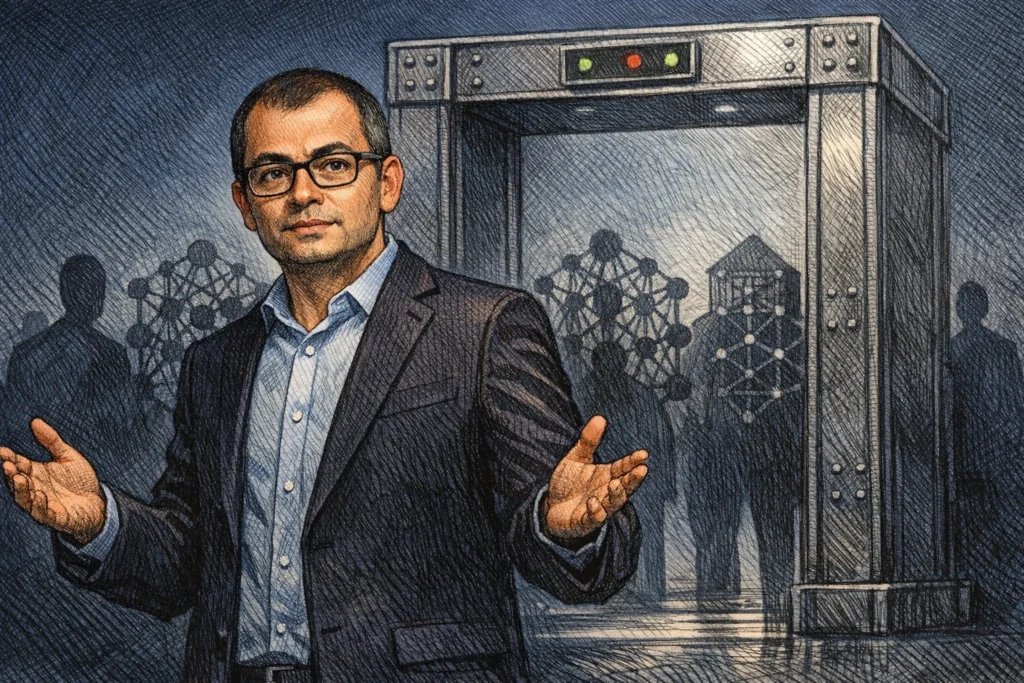
Google DeepMind CEO Demis Hassabis has called for a new international body to review frontier AI models before they are released, with mandatory checks that could last up to 30 days.
Hassabis set out the idea this week in a Substack essay titled "A Framework for Frontier AI and the Dawning of a New Age." The proposal would create an institution outside both government and corporate control, designed to act as a pre-launch examiner for the most advanced AI systems.
A review regime for the most advanced models
In Hassabis' proposal, "frontier models" are the latest generation of AI systems with the strongest computing capabilities and risk boundaries that are still not fully understood. Any model that meets the threshold would be subject to review before release. The proposal says that would apply across open-source and closed-source systems and would not depend on the country where the model was developed.
The review period could run for as long as 30 days. Governance would sit with a board where independent technical experts hold the majority of seats, including figures at the level of Turing Award winners. Other seats would be reserved for representatives from industry, government and the open-source community.
OpenAI CEO Sam Altman described the concept as "very thoughtful," while Elon Musk called it "a good discussion starting point," according to the report.
Mythos helped push the proposal into public view
Hassabis had been working on the framework for months, but said the immediate trigger for publishing it earlier was Anthropic's limited release of its Mythos model.
The report says the model, introduced in April, showed cyber offense and defense capabilities far beyond expectations. That stirred concern in industry and policy circles over what was described as a possible new era of AI-driven cybercrime. Hassabis called it a "warning sign" and argued that regulators could not afford to keep moving slowly.
He said he expects to travel to Washington next week to discuss the framework directly with U.S. policymakers.
Cyber risk now, biosecurity risk later
Alongside near-term cybersecurity concerns, Hassabis also raised a longer-range issue in an interview: biosecurity.
He said the concern is that AI models could eventually help design pathogens or biochemical weapons that threaten public health. "Current models are not yet that strong, but if you extrapolate from the current pace of progress, that may appear within a few years," he said.
At the same time, scrutiny from the U.S. government over new models has already put the sector on edge. The report says Anthropic and OpenAI both delayed wider releases of new products under pressure from the Trump administration. That caught other countries that rely on U.S. technology off guard and also contributed to talks between the European Union and the U.S. government over access to models. AI company CEOs also used the G7 summit in France to meet directly with national leaders.
Borrowing from FINRA's structure
Hassabis pointed to the U.S. Financial Industry Regulatory Authority as a model. As described in the report, FINRA is funded by Wall Street brokerages, operates independently, and is overseen by the U.S. Securities and Exchange Commission. It is responsible for examining whether financial firms comply with rules and can impose penalties or suspensions when needed.
He wants to apply the same logic to AI governance: industry funding, but decision-making in the hands of people who are not tied to any one company.
Under the design he outlined, funding would come entirely from leading for-profit AI labs. Every model that crosses the frontier threshold would be reviewed under the same standard, no matter where the company is based and no matter whether the model is open or closed. The threshold itself would be updated over time as model capabilities change.
Hassabis also said the system could be tightened as conditions become more serious. In an extreme case, it could even coordinate major labs to slow development. His target is to have such an institution operating by the end of this year.
Industry agreement may be easier than political agreement
Before making the plan public, Hassabis said he had privately circulated the draft to nearly all major AI labs, including Anthropic CEO Dario Amodei, whom he described as a friend.
Amodei had earlier suggested that the U.S. should create a dedicated AI regulator similar to the Federal Aviation Administration. Altman has also floated international oversight ideas. In an interview with Bloomberg, Hassabis said, "We've talked a lot, and I think this is highly compatible with ideas Dario and Sam have been putting forward for a long time. What we need is a concrete plan, not an abstract concept."
The report says Hassabis, as a Nobel Prize winner who has spent longer in AI research than many of his peers, may have an easier time building internal industry consensus than either Musk or Altman. But one unnamed AI industry leader cautioned that industry alignment alone will not settle the issue. The harder problem is political.
- The U.S. Congress has not passed meaningful federal AI legislation.
- The Trump administration's stance on AI has swung between restraint and intervention.
- The U.S., the European Union and China continue to follow different regulatory paths.
Hassabis said he believes the current momentum may be enough to carry the idea forward, but added that the next step is to make it real rather than stop at publishing a blog post.