
DeepSeek has redesigned its interview process for a large social hiring campaign covering 150 roles, replacing ACM-style coding questions in written tests for experienced hires with a new set of system design problems.
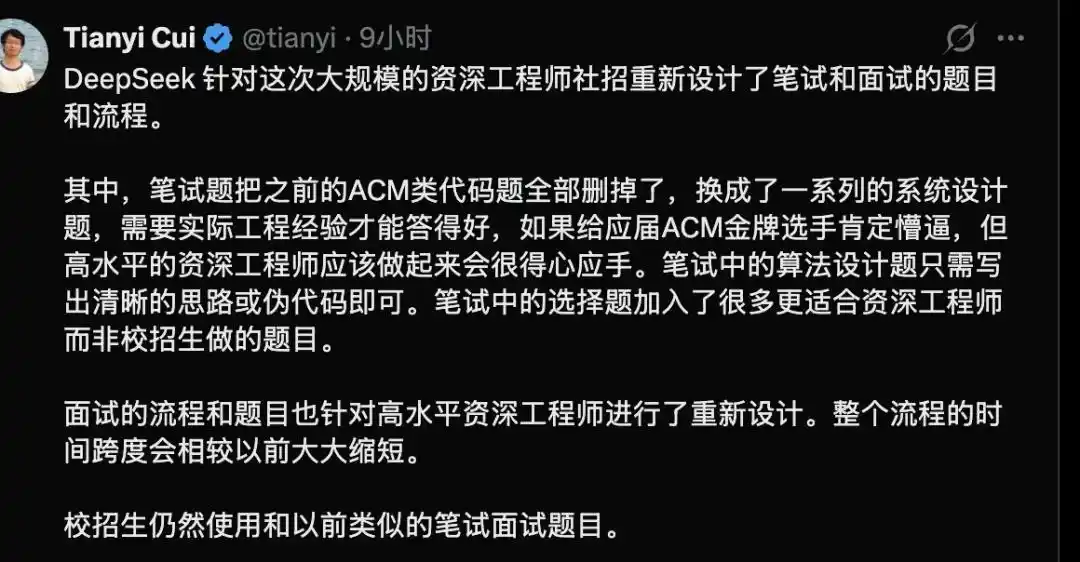
According to Cui Tianyi, the person identified in the report as being in charge, the old ACM-style code questions have been removed entirely. He said a fresh ACM gold medalist would likely be caught off guard by the new test, while a highly capable senior engineer should find it much more natural to handle.
DeepSeek has also changed how algorithm design questions are evaluated. Candidates are no longer required to write complete runnable code and can instead provide a clear solution outline or pseudocode. The multiple-choice portion has likewise been adjusted to include more questions suited to experienced engineers rather than campus recruits. The company also plans to shorten the overall time span of the interview process.
The change applies only to experienced hires. Campus recruitment will continue to use written tests and interviews similar to the previous format. In practice, that means DeepSeek has split its assessment systems for social hiring and campus hiring.
Debate follows the interview overhaul
The redesign has triggered mixed reactions online. Some commenters argued that in the AI era, ACM-style questions no longer carry much value in evaluating engineering talent. Others pushed back on the company’s stated focus on experienced engineers with 2 to 10 years of work history, questioning whether that language is effectively a softened version of an age cutoff.
The report says DeepSeek’s interview process has long been a target of criticism on the internet. Alongside the widely discussed complaints from a former Huawei "genius youth" recruit about his DeepSeek interview experience, candidates have repeatedly raised two broader issues: written tests that did not match the level of the role, and an interview process that felt inconsistent.
One example cited in the report is the mismatch between a candidate who has designed large distributed systems in production, handled live incidents, and made architecture trade-offs, and a recent graduate who has solved 500 LeetCode problems. Measuring both with the same set of questions does not create enough separation, the article argues.
Assessment moves from handwritten algorithms to engineering judgment
Based on the details disclosed so far, DeepSeek’s redesign shifts the focus of evaluation for experienced hires away from handwritten algorithm questions and toward system design and engineering judgment.

These new system design questions do not have standard answers. Instead, they test how candidates make trade-offs in real engineering scenarios: what the constraints are, why a given solution was chosen, where its weaknesses and risks sit, how failures would be diagnosed quickly, and what measurable gains the work ultimately produced.
The report says those dimensions match how DeepSeek describes senior engineers in its hiring documents. The profile includes people who personally solved problems widely recognized by their teams as highly difficult or highly complex, or who drafted the technical plan themselves. It also includes people who end up resolving issues whose root causes remain hard to identify even after upstream and downstream teams work on them together.
Algorithm design questions have been adjusted in the same direction. By allowing candidates to submit a clear approach or pseudocode instead of a full implementation, the company is moving the emphasis from whether code can run end to end to whether the proposed solution is well designed.
Shorter process responds to prior candidate complaints
The shorter interview cycle addresses another complaint that candidates had raised repeatedly. The report says some applicants previously waited weeks for interviews after passing written tests, and that progress varied sharply from one team to another.
The article also places the change in a broader industry setting. With AI code generation tools spreading quickly, it argues that the ability to distinguish candidates by handwritten coding speed alone is weakening. The skills that matter more, according to the report, are identifying problems, breaking down requirements, designing systems, and validating outcomes.
The reference link cited in the article points to a post by Cui Tianyi on X. The original piece was published by the WeChat public account Quantum Bit, with Meng Chen listed as the author.