
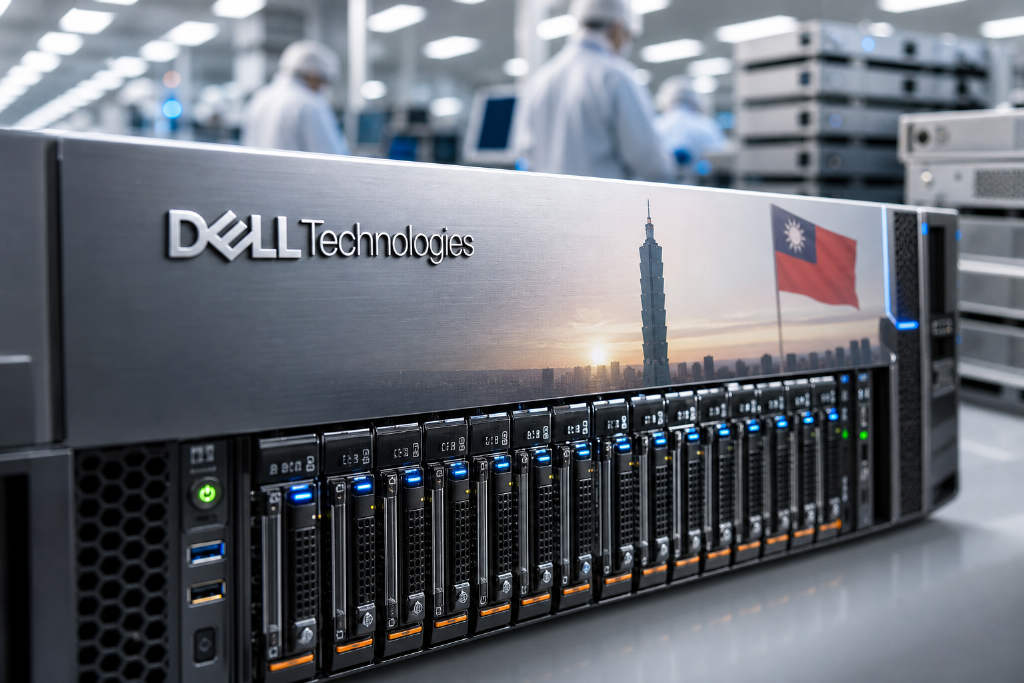
Dell Technologies raised its full-year revenue forecast to $192 billion as demand for generative AI equipment continued to drive server procurement. AI servers are expected to contribute $74 billion of that total, three times the revenue recorded in the previous year. The AI server business has become the main contributor to the company’s larger revenue outlook.
Dell’s quarterly results also exceeded market expectations. Revenue and adjusted earnings per share came in above forecasts, and the company’s stock rose about 10% in after-hours trading.
Management said Dell had received more than $130 billion in AI server orders over the past 12 months. The company’s current unfulfilled AI server backlog stands at $95 billion.
General-purpose server demand recovers
The recovery is not limited to high-end computing equipment. Demand for Dell’s traditional general-purpose servers has also risen noticeably. Enterprises building complex architectures that include AI agents still need standard central processing unit, or CPU, servers for resource allocation and task management.
That requirement helped push revenue from Dell’s traditional server business over the past two quarters to a level close to the company’s total revenue from a single previous year.
Dell’s personal computer division benefited from passing higher component costs, including memory, on to end customers. Quarterly PC revenue increased 20% year over year to $15 billion, while division profit climbed 42%. The figures reflected support from replacement demand in the commercial market.
Taiwan suppliers remain tied to Dell’s shipment schedule
Dell’s improved full-year outlook has strengthened the order outlook for Taiwan-based manufacturers closely connected to its business. Wistron, or Wistron Corporation, ticker 3231, is a major supplier of motherboards and GPU computing baseboards. Hon Hai, ticker 2317, has the ability to manufacture and integrate complete server racks. Both are expected to continue benefiting from expanded procurement by large cloud service providers.
Inventec, ticker 2356, is supported by the recovery in general-purpose server demand, which helps sustain capacity utilization. Compal, ticker 2324, is a notebook computer manufacturer that has maintained its existing shipment momentum while average selling prices, or ASP, remain stable. Cooling and power-component manufacturers are also part of the supplier group linked to the server demand.
The article says that larger hardware shipment volumes could support supply-chain visibility, with shipment schedules extending into next year. The actual benefit to each supplier will still depend on the difficulty of system integration, its ability to pass raw-material costs on to customers, and the resulting changes in gross margin.