
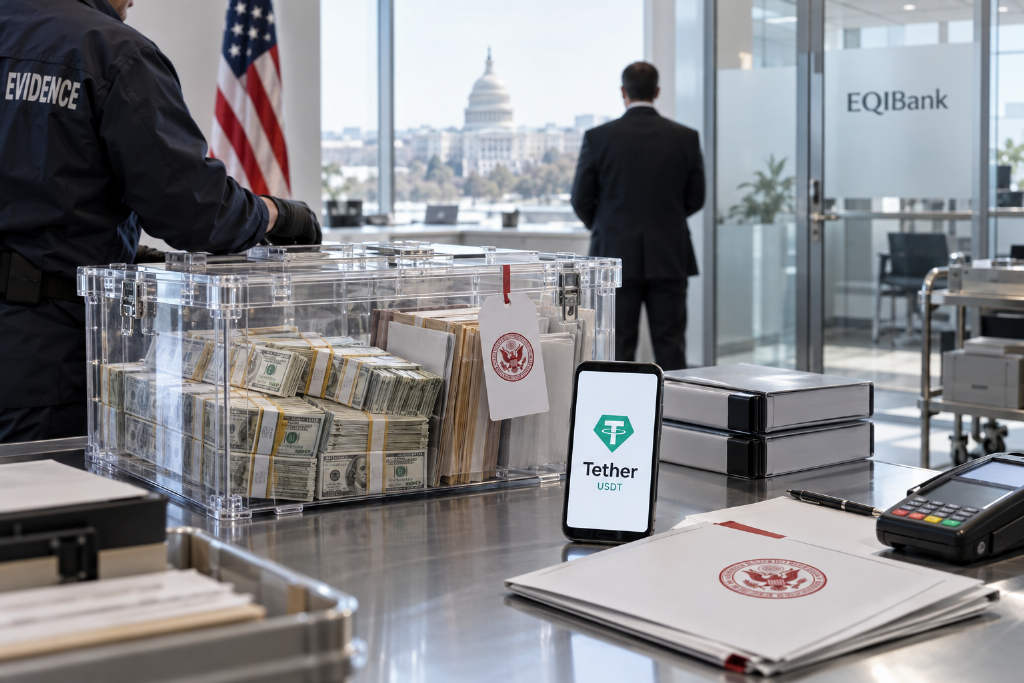
USDT’s banking-channel risk has not gone away.
A U.S. Department of Justice civil forfeiture case against payment processor Capstone Limited is drawing fresh attention to one of the banking routes tied to Tether. The Financial Times reported that about 80% of the assets of EQIBank, a licensed bank in Dominica used by Tether, were frozen in the seizure action targeting Capstone. Protos, citing the complaint and court filings, laid out the structure behind that relationship: EQIBank relied on Capstone to hold funds in the United States and maintain ties with U.S. banks, while Capstone is accused of concealing the true nature of its business and moving funds linked to fraud and crypto activity.
How EQIBank was tied back to Tether
The Financial Times said the relationship between Tether and EQIBank ran through Marlin Capital Partners. The report said Marlin Capital, which has long served as an investment adviser to Tether, invested in EQIBank and allegedly promised more capital if EQIBank succeeded in helping Tether open an account at DBS Bank in Singapore.
EQIBank said in one filing that it had a relationship with a company called Clarency, which “provides correspondent banking services through DBS Bank Singapore.” The setup points to a layered route into the dollar system rather than a direct banking line.
EQIBank also appears to have depended on Capstone Limited to place deposits in the U.S. and preserve banking relationships there.
The complaint says Capstone misled banks about its business
According to a civil forfeiture complaint filed in July 2026, Capstone allegedly misrepresented its business to several banks, including Wells Fargo, JPMorgan Chase, and Citibank. It described itself as an “application development services” company rather than a money services business.
Capstone Limited was registered with the Financial Crimes Enforcement Network, or FinCEN, as a money services business. But it was registered only in Montana, not in California, where it actually operated, and the complaint says it did not clearly disclose that line of business when dealing with those banks.
In negotiations with EQIBank, however, Capstone emphasized that registration. One filing refers to “an agreement dated August 20, 2024, signed by Dominica Bank 1 and Capstone,” stating that Capstone “is a technology development company and money services business registered with FinCEN.”
The complaint also says the Montana Capstone entity was not incorporated until September 2024, meaning it could not have already been registered with FinCEN on August 20, 2024.
According to the complaint, Capstone ultimately moved hundreds of millions of dollars through its accounts. One passage says that of the $337 million withdrawn from a Wells Fargo account ending in 7500, nearly two-thirds appeared to be payments sent on behalf of “Cryptocurrency Company 1/Cryptocurrency Exchange 1” to hundreds of individuals and entities.
The complaint also describes a Chase account whose outgoing “international wires” likewise appeared to be sent on behalf of “Cryptocurrency Company 1/Cryptocurrency Exchange 1” to individuals and entities.
The filing describes “Cryptocurrency Company 1” as an offshore entity issuing a stablecoin pegged 1:1 to a corresponding fiat currency. It adds that people associated with that company were also linked to “Cryptocurrency Exchange 1,” and that the company had publicly said its U.S. Treasury holdings were large enough to rank among the biggest holders in the world. Protos said those descriptions strongly suggest Tether and Bitfinex.
The complaint also says Capstone received “U.S. Treasuries belonging to an offshore cryptocurrency company,” which were transferred into a securities account opened in Capstone’s name.
The seizure’s impact on EQIBank
The seizure created immediate stress for EQIBank. In one filing, the bank said the frozen funds accounted for “approximately 80% of the bank’s monetary assets.”
The same filing said the Financial Services Unit, or FSU, had placed the bank under enhanced supervision and warned that further action could follow, including possible liquidation.
EQIBank wrote: “The Bank is therefore facing a severe liquidity crisis. If the Bank fails, the years of work since 2018 by its directors, officers and founders will be destroyed.”
The filings also raised another issue. EQIBank listed assets that did not appear to fall within the government’s forfeiture action. The bank said it believed it had more money in one account than the government seized, but added that this may have been “because Capstone appears to have misled the Bank through the portal system as to the amount of funds held by the Bank at certain banks.”
The filing also referred to funds held at Barclays and Clear Bank that did not appear on the government’s public seizure list.
Kotaro Shimogori and a long history in high-risk payments
Capstone often said the company was led or operated by Mary Jeanne Thompson. But according to the complaint, Thompson told the FBI that she “did not have much to do with Capstone.” The complaint goes on to say: “Her husband, Kotaro Shimogori, … was the true operator of Capstone.”
Protos traced Shimogori’s history through court records and corporate filings. In the 2000s, just days after Ikessai, Inc. and Shimogori himself were named in a lawsuit alleging breach of contracts tied to payment agreements, Shimogori became the company’s agent. That case was later dismissed.
The same litigation said Shimogori was also the CEO of another payment company, Okaikei, Inc. Around that period, his website included a page dedicated to “credit card authorization and settlement.”
Also in the 2000s, Shimogori served as president of Foreal, Inc. That company was sued for contract fraud, and the court later entered a default judgment of $589,097.47 against it.
Shimogori and Thompson have more recently filed for bankruptcy. Their bankruptcy papers list a $500,000 claim tied to that litigation, and the creditor appears in the discharge schedule.
That did not end the business trail. In 2011, a company called TechnoUnicorn Ltd was incorporated in Hong Kong. It was later renamed ComCopious Limited and then Capstone Limited.
Protos drew careful distinctions among several similarly named entities. The Hong Kong company was not the Montana Capstone Limited registered with FinCEN and used by EQIBank. It was not Capstone US Limited, whose director was George Thompson and whose registered address matched a correspondence address Shimogori used for Trans Global Systems Ltd. It was not Capstone SGP Pte. Ltd. in Singapore, where Shimogori served as a director. And it was not the California Comcopious entity led by Shimogori. Even so, the overlap in names stands out.
Shimogori was a director of the Hong Kong entity and held 13,500 of its 15,000 shares. When the company was still called ComCopious Limited, a website at icanpay.cn.com listed “COMCOPIOUS, LIMITED” in its copyright notice and advertised that if a business fell into one of the high-risk merchant categories, its proprietary system could get an application approved within minutes.
ComCopious Limited, both the Hong Kong and California entities, along with Shimogori himself, were repeatedly sued over allegations including fraud, conversion, and breach of contract. Those cases offered a look at the kinds of clients these companies served, and the pattern matched the company’s own marketing: high-risk merchants.
In the Life-FX case, the plaintiffs were described as a company selling biochemical compounds online to companies and scientists engaged in non-clinical scientific research, especially in cognition, metabolism, and longevity enhancement; a company operating a lawful online medical cannabis and cannabis-related products dispensary; and a company lawfully selling cannabis seeds online.
The case also involved iCanPay UK Limited, another company controlled by Shimogori.
The Helexo case followed a similar pattern. In a filing supporting a motion, the defendants alleged that “Helexo operates multiple gambling websites,” and that those sites were illegal in California. In a declaration in that case, Shimogori said “iCanPay assisted Helexo in processing credit card transactions and transferring funds payable to Helexo into a cryptocurrency wallet held by Helexo.”
The lawsuit also alleged that “iCanPay used Shimogori’s personal HSBC account … to perform iCanPay’s basic obligations.”
The Fresh Horizons case also involved a high-risk client. According to Shimogori’s declaration, Fresh Horizons Limited was a British Virgin Islands gaming company offering remote gaming services under a license from the Kahnawake Gaming Commission. A defense memorandum in the case alleged that Fresh Horizons operated “in a legal gray area through a British Virgin Islands shell company.”
The litigation also named Pan Digital Network Limited in the U.K., formerly Comcopious UK Limited, where Shimogori had served as a director and held significant influence or control. Separate from that was a California entity called Pan Digital Network Ltd, where Shimogori was the incorporator and Thompson was listed as CEO and director.
That California Pan Digital Network is now facing a lawsuit filed after Shimogori resigned as a director of the U.K. company. The complaint alleges that “Pan Digital Network Limited formerly and currently operates the Brango gaming platform.”
Protos said the latest seizure involving Capstone appears to be only one part of Shimogori’s broader history in high-risk payment processing, and the companies named so far may represent only part of the full network.
The report also said multiple websites shared the same IP address, including sites that appeared tied to Capstone and Shimogori’s personal site, suggesting they used the same hosting service.
Shimogori’s personal website prominently displayed design awards, patents, and his profile as an “e-commerce leader” behind companies including WorkoutUltimate and NIKO NIKO. Workout Ultimate was the former name of California Pan Digital Network Limited.
The site niko-niko.co.uk previously said it was “owned by Capstone Limited” and “operated by AuthPay Limited.” The domain no longer has DNS records, but it still resolves if queried through 78.129.240.8, and it still mentions AuthPay.
Its metadata says: “NIKO NIKO’s secure banking technology was developed under the strategic oversight of Kotaro Shimogori, a fintech pioneer with extensive experience in secure payment systems and cross-cultural digital commerce.”
The domain nikoniko.co.uk still has DNS records and also mentions AuthPay. Its source code contains the same language about Shimogori. Other sites tied to the same IP address mention names linked to Shimogori, including ComCopious, Caikhien, Secher, Capricorn Innovations, and Trans Global Systems Ltd.
The complaint also links Capstone accounts to scam proceeds
The government’s civil forfeiture complaint says some of the funds handled by Capstone Limited were tied to fraud.
One passage says: “Chase account ending in 6970 was used to receive proceeds of impersonation scams. In these schemes, fraudsters impersonated government or law enforcement officials and coerced victims into transferring funds. At the direction of the fraudsters, victims wired funds into Chase account ending in 6970.”
The complaint describes several victims. One was a 69-year-old who received a call from someone posing as an FBI agent and was told he “was a person of interest in an international money laundering investigation.” Another victim was told she appeared to be involved in serious criminal activity and would be arrested unless she paid “bail” equal to part of her assets. A third victim was told by a fake FBI agent that his name was linked to an account suspected of laundering $2.38 million.
According to the complaint, when Chase asked questions about the transactions, it received a “Capstone Limited Contract Service Agreement” dated May 20, 2025, saying Capstone would provide “software development and related technical services” to an offshore counterparty; a Capstone invoice dated November 12, 2025, charging that offshore counterparty $1.9 million for software licensing, website development, advanced web modules, and API integration; and a bill showing that offshore counterparty charged Victim 1 an $868,000 “service fee.”
The complaint says that during a call with Chase, Thompson could not answer basic questions and turned to Kotaro Shimogori, who gave inconsistent answers about whether the software was provided by Capstone or the offshore counterparty, and claimed Victim 1 had purchased a medical billing system.
Chase found no evidence of real software development and concluded the software-related claims “appear fabricated.”
According to the complaint, that software story was also challenged by Capstone’s own chief operating officer, whose identity was not disclosed. He told Miami Beach police that he had “sold Victim 1 $900,000 worth of USDT Tether (TRC20 coin),” transferred the tokens to a wallet, and received a wire that was later recalled.
An “executive summary” that the COO submitted to Miami Beach police said: “A Bank of America wire was sent into Capstone’s JPMorgan Chase account for the purchase/settlement of USDT (Tether) … After on-chain delivery of the USDT was completed at the direction of Capstone’s institutional counterparty, the original wire was recalled/reported as fraud.”
The COO’s identity remains unclear. Protos noted, however, that Capstone US Limited, linked to George Thompson and sharing an address with other Shimogori-related companies, lists Michael Khait as a director, with a registered address in Miami Beach.
EQIBank’s DeFi links and the EQX token
EQIBank also had visible ties to crypto products of its own. Protos noted that EQIFi was originally promoted with the line: “One of the world’s leading digital banks, EQIBank, today announces the launch of EQIFI — the global DeFi alternative to traditional financial products.”
An affiliated company later issued the EQX token, saying it would provide governance rights on the EQIFi platform and that “token holders can enjoy lower fees and better rates across the platform’s transactions and other services.” EQIFi also said EQX would give holders “priority access to EQIBank bank accounts.”
The token was once listed on KuCoin and has since been delisted.
Beyond Enterprises, sometimes spelled Beyond Enterprizes, led by Brad Yasar, was linked to the token as a “joint venture partner” and is now suing EQIBank for alleged breach of contract.
The report also said invoices filed in that case included USDT payment addresses. Matching those dates and amounts against on-chain data suggests EQIBank and EQITech (SEZC) Limited likely made payments in USDT. That would mean Tether was not only a client of EQIBank; EQIBank itself was also using USDT for payments.
Marlin Capital, Deltec Bank, and Tether’s advisory circle
The Financial Times said Marlin Capital Partners was the firm that invested in EQIBank and promised additional investment if the bank secured the DBS relationship.
In a U.K. court filing, Marlin Capital was described as Tether’s “de facto financial adviser.” In documents filed with the Securities Commission of The Bahamas, the firm listed Zachary Lyons as chief executive officer, adviser representative, and managing representative.
Lyons was later announced as Tether’s chief investment officer, replacing Richard Heathcote, who had also served as an adviser representative for Marlin Capital.
Before that, both Heathcote and Lyons had worked at BankPro, where Heathcote was chief executive officer. Earlier still, both had been representatives of Deltec Bank and Trust. Deltec has long been one of the key banking institutions in Tether’s history, providing services when many others would not.
Lyons also serves on the board of Twenty One, a Tether-backed company.
From Crypto Capital to Capstone
Protos closes by placing the latest case alongside Tether and Bitfinex’s earlier relationship with Crypto Capital Corp. Crypto Capital was an unlicensed payment company, and the seizure of its funds caused major problems for Tether and Bitfinex.
In that episode, Tether, and especially Bitfinex, relied on Crypto Capital and its operators to maintain access to the U.S. banking system. Those funds were later seized in investigations involving money laundering and drug proceeds, leaving a hole on the books of Tether and Bitfinex. After the issue became public, the two companies issued the Unus Sed Leo (LEO) token to raise enough money to cover the gap.
Now, after the seizure of accounts tied to another payment processor, Tether and Bitfinex appear to have again lost access to part of their funds. The difference, Protos said, is scale: even if the full $84 million seized belonged to Tether, it would amount to only a tiny fraction of Tether’s reserves.
Tether told the Financial Times it was “unaware” of the Capstone fraud alleged by the DOJ. A lawyer for Capstone told the Financial Times that the company “denies any wrongdoing and plans to soon file a motion to dismiss challenging the government’s civil asset forfeiture complaint and its allegations.” The lawyer added: “Capstone has cooperated with the government’s investigation and hopes to resolve this matter promptly.”
The report said Capstone has since filed that motion to dismiss. Protos also said it contacted Capstone, Shimogori, and EQIBank for comment, but did not receive an immediate response.