
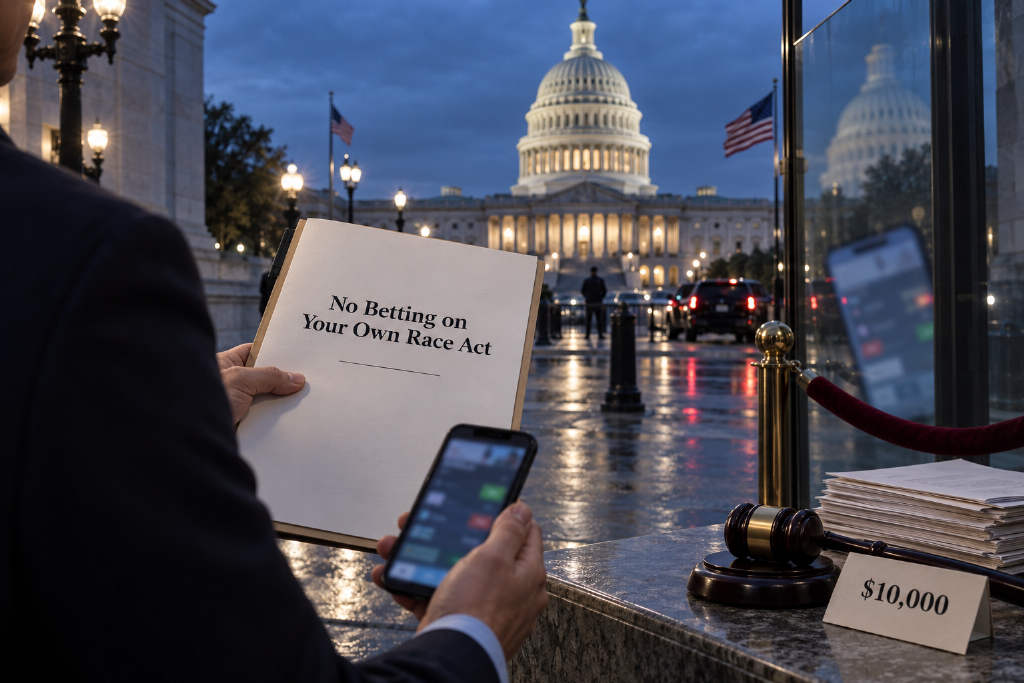
Federal candidates, their spouses, and campaign committees would be barred from trading prediction market contracts tied to their own elections under a bill introduced in the U.S. House on Monday.
The proposal, introduced by Representative Don Davis of North Carolina, is titled the No Betting on Your Own Race Act. It would amend federal election law to make that conduct a civil offense, carrying a penalty of $10,000 for each violation or three times the net financial gain, whichever is greater.
In a post on X, Davis wrote, 「We don't want our athletes to bet on their games. Candidates running for federal elected office should be treated exactly the same and should not be allowed to trade on their own election.」 He also said candidates from different political parties have traded on their own races and that Congress must end the practice.
Who and what the bill would cover
The bill is written broadly. It would apply not only to the candidate, but also to a spouse, a dependent child, and any authorized committee.
The prohibition would reach beyond contracts that settle on who wins an election. It would also cover contracts tied to whether a person remains a candidate at all, as well as contracts based on vote share, margin, or placement.
Indirect exposure would count too. The text says the ban would include inducing another person to trade, holding a beneficial interest under any title, or funding another person’s position while knowing what the money is for.
Exchanges would get room to act
Much of the bill’s text is aimed at exchanges rather than the candidates themselves. Under the section, platforms and their staff would not face penalties, and they would be protected from liability if they act in good faith to stop a violation. That protection would include restricting, suspending, or closing an account, and canceling, voiding, or unwinding a position.
Exchanges would also be allowed to report suspected violations to the Commodity Futures Trading Commission, the attorney general, or the Federal Election Commission without liability and without informing the person being reported.
FEC screening list and candidate notice requirements
To make screening possible, the bill would require the FEC to publish a free, machine-readable list of every federal candidate and update it at least once a week. The list would have to include each person’s name, commission identifier, office sought, and the dates they entered and left the race.
The FEC and state election boards would also have to notify candidates of the rules when they file.
A divestment window is included
The bill includes a limited grace period. If someone already holds or sells a position that becomes a covered contract once that person declares a candidacy, it would not be treated as an offense during the minimum divestment window allowed by the platform.
The definition of political event contracts is broader than election races
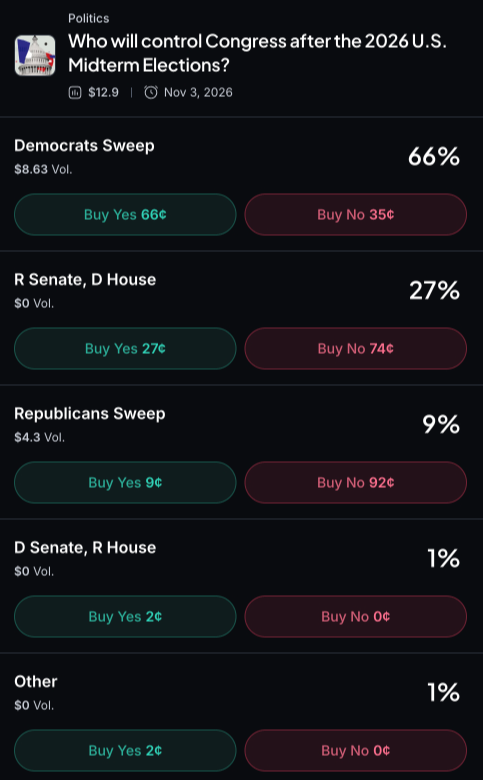
Its definition of a political event contract goes beyond candidate races. The bill would also cover caucuses, nominations, control of Congress, and any other political or governmental event that the CFTC designates by rule. The ban would apply to conduct from the date of enactment.
Exchanges have already been policing similar conduct
Before this proposal, exchanges had largely handled the issue on their own. According to Decrypt, Kalshi fined multiple congressional candidates earlier this year over bets on their own races and has since suspended candidates.
Separately, the CFTC is investigating former Representative Adam Kinzinger over trades tied to his own presidential pardon. Agency staff also warned exchanges last month that contracts settling on the conduct of named individuals should be presumed vulnerable to manipulation.