
This article was originally published by Bit.Fan. For more cryptocurrency news and market insights, visit www.bit.fan.
2026 Q2 Earnings Put Enterprise AI Agents on a Financial Scorecard
N
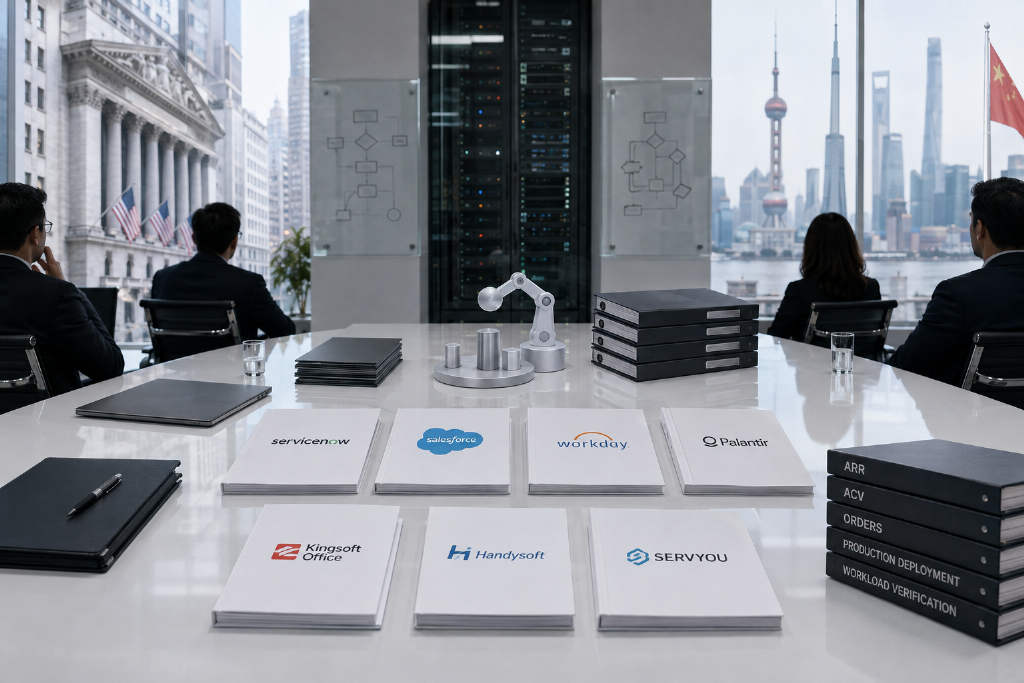
News EditorAfter reviewing Q2 earnings from U.S. and Chinese listed companies, PANews author qinbafrank argues that the market’s lens on AI agents has shifted. The question is no longer whether a model can call tools or finish a multi-step task. Investors are now watching ARR, ACV, production deployments, order flow, task volume, and whether agents are actually generating revenue, contracts, and cash flow.
ServiceNow, Salesforce, Workday, and Palantir each offer a different read on where enterprise agents are creating value. ServiceNow is increasingly framed as a governance layer for identity, permissions, monitoring, and execution. Salesforce is using Agentforce metrics to show that CRM context still matters. Workday’s data suggests AI is already contributing to new ACV in sensitive HR and finance workflows. Palantir, meanwhile, is closer to measuring outcomes than answers.
On the China side, Kingsoft Office, Taxaccurate, and Hande Information point to a different route: vertical workflows, document entry points, tax compliance, ERP integration, and legacy-system deployment. The piece argues that 2026 may be the first year when enterprise agents can be meaningfully validated in financial statements, even if the industry is still far from maturity.
Q2 earnings season is forcing enterprise AI agents onto a financial scorecard.
PANews author qinbafrank says the market has moved past the old questions — whether a model can call tools, chain together multi-step tasks, or power yet another demo. The new focus is ARR, ACV, new orders, production deployments, quarterly task volume, and whether agents are actually producing revenue, contracts, collections, and profit.
That matters because a working product only proves the technical path is real. Revenue and cash flow show that companies are willing to keep paying for it. The author argues that 2026 is shaping up as the “financial validation year” for enterprise agents, not as a sign of maturity, but as the first moment when real numbers can enter a financial model.
On the U.S. side, several companies stand out because they already sit inside enterprise data, permissions, and workflows.
ServiceNow reported Q2 subscription revenue of $3.877 billion, up 24.5% year over year. Its AI business has passed $1 billion in annual contract value, and agent deployments rose ninefold in nine months. The company is increasingly being viewed not just as IT ticketing or workflow software, but as a control plane for enterprise agents — a place where identity, permissions, monitoring, approvals, and rollback logic can be managed across multiple models.
Salesforce offered a cleaner test. Agentforce ARR has topped $1.5 billion, up more than 240% year over year, while combined ARR for Agentforce and Data 360 is close to $3.9 billion. In Q2, Agentforce and Slack handled 3.2 billion Agentic Work Units, up 97% sequentially. The author notes that this is not just about model intelligence. To finish real enterprise work, models still need customer records, order history, contract status, lead data, and permission systems. Claude may interpret intent, but Salesforce owns the business context and the execution path. The growth rate, however, should be read with caution, because Salesforce expanded the ARR scope this quarter to include other AI products, Slackbot, and Headless 360.
Workday shows a similar pattern in a more sensitive environment. AI has already contributed more than 25% of new ACV, and more than 5,500 customers are using at least one Workday-built agent. That suggests companies are not simply bypassing their core software in HR, finance, and audit workflows. Employee data, pay rules, financial policies, and organizational permissions already live inside Workday, so agents must operate within those fixed rails. Traditional SaaS vendors may lose some low-value seats and clicks, but platforms that own core data and business rules may find new upsell opportunities.
Palantir represents another shape of the same trend. Q2 revenue rose 93% year over year, while U.S. commercial revenue increased 149%. The company’s edge has long been connecting enterprise data, business objects, permissions, and production processes, then turning that into decisions and execution. Many agent products stop at generating an answer. Palantir is closer to delivering a result. Manufacturers care about reduced downtime, supply-chain teams care about inventory turnover, and sales teams care about conversion rates. Those measurable outcomes are what companies tend to pay for.
Put together, the pattern is clear: the earliest winners are usually the companies already embedded in core enterprise systems. Model quality matters, but deployment also requires data, permissions, workflows, audit trails, and customer entry points. A thin chat layer over a model is easy to copy.
The biggest change in this earnings season is how the market measures the category. User signups, trial customers, and token usage can show interest, but they do not prove the business model. More companies are now disclosing how much new ACV AI contributes, how much ARR agents create, how many customers move from trial to production, and how many tasks are actually completed. Salesforce’s use of Agentic Work Units is an important signal. SaaS used to charge per seat. The likely next step is a mix of base seat fees, AI usage, and task completion; in some high-value cases, pricing could even shift to outcome-based billing. That would push SaaS deeper into labor, outsourcing, and operating budgets rather than just internal IT spending.
Why could agents become a long-duration industry? The answer is reliability. If a single step works 95% of the time, a ten-step workflow has only about a 60% chance of finishing cleanly. Early agents often looked smart step by step, then failed in long processes, forcing employees to check, correct, and redo the work. As reasoning, context length, tool use, and memory improve, more steps can be completed before human intervention is needed. Once reliability crosses a threshold, an entire workflow can be automated. That is why the revenue curve may be nonlinear: agents may first organize information, then update systems, submit approvals, track progress, and handle exceptions.
The China market is validating the thesis too, but along a different path.
Kingsoft Office reported first-half revenue of 3.313 billion yuan, up 24.69%, and WPS 365 has now posted more than 60% growth for six straight quarters. Its strengths are obvious: document entry, formatting, collaboration, and enterprise office data. An office agent that can create, edit, review, and deliver files is more valuable than a chat box next to a document. Still, net profit rose more than 200% partly because of investment gains, so those one-off items need to be stripped out when looking at the core business.
Taxaccurate is one of the clearest vertical-agent cases on the A-share market. First-half revenue reached 1.012 billion yuan, up 9.72%, while adjusted net profit rose 44.04%. AI product and business collections already account for 33% of digital tax and finance collections, up from 28% for full-year 2025. Tax is a natural fit for agents: the rules are relatively clear, data is structured, results can be checked, and customers are willing to pay to reduce labor costs and tax risk. You do not need a model that can do everything; one narrow workflow done reliably can already create real revenue.
Hande Information is another example. Its AI smart-business revenue was about 220 million yuan in the first half, up more than 100%, and now makes up a double-digit share of total revenue. The company has long worked on ERP, supply-chain, manufacturing, and finance implementations. Enterprise agent deployment often runs into legacy-system integration, non-standard data, and complex approval flows — exactly the terrain Hande knows well. It may become a deployment and integration layer for domestic enterprise AI. But the A-share market also requires more caution on financial quality: many companies still rely on project-based revenue, and it remains unclear whether AI products can be standardized, improve margins, and shift from one-off implementation to subscription or usage-based billing.
The author breaks the agent stack into four layers. Layer one is foundation models and compute, which set the intelligence ceiling and inference cost. Layer two is data, identity, permissions, and governance; ServiceNow, Salesforce, and Workday are competing here. Layer three is workflow orchestration and execution, where Palantir, UiPath, and some enterprise digital-service vendors are active. Layer four is vertical agents in areas such as tax, office work, legal, healthcare, manufacturing, customer service, and sales.
Financial validation is clearest in layer two, because enterprises will not let an agent without permission boundaries and auditability touch core systems. Long term, layer four may have the most flexible upside because it maps directly to measurable work and can be priced against labor and outsourcing budgets. Layer three determines whether agents can actually reach production, since thinking is not enough — they also need to connect to legacy systems, call tools, handle exceptions, and finish the workflow. UiPath will be one important watchpoint when it reports Q2 earnings after the U.S. market closes on September 3, 2026.
For investors, the next checklist is straightforward: look at AI ARR, ACV, and real revenue first; then production customers; then AI’s share of new contracts; then task volume, end-to-end success rates, renewal rates, and expansion rates. Finally, return to the financial statements: gross margin after inference costs, implementation cycles, receivables, and operating cash flow. If every deployment requires six months of custom engineering, it looks more like traditional IT services. If agents can be copied quickly and marginal costs fall as usage rises, software operating leverage can finally show up.
The bottom line is simple. Model intelligence determines how much an agent can do. Enterprise data, permissions, and workflows determine whether that intelligence can safely enter production. Real task outcomes determine what customers are willing to pay. 2026 may be the first year enterprise agents are judged less by how smart they sound and more by how much work they actually finish.
100
Disclaimer:
The market information, project data, and third-party content displayed on this platform are for industry information sharing only and do not constitute any form of investment advice or return commitment.
Cryptocurrency trading carries high risks. Users should fully assess their risk tolerance and make independent decisions. All profits, losses, and legal responsibilities are borne by the users themselves.