
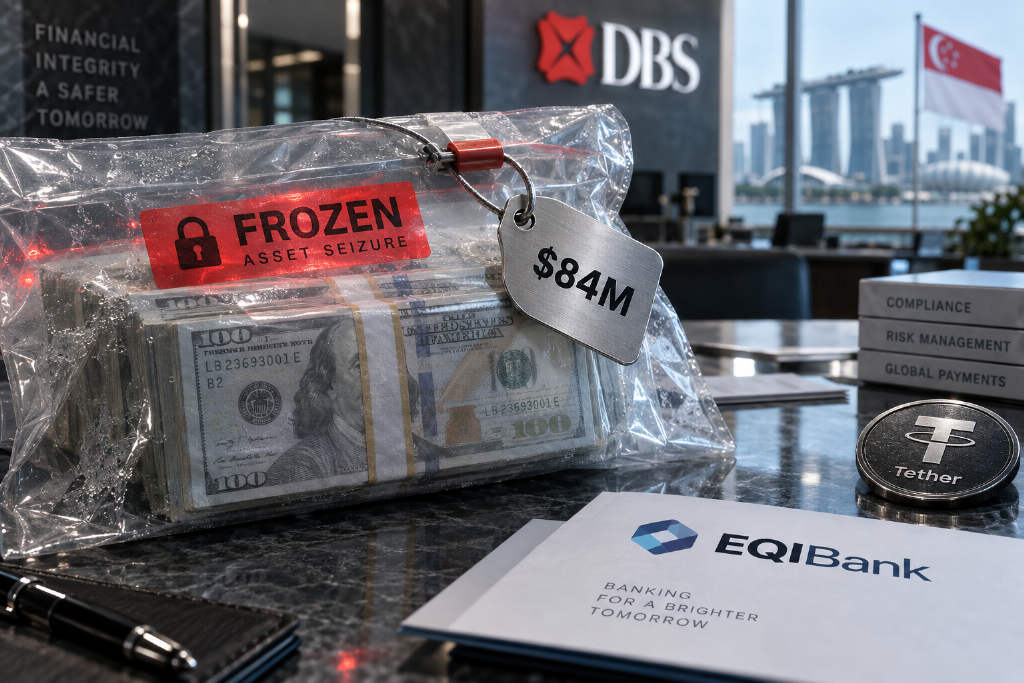
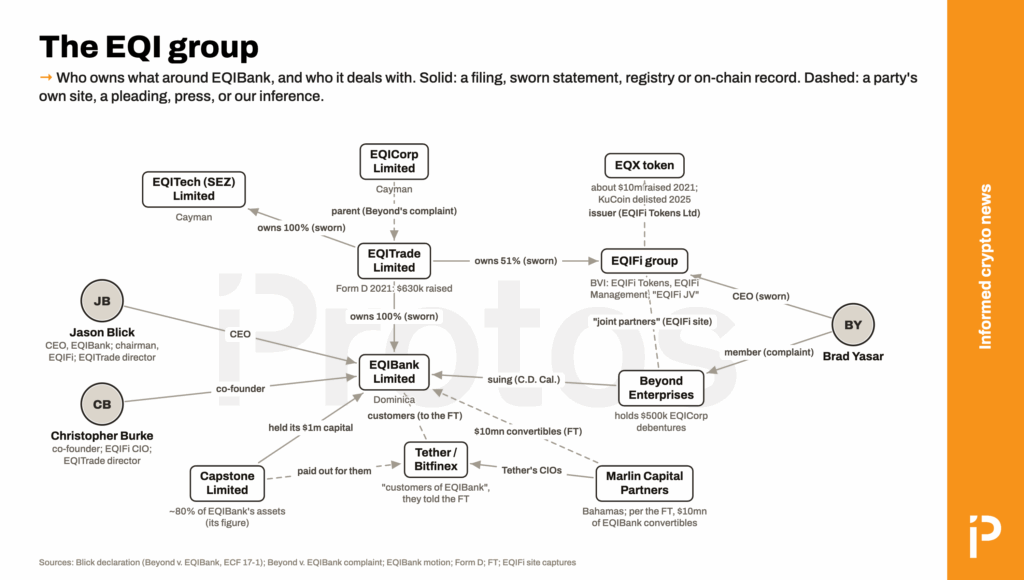
EQIBank said funds frozen in a US seizure tied to Capstone Limited accounted for roughly 80% of the bank’s monetary assets, a blow the lender described as a material liquidity crisis. Protos, citing Financial Times reporting, said the bank had been used by Tether and that the $84 million seizure targeted Capstone rather than EQIBank directly.
How the seizure hit EQIBank
According to the Financial Times reporting cited by Protos, Tether’s relationship with EQIBank ran through Marlin Capital Partners. Marlin Capital, described in the report as an investment adviser to Tether, had invested in EQIBank and reportedly promised more capital if the bank could help Tether open an account at Singapore-based DBS.
EQIBank said in a filing that it had a relationship with a firm called Clarency, which provided correspondent banking through DBS Singapore. The bank also relied on Capstone Limited to place deposits in the US and maintain relationships with US-based banks.
A civil forfeiture complaint filed in July alleged that Capstone misrepresented its business to banks including Wells Fargo, JPMorgan Chase, and Citibank. Instead of presenting itself as a money services business, Capstone said it was an application-development services company. The report says Capstone Limited was registered with the Financial Crimes Enforcement Network, or FinCEN, as a money services business, but only in Montana, not in California where it actually operated, and it did not clearly disclose that activity to the banks it used.
That registration was highlighted in negotiations with EQIBank. Protos pointed to an agreement dated August 20, 2024, between Dominica Bank 1 and Capstone stating that Capstone was a “FinCEN-registered technology development company and money service business.” The complaint, though, also alleges that Capstone’s Montana entity was not incorporated until September 2024, meaning it could not have been registered with FinCEN at the earlier date.
The complaint says Capstone moved hundreds of millions of dollars through its accounts. One passage states that of the $337 million withdrawn from Wells Fargo x7500, almost two-thirds appeared to go to hundreds of individuals and entities on behalf of “Cryptocurrency Company 1/Cryptocurrency Exchange 1.” Another Chase account sent international wires that likewise appeared to go to individuals and entities on behalf of the same pair.
In the complaint, Cryptocurrency Company 1 is described as a foreign issuer of a stablecoin pegged one-to-one with fiat currency, and people associated with it are also tied to Cryptocurrency Exchange 1. The filing also notes the company’s public statements about holdings of US Treasuries large enough to rank among the world’s biggest holders. Protos said that description likely points to Tether and Bitfinex.
The complaint also alleges that Capstone received US Treasury securities belonging to a foreign cryptocurrency company and that those securities were transferred into a securities account in Capstone’s name.
EQIBank said in its filing that the seized funds represented about 80% of the bank’s monetary assets. It also said the FSU had placed the bank under enhanced supervision and warned of possible further action, including liquidation. The filing states: “The bank faces a resulting material liquidity crisis. If the bank fails, years of work by its directors, officers, and founders since 2018 will be destroyed.”
EQIBank also said some assets it believed it held did not appear in the public forfeiture action. The bank said one account seemed to contain more money than the government actually seized and suggested that “Capstone, using the portal, may have misled the bank as to the amount of funds held for EQIBank at certain banks.” It also referenced funds at Barclays Bank and Clear Bank that were not mentioned in the public government seizure.
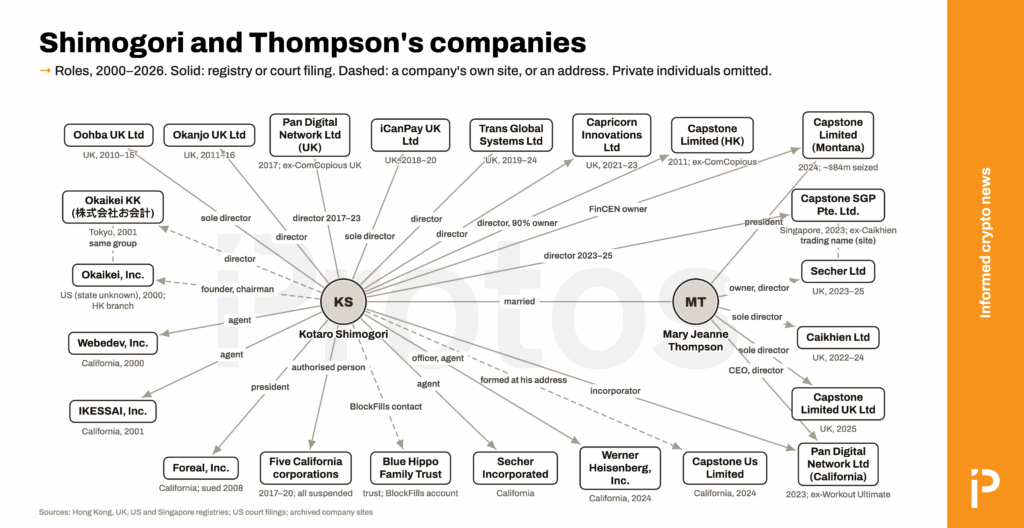
Kotaro Shimogori and the Capstone network
Capstone often presented Mary Jeanne Thompson as the person leading or operating the business. The complaint says Thompson told the FBI she was not heavily involved. It adds: “Her husband, Kotaro Shimogori actually operated Capstone.”
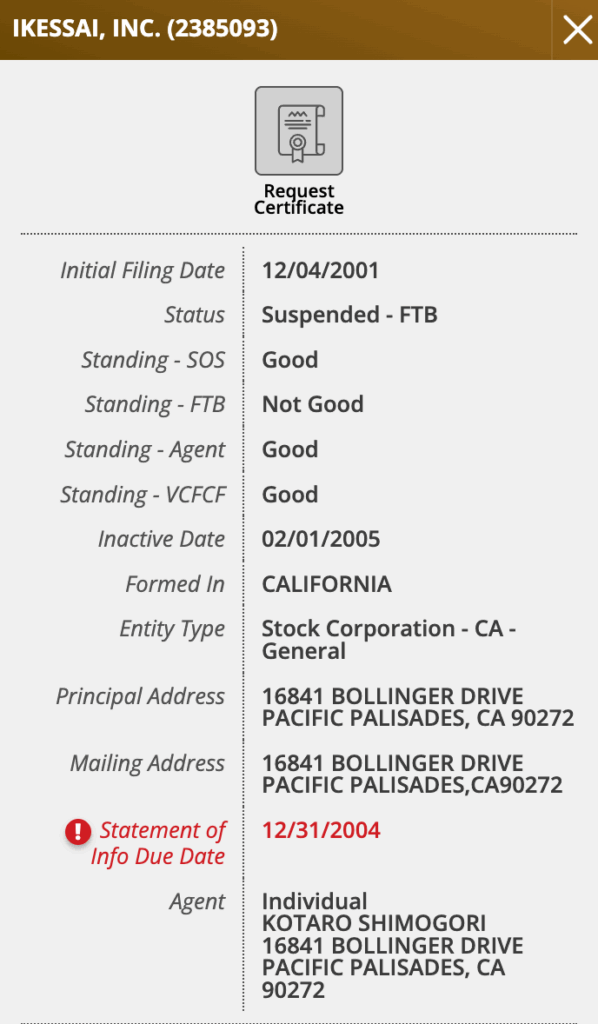
Protos then traces Shimogori’s record in payment processing back more than two decades. In the 2000s, he became the agent for Ikessai, Inc. days after the company, and Shimogori himself, were named in a lawsuit later dismissed. That case alleged breach of contract connected to a payments agreement. The same suit identified him as chief executive of another payments firm, Okaikei, Inc. Around the same period, his website included a page focused on card authorization and settlement.
Shimogori also served as president of Foreal, Inc. That company was later sued for contractual fraud, and a default judgment of $589,097.47 was eventually entered against it. Protos said Shimogori and Thompson later filed for bankruptcy, listing a $500,000 claim tied to that lawsuit, and the creditor also appeared on the discharge list.
In 2011, a Hong Kong firm called TechnoUnicorn Ltd was formed. It later became ComCopious Limited and then Capstone Limited. Protos stresses that this was not the Montana-registered Capstone Limited used by EQIBank and registered with FinCEN. Nor was it Capstone US Limited, a separate entity directed by George Thompson and incorporated at the same address Shimogori used as a correspondence address for Trans Global Systems Ltd. It was also distinct from Capstone SGP Pte. Ltd. in Singapore, where Shimogori served as a director, and from a California Comcopious entity, though the repeated names are hard to ignore.
Shimogori is a director of the Hong Kong entity and holds 13,500 of its 15,000 shares. When that company was still called ComCopious Limited, a website at icanpay.cn.com attributed copyright to COMCOPIOUS, LIMITED and advertised that businesses in high-risk merchant sectors could have applications approved within minutes through its proprietary system.
Protos said ComCopious Limited, both the Hong Kong and California entities, along with Shimogori, were repeatedly named in lawsuits alleging fraud, conversion, and breach of contract. Those cases offer a picture of the kinds of clients these businesses served. They were high-risk merchants, exactly as the marketing suggested.
In the Life-FX litigation, the plaintiffs were described as firms selling biochemical compounds online for non-clinical scientific research, businesses operating a legal online dispensary for medicinal cannabis and related products, and companies marketing marijuana seeds online. The report notes that those sectors drew close regulatory attention and plainly fell into higher-risk categories.
The same dispute also drew in iCanPay UK Limited, another company controlled by Shimogori. A separate case involving Helexo followed a similar pattern. In a reply supporting a motion, the defense said Helexo operated multiple gambling websites that were unlawful in California. Shimogori stated in that suit that iCanPay helped Helexo process credit-card transactions and transferred the proceeds owed to Helexo to a cryptocurrency wallet held by Helexo. The suit also alleges that iCanPay used Shimogori’s own HSBC account to meet critical obligations.
The Fresh Horizons matter showed another similar pattern. According to Shimogori’s declaration, Fresh Horizons Limited was a British Virgin Islands gaming company offering remote gaming services under a license from the Kahnawake Gaming Commission. A defense memorandum, though, accused the company of operating in a legal gray zone through a British Virgin Islands shell company.
Related suits also named Pan Digital Network Limited in the UK, formerly Comcopious UK Limited, where Shimogori served as a director and exercised significant influence or control. There was also a California-incorporated Pan Digital Network Ltd, where Shimogori is listed as incorporator and Thompson as chief executive and director. Protos said one lawsuit, filed after Shimogori resigned from the UK-based Pan Digital Network, alleged that Pan Digital Network Limited had operated and continued to operate the Brango Gambling Platform.
Shared infrastructure and payment rails
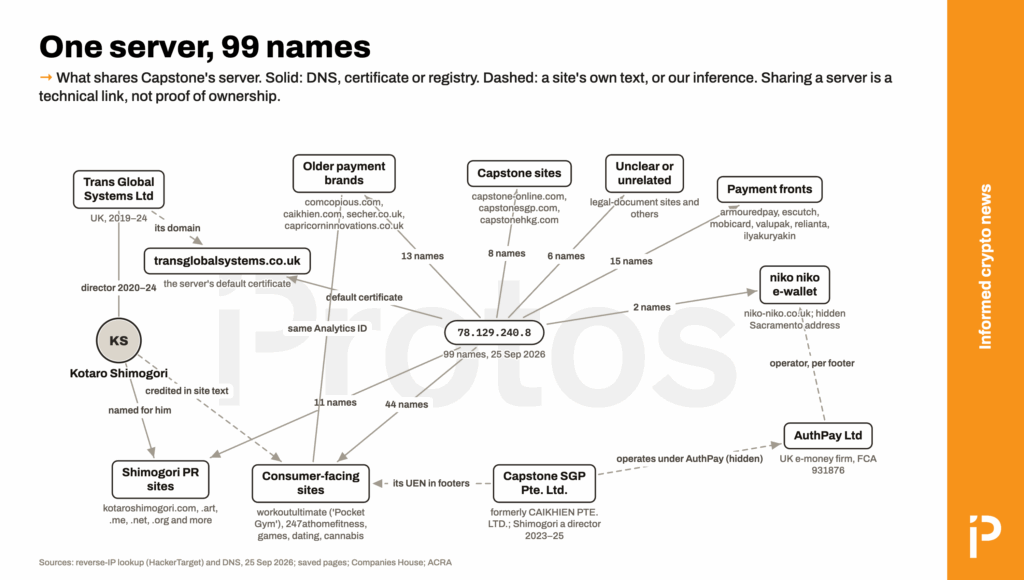
Protos argues the latest seizure is only one small part of Shimogori’s history in high-risk payment processing. It also points to technical links between websites associated with Capstone, Shimogori, and several related entities.
Several sites that appear connected to Capstone, along with Shimogori’s personal website, share an IP address, a sign they may have been hosted together. His personal site advertises design awards, patents, and his work as an e-commerce leader for companies including WorkoutUltimate and NIKO NIKO, the latter promoted as “mobile banking everyone loves.” Workout Ultimate was the former name of the California-based Pan Digital Network Limited.
The site niko-niko.co.uk previously said it was owned by Capstone Limited and operated by AuthPay Limited. There are no longer DNS entries for that domain, but Protos said a query to 78.129.240.8 still returns it and still references AuthPay. Metadata on the site said NIKO NIKO’s secure banking technology was developed with strategic oversight from Kotaro Shimogori, describing him as “a fintech pioneer with extensive experience in secure payment systems and cross-cultural digital commerce.”
DNS entries still exist for nikoniko.co.uk, which also references AuthPay and uses the same description of Shimogori in its source code. Other sites tied to the same IP address refer to names including ComCopious, Caikhien, Secher, Capricorn Innovations, and Trans Global Systems Ltd.
Fraud allegations in the forfeiture complaint
The government’s forfeiture complaint says some of the money processed by Capstone was tied to scams. It specifically alleges that Chase x6970 received proceeds from impersonation fraud schemes, in which scammers posed as government or law-enforcement officials and pressured victims into wiring money.
The complaint describes several victims. One was a 69-year-old who got a call from someone pretending to be an FBI agent and was told the victim was a person of interest in a multinational money-laundering scheme. Another was told she appeared to be involved in major crimes and would be arrested unless she posted bail equal to part of her assets. A third was told by a fake FBI agent that his name was linked to an account involved in laundering $2.38 million.
When Chase raised questions, the complaint says Capstone and related parties produced a contract service agreement dated May 20, 2025, between Capstone and a foreign counterparty describing “software development and related technology services.” They also produced a Capstone invoice dated November 12, 2025, billing that foreign counterparty $1.9 million for software licensing, web development, advanced web modules, and API integration, among other items, and a billing statement from the foreign counterparty charging Victim 1 $868,000 for services rendered.
The complaint then says: “On a call with Chase, Thompson could not answer basic questions and deferred to Kotaro Shimogori, who gave contradictory accounts of who supplied the software — Capstone or a foreign counterparty — and claimed Victim 1 purchased a medical billing system. Chase identified no bona fide software development work and concluded the software references appear to be fictitious.”
But the complaint also describes a different version of events from Capstone’s own chief operating officer, who is not named. According to Protos, that executive told the Miami Beach Police Department that he had “sold nine hundred thousand dollars worth of USDT Tether, TRC20 coins to Victim 1, sent the coins to a wallet, and received a wire that was later recalled.” The executive summary he submitted said US bank wires were received into Capstone’s JPMorgan Chase account for the “purchase/settlement of USDT (Tether)” and that, after USDT was delivered on-chain following instructions from Capstone’s institutional counterparty, the originating wires were recalled or claimed as fraudulent.
Protos says the complaint does not identify the COO. It notes, however, that Capstone US Limited, the George Thompson-linked company that shared an address with Shimogori-related firms, named Michael Khait as a director and listed a Miami Beach address.
EQIBank, EQIFi, and USDT payment trails
EQIBank is regulated in Dominica and, according to Protos, appears to have held part of Tether’s reserves. The report also says the bank had links to a token project.
EQIFi originally promoted itself by saying that EQIBank, “one of the world’s leading digital banks,” had launched EQIFI as a global DeFi alternative to traditional financial products. Companies connected to EQIFi later issued the EQX token, marketed as a governance token for the platform. The project also said token holders would receive lower fees, better trading rates, and access to other platform benefits.
EQIFi also stated that the EQX token would give holders priority access to EQIBank bank accounts. The token was listed on KuCoin and was later delisted.
Beyond Enterprises, sometimes spelled Beyond Enterprizes, was described as a joint partner in the token project and is led by Brad Yasar. That company is now suing EQIBank for breach of contract. Protos says invoices filed in that case included addresses for USDT payments and that, when those dates and amounts are compared with blockchain data, it appears likely that EQIBank and EQITech (SEZC) Limited used USDT to make payments. On that basis, the report suggests Tether may not have been only a client of EQIBank and that EQIBank itself may have used USDT for payments.
Marlin Capital, Deltec, and Tether’s financial advisers
The Financial Times reporting cited by Protos says Marlin Capital Partners invested in EQIBank and offered more investment if the bank could secure the DBS relationship. In a UK court filing, Marlin Capital was described as Tether’s de facto financial adviser.
Filings with the Securities Commission of the Bahamas list Zachary Lyons as Marlin Capital’s chief executive, advising representative, and managing representative. Lyons was also announced as Tether’s chief investment officer, succeeding Richard Heathcote, who had likewise been an advising representative for Marlin Capital.
Before that, both Heathcote and Lyons worked at BankPro, with Heathcote serving as chief executive. Earlier still, both had been representatives of Deltec Bank and Trust, a bank Protos describes as an important part of Tether’s history because it provided banking services at a time when many institutions would not. Lyons also sits on the board of Twenty One, a Tether-backed company.
Echoes of Crypto Capital Corp
Protos says Tether’s direct or indirect reliance on payment processors with troubling histories is a recurring theme. The clearest earlier example, it argues, was the relationship between Tether, Bitfinex, and Crypto Capital Corp.
Crypto Capital Corp was an unlicensed payments firm. When its funds were seized, it created major problems for Tether and Bitfinex. According to the report, both firms depended on Crypto Capital and its principals to keep access to the US banking system. Those funds were later seized in matters tied to money laundering and drug-proceeds investigations, leaving a hole in Tether and Bitfinex’s books.
After that gap became public, the companies issued the Unus Sed Leo token to raise enough money to fill it. Protos says the current situation again appears to involve Tether and Bitfinex losing access to funds after accounts connected to a payment processor were seized.
There is one major difference. Even if the full $84 million seized were entirely Tether’s, the report says that amount would represent only hundredths of one percent of Tether’s reserves.
Responses from Tether and Capstone
Tether told the Financial Times that it had no knowledge of the fraudulent conduct by Capstone alleged by the US Department of Justice.
A lawyer for Capstone told the Financial Times that the company denies wrongdoing and plans to challenge the government’s civil asset forfeiture complaint by filing a motion to dismiss. The lawyer added: “Capstone has co-operated with the government’s investigation and hopes to resolve this matter quickly.” Protos said that motion to dismiss has since been filed.
Protos also said it had contacted Capstone, Shimogori, and EQIBank with questions, but none immediately responded.