

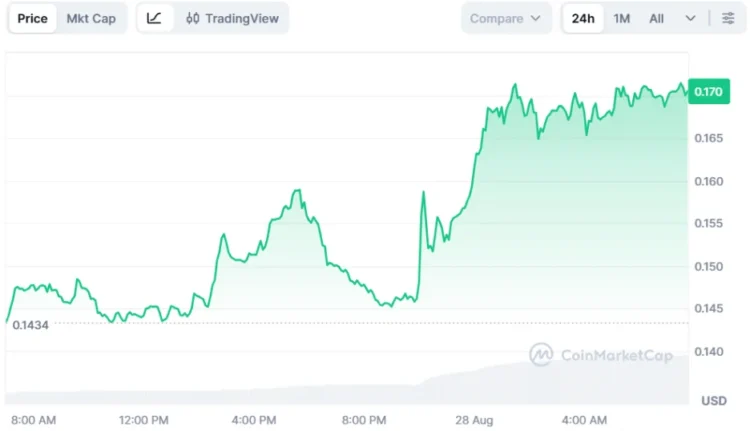
Ethena Foundation rolled out a sweeping reform package for its protocol ecosystem and tokenomics on the evening of Aug. 27, putting supply pressure, value capture and buybacks at the center of the plan. After the announcement, ENA climbed more than 20% at its intraday high and nearly 60% over the week, extending gains seen over the past month.
The package consists of four connected changes. Together, they are aimed at reducing the overhang created by recurring VC unlocks and channeling more of the protocol’s economic value to ENA holders.
Four changes in one package
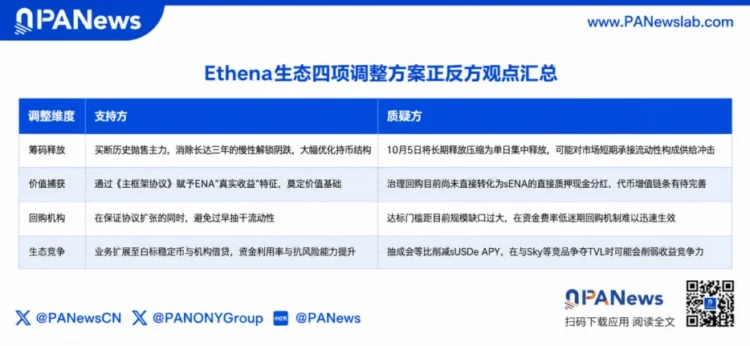
The plan includes buyouts of some early investors’ locked tokens, the removal of the three-year monthly unlock schedule for VC investors, a Master Framework Agreement covering protocol economic rights, and a tiered fee-switch model that ties ENA buybacks to USDe supply.
At the core of the redesign is a simple issue: the market has been dealing with two problems at once, ongoing supply concerns and weak direct linkage between protocol revenue and tokenholder value.
Targeted repurchases of early locked allocations
The first move is a repurchase of locked tokens held by some early backers. The foundation split seed investors with initial allocations above 0.25% of total supply into two groups.
For institutions that had already reduced positions in the secondary market after the market peak in October last year, the foundation offered to buy out all of their remaining locked tokens. One wallet declined the offer. For investors that had never sold, the foundation offered an option to exit at par, but no institution chose to give up its tokens.
In practical terms, the step is meant to remove part of the unstable overhang from the cap table. Ethena did not disclose the number of tokens involved or the size of the transactions, so the immediate effect on circulating supply cannot yet be measured.
Monthly VC unlocks to end, full release set for Oct. 5
The second change is the cancellation of the token’s three-year monthly unlock schedule for VC investors. All remaining locked VC tokens will instead be released in full on Oct. 5. Team allocations will remain locked under the original schedule and will not be accelerated.
After the change, the share of tokens still locked across the network will fall to about 12%, mainly held by the team, the ecosystem and the foundation.
The article argues that the problem with monthly vesting is not only fresh supply, but the constant expectation of selling pressure. A new tranche becomes liquid each month, and that can weigh on valuation over a long period. A one-time release concentrates the supply shock into a single event rather than stretching it out.
That does not remove the risk. A full release at one time can also create a larger short-term supply shock. The outcome will depend on two variables cited in the article: the size of the unlocked amount and how investors actually behave after the release.
Master Framework Agreement to define where value sits
The third change addresses a long-running DeFi question: who ultimately holds claim over protocol economics. Ethena Foundation and development entity Ethena Labs have reached a Master Framework Agreement, with the full text scheduled for release in October.
Based on what has been disclosed so far, key intellectual property tied to Ethena and the economic value generated by the protocol will belong to the foundation and its ecosystem, with governance exercised by ENA holders.
If implemented as outlined, ENA’s value proposition would no longer rest only on governance in the abstract. Protocol economics would be folded into the token’s value-capture structure.
Fee switch would direct revenue to ENA buybacks
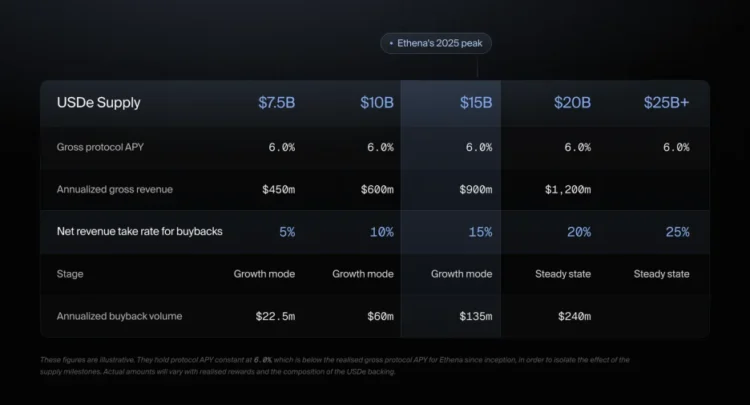
The most closely watched piece of the package is the tiered revenue buyback mechanism, described as a fee switch. The proposal has already been approved by the risk committee and has gone live for governance voting, with results due on Sept. 2.
Under the design now on the table, once USDe supply reaches the activation threshold of $7.5 billion, 95% of the foundation’s net revenue would be used for programmatic ENA buybacks in the secondary market. The remaining 5% would go to ecosystem growth. As USDe supply climbs to higher levels, both the percentage allocated to buybacks and the size of those buybacks would increase in steps.
The funds would come from three business lines inside the protocol: USDe savings yield, white-label stablecoin operations, and net revenue from Ethena [X], which the article says is due to launch next week.
That gives ENA a direct line to protocol income, but only if USDe returns to growth. The article notes that the derivatives market is currently subdued and funding rates are low, which could leave the buyback engine underused in the near term.
USDe fell from nearly $15 billion to $4 billion
The backdrop to the overhaul is a major contraction in USDe scale. The article says USDe previously relied on a delta-neutral hedging strategy built around long spot crypto positions and short futures positions, capturing basis-trade income during a stronger derivatives market. At one point, supply approached $15 billion, making Ethena one of the standout names in the synthetic dollar sector.
As the crypto market cooled and derivatives funding rates dropped sharply, USDe market value shrank to $4 billion. Protocol revenue tightened, and ENA was left facing both supply overhang and a lack of a clear value anchor.
That is why Ethena’s challenge now is not only token supply. It also involves a stalled feedback loop between USDe growth, protocol revenue and token value.
Business diversification efforts are already underway
According to the article, Ethena has already started trying to reduce its reliance on crypto derivatives funding rates this year and broaden its revenue mix.
- It set up a $1 billion financing facility with FalconX to connect USDe-backed collateral to the institutional overcollateralized lending market.
- It brought in Janus Henderson as an ENA investor while exploring distribution channels for USDe.
- It teamed up with Coinbase to launch savings-related structured products for both retail and institutional users.
The protocol is trying to expand into stablecoins, savings products and institutional credit. In that context, the tokenomics changes are presented as a matching redesign of the value model. In the old setup, USDe growth mainly translated into protocol revenue, while ENA holders did not necessarily capture that upside directly. The new structure aims to pass some of that value through buybacks.
Short-term reaction versus long-term execution
In the near term, improved supply expectations and the prospect of buybacks may support sentiment. Whether the reform works over time will depend on business growth underneath it.
The article frames the main question this way: can Ethena move from a pro-cyclical high-yield product to a diversified revenue infrastructure? If USDe returns to growth and newer businesses such as white-label stablecoins and institutional lending keep contributing revenue, a loop of revenue growth, larger buybacks, token appreciation and ecosystem expansion could take shape.
If revenue remains heavily tied to the crypto market cycle and those newer businesses do not scale as hoped, the buyback mechanism may function more as a valuation adjustment tool than as a durable value-capture system.
The broader point is that Ethena’s restructuring fits into a wider DeFi shift. Many governance tokens have long depended more on narrative and expectations than on direct economic linkage, while token unlocks and inflation stayed as persistent pressure points. More large protocols are now trying to tie buybacks to revenue and use governance structures to capture protocol value.
For Ethena, the first major test of this redesign will come on Oct. 5, when the one-time token unlock takes place.