
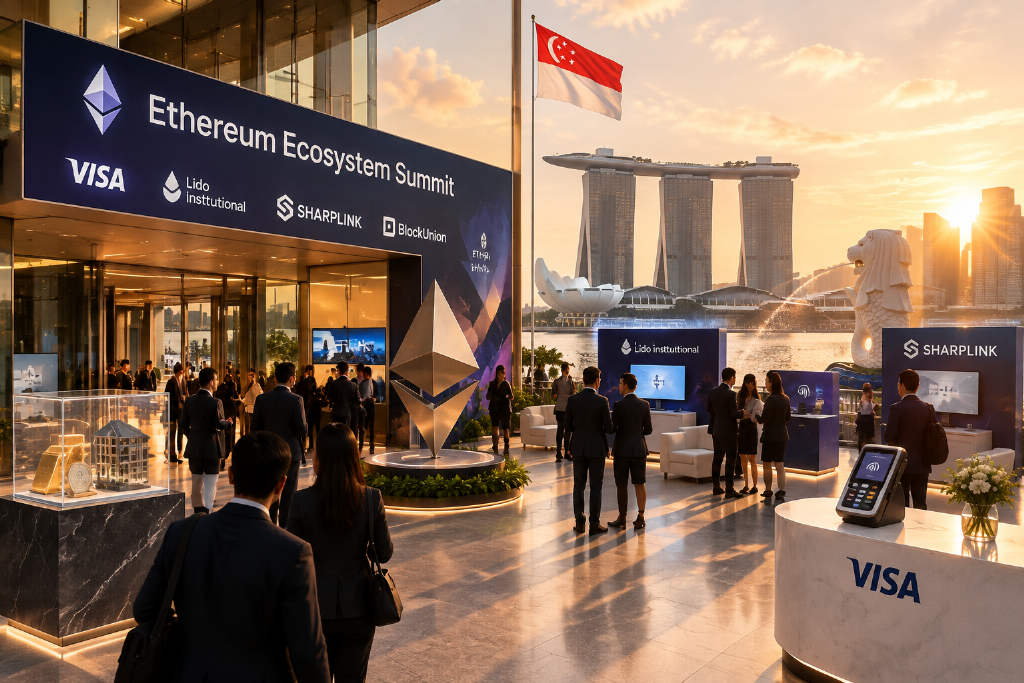
The Ethereum Ecosystem Summit was held during TOKEN2049 in Singapore. The event was hosted by Sharplink, Visa and BlockUnion, with Lido Institutional and ETH HK Hub serving as co-hosts. Conversations focused on institutional-grade infrastructure, stablecoin payments, asset tokenization, agentic finance and cross-regional ecosystem coordination.
Organizers said the summit received more than 1,800 registrations, making it one of the more closely watched side events during TOKEN2049 Singapore. Attendees included participants from protocol research, staking services, payment networks, asset management, digital asset custody and application development across the Ethereum ecosystem.
Ethereum’s next decade: cryptographic trust, finance and user control
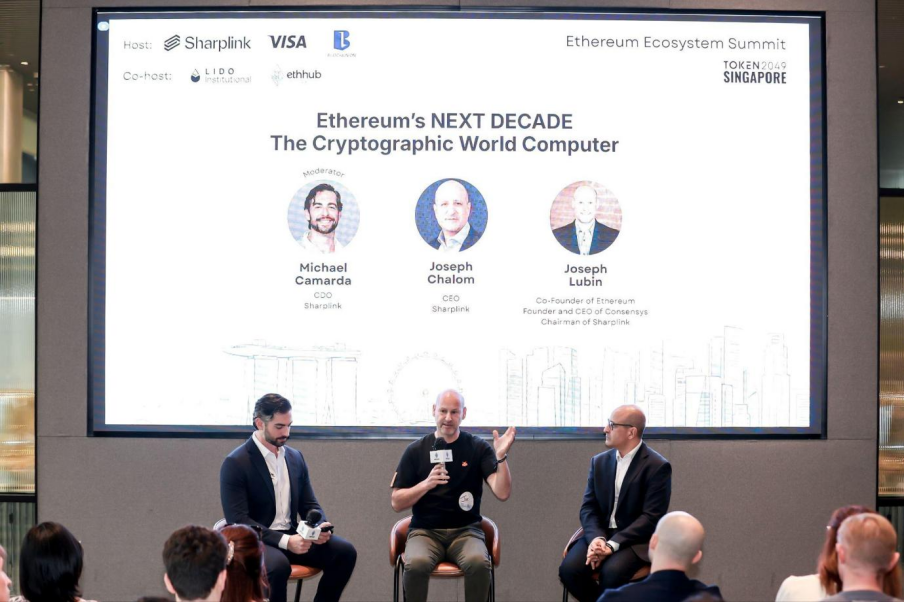
In a fireside chat moderated by Sharplink Chief Development Officer Michael Camarda, Ethereum co-founder, Consensys founder and CEO, and Sharplink Chairman Joseph Lubin joined Sharplink CEO Joseph Chalom to discuss Ethereum’s next ten years, covering technical evolution, financial use cases and user autonomy.
Lubin said Ethereum offers a new technical basis for global coordination through decentralized trust. As traditional finance and decentralized finance move closer together, he said open, programmable networks could support smoother movement of assets and extend into identity, data and internet applications. He also pointed to the potential role of zero-knowledge proofs, or ZK, in real-time verification and cross-network coordination, saying the technology may reduce duplicated computation, improve network performance and create new routes for linking assets and liquidity across different networks.
Drawing on his experience with the tokenization of the BUIDL fund, Chalom said credible neutrality, openness and decentralization matter in practical terms for financial institutions. He said institutions changing core infrastructure need confidence in the stability of operating rules, network availability and long-term access.
Both speakers stressed the importance of real-world use and user experience. Chalom said stablecoins and tokenized products need to enter actual trading and treasury workflows and keep generating liquidity. On agents, he said they should operate with defined permissions, persistent identity and transparent execution so user-defined rules can be enforced in code. Lubin, referencing the direction of MetaMask, spoke about links between self-custody, payments, asset management and delegated authorization. He said wallets may evolve into the application layer for personal finance, identity and data management, giving users more control over digital assets and online activity.
Institutional infrastructure: protocol capability, privacy and system connectivity
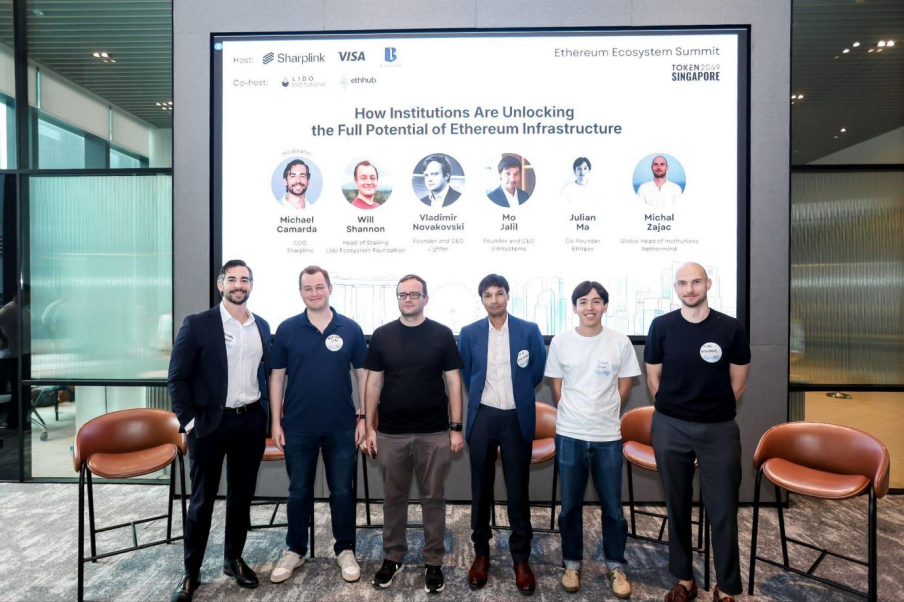
A separate panel, also moderated by Michael Camarda, examined the protocol features, privacy tools, staking services and systems integration institutions need before adopting Ethereum at scale. The conversation also touched on longer-term areas such as privacy protection, quantum resistance and mainnet scaling, with panelists saying institutional adoption will require protocol capability, risk controls and system compatibility to advance together.
Ethlabs co-founder Julian Ma said the company is working to bring core protocol development closer to the needs of application teams and institutions. He highlighted shorter transaction confirmation times, better interoperability between Ethereum mainnet and layer-2 networks, and a smoother experience for moving assets across networks.
EthSystems co-founder and CEO Mo Jalil said confidentiality and compliance controls remain important requirements for large institutions entering public blockchains. He said EthSystems has been speaking with banks, asset managers and regulators, then turning those requirements into open-source tools, technical standards and reusable privacy infrastructure.
Lighter founder and CEO Vladimir Novakovski used Lighter’s own work to describe the relationship between Ethereum’s security base and high-performance trading systems. He said layer-2 networks can handle high-frequency trade execution while posting cryptographic proofs of correctness back to Ethereum, creating verifiable assurance around execution quality.
Will Shannon, Head of Staking at the Lido Ecosystem Foundation, said institutional staking due diligence now extends across node operator distribution, client diversity, infrastructure resilience, liquidity and custody access. He said Lido’s stVaults are designed to give institutions more flexible node selection and separate accounting while preserving access to stETH liquidity and DeFi applications.
Michal Zajac, Global Head of Institutional Business at Nethermind, discussed how internal institutional systems connect to blockchains. He described pre-trade transaction checks, controls over who receives transaction-fee payments, and reporting of onchain transaction data back into internal systems. He also said tokenized assets need standardized information formats that existing trading systems can recognize if institutions are to reduce onboarding and operational complexity.
Agentic payments: programmable money, authorization and financial automation
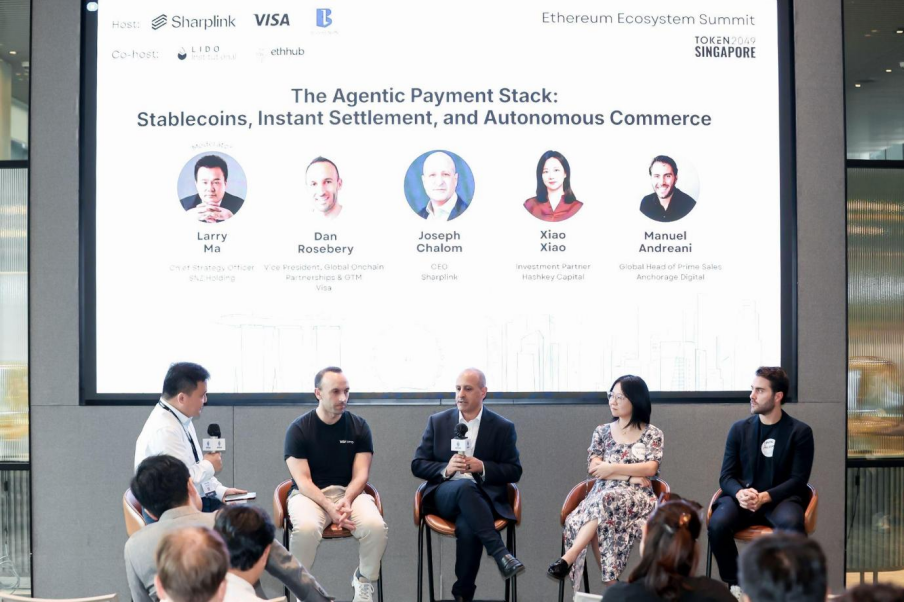
In a panel moderated by SNZ Holding Chief Strategy Officer Larry Ma, speakers discussed how stablecoins, instant settlement and agentic technology could reshape financial services and commercial transactions. Panelists offered different views on whether enterprise use or consumer use would come first, but kept returning to the same issue: how to improve execution efficiency while maintaining clear authorization boundaries and accountability.
Chalom said stablecoins provide always-on programmable money, tokenized assets expand the utility of assets, and onchain trading platforms create new venues for financial activity. Agents, he said, could become the persistent automation layer running across those functions. He added that as financial knowledge and ongoing engagement improve, individual users may take a more active role in managing cash, investment portfolios and other financial needs.
Visa’s Dan Rosebery said trust, clearly defined permissions and payment authorization are central in agent-driven commerce, while existing payment networks still have an important role in helping merchants accept those payments.
Manuel Andreani, Global Head of Prime Sales at Anchorage Digital, said agents in institutional settings need to operate under defined compliance, risk and settlement rules while preserving a full audit trail. He said “Know Your Agent,” or KYA, is set to become a capability worth watching. Even as execution becomes more automated, he said financial institutions will continue to hold value in rule enforcement, responsibility and client relationships.

Xiao Xiao, Investment Partner at HashKey Capital, said treasury management and cross-border payments already present relatively clear enterprise demand, and programmable payments could remove friction from traditional processes. At the same time, identity verification for agents, permission management, anti-fraud tools and risk controls could open new infrastructure opportunities.
Lido outlines Lido Lend as it expands beyond liquid staking
Isidoros Passadis, Chief Staking Officer at the Lido Ecosystem Foundation, used a keynote to describe Lido’s product expansion strategy and the newly announced Lido Lend. He said Lido’s long-term vision is to support Ethereum as the internet’s core economic and coordination layer, extending from liquid staking and Lido Earn into open and resilient onchain financial infrastructure.
Passadis said Lido Lend will focus on specific use cases such as loop lending and target conservative lenders and professional borrowers. The aim, he said, is to offer a more reliable exit path and reduce the impact of market volatility on borrowers. The design is based on a modified fork of Morpho Blue and is expected to introduce additional safety mechanisms while complementing existing lending markets and Lido’s broader product suite. He added that launch and acceptance by Lido DAO still require governance votes, and invited institutions to provide feedback based on business needs and regulatory requirements.
Institutional adoption and tokenization: utility first
Another panel, moderated by Henry Chen, Chief Business Officer at SNZ Holding and Partner at BlockUnion, focused on asset tokenization, onchain asset-management vaults and enterprise blockchain development. Speakers compared native issuance and wrapped tokenization across legal rights, market access, privacy and issuance efficiency.
Ian Wallis, Digital Assets Director at Baillie Gifford, said onchain funds need to be operated like software products that keep evolving. Tokenization, he said, should deliver concrete improvements for investors, including more efficient subscriptions and redemptions, secondary-market liquidity, and the ability to use fund shares as collateral. He also described Baillie Gifford’s product thinking around starting from client demand and exploring how native onchain funds can map directly to legal rights.
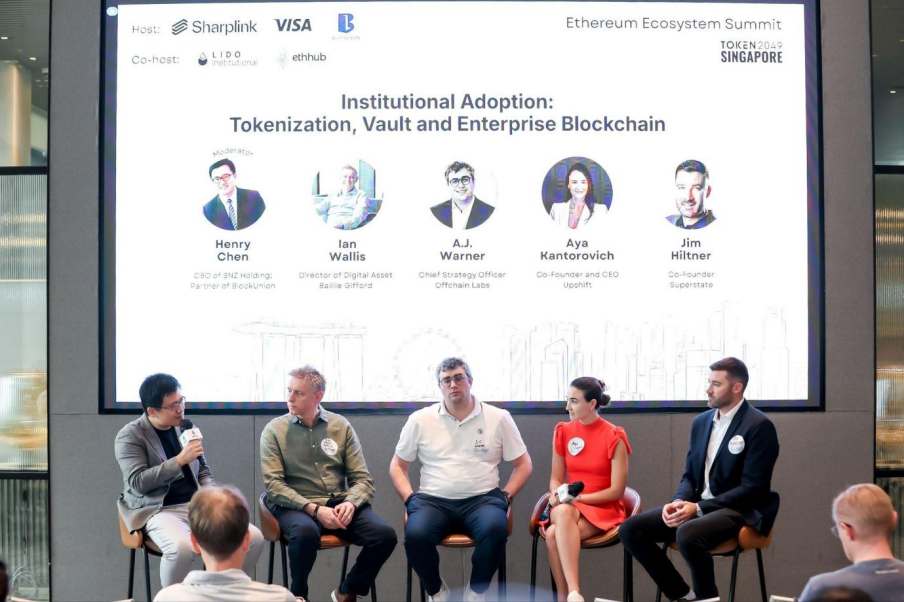
Superstate co-founder Jim Hiltner said stablecoins are becoming a funding rail for some investors buying financial assets. Through tokenization, asset managers can reach new investor groups and allow funds, stocks and bonds to participate in lending, trading and other onchain applications. Native tokenization may also strengthen the direct link between issuers and investors, he said.
Aya Kantorovich, co-founder and CEO of Upshift, said onchain vaults and strategy management are becoming more customized as demand expands from overcollateralized lending into U.S. Treasuries, equities, debt instruments and thematic portfolios. She said crypto-native strategy teams and traditional asset managers are likely to work more closely together, and traditional managers are also expected to become more active in managing onchain strategies. She added that once products move onchain, they still require ongoing management and distribution across different ecosystems.
A.J. Warner, Chief Strategy Officer at Offchain Labs, referred to Offchain Labs’ experience working with Robinhood when discussing how enterprise blockchain systems can be designed around trading, privacy, compliance and product experience. He said the decision to build a standalone network should be driven by business goals, and that for some issuance use cases, shared infrastructure, shared liquidity and composability may prove more valuable.
Academic research: NFT behavior, risk links and listing signals
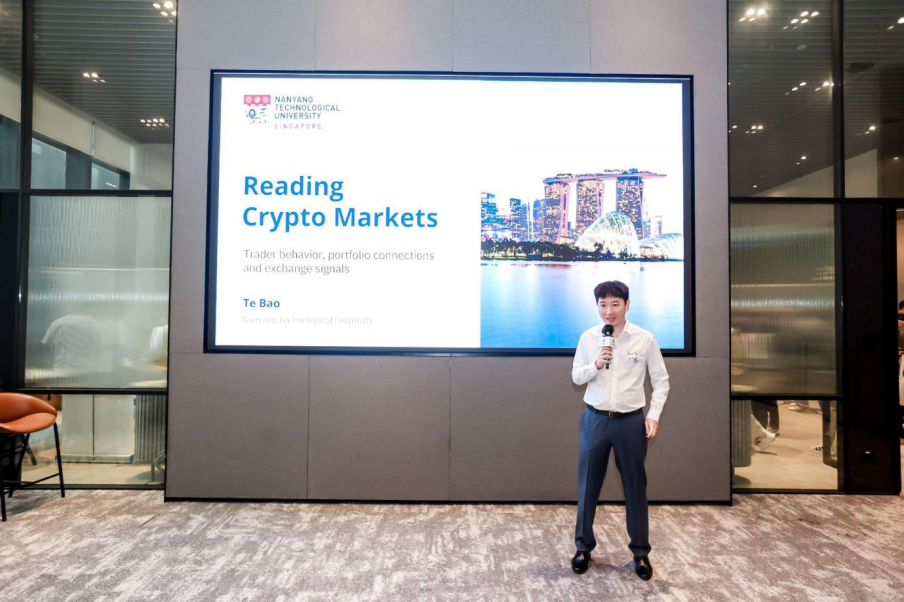
Bao Te, Associate Professor at the School of Social Sciences and Assistant Dean of Graduate Studies at Nanyang Technological University, presented three research topics tied to crypto markets: herding effects in NFT markets, risk connections among assets, and listing premiums on trading venues.
He discussed how major news and market signals affect investor behavior, and compared crypto assets with traditional equities in terms of risk networks and risk-adjusted returns. He also shared findings on abnormal returns when assets are first listed on higher-rated trading platforms, followed by weaker listing premiums later on. Those findings were presented as reference points for understanding digital-asset pricing and portfolio construction.
Global ecosystem coordination: Devcon and India’s builder base
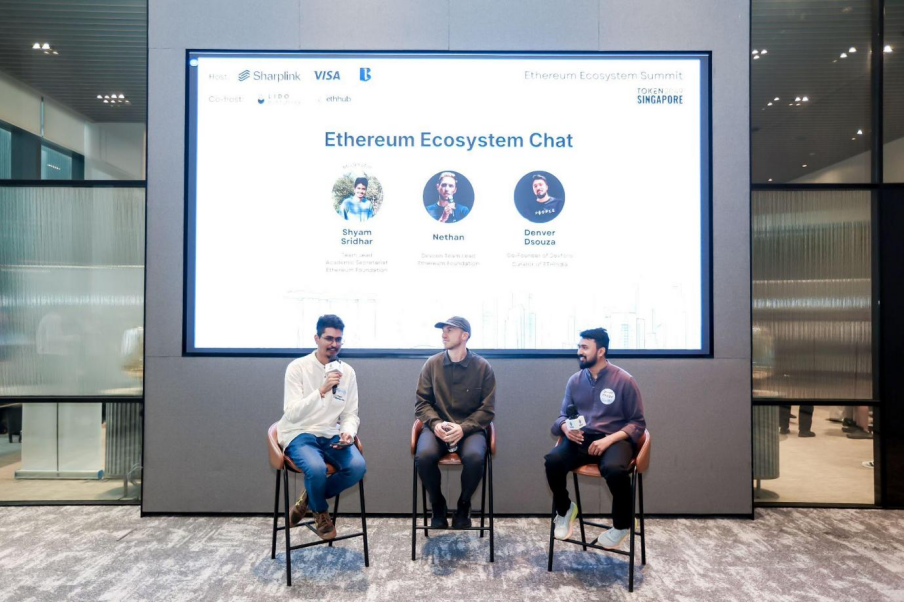
In an ecosystem session moderated by Shyam Sridhar, who leads the Academic Affairs team at the Ethereum Foundation, speakers turned to Devcon and the growth of Ethereum in India. Nethan, who leads the Devcon team at the Ethereum Foundation, said India’s active developer and user base is a major reason Devcon is heading there. He said he hopes the event can improve public and regulatory understanding of Ethereum’s real-world use while supporting developers building locally.
Denver Dsouza, co-founder of Devfolio and curator of ETHIndia, said the Indian community has built a deep base through hackathons and developer events, and that tokenization and institutional applications are becoming new points of focus. ETHIndia, he said, will connect local builders, the international community and institutional participants to deepen collaboration and strengthen understanding of Ethereum as a neutral and trusted technical foundation.
Connecting Asia with the global Ethereum ecosystem
According to the organizers, the summit’s agenda covered protocol research, institutional access, financial products, payment applications and community building. Taken together, the discussions showed how different parts of the Ethereum ecosystem are becoming more tightly connected. Topics ranged from infrastructure performance and privacy to practical utility for tokenized assets and the trust and authorization models needed for agentic finance.
As organizer, BlockUnion, together with co-host ETH HK Hub, said the summit helped connect the Asian Ethereum ecosystem with global participants and created a platform for traditional financial institutions, technical teams and startups to collaborate. The organizers said the Hub will continue to support Ethereum research, institutional adoption and real-world applications through cross-regional events, community work and resource coordination.
About the organizations mentioned by the organizers
BlockUnion
BlockUnion (HK) Limited described itself as a Web3 ecosystem platform in Asia built around the idea of “Connect to Empower.” According to the event materials, the firm draws on more than a decade of investment and project experience in Ethereum and Web3, along with long-term work in Hong Kong and broader Asian markets, and focuses on community aggregation, ecosystem acceleration, research and consulting, and innovation investment incubation.
The company said it serves global Web3 ecosystems expanding in Asia, enterprises and financial institutions using blockchain and digital assets, and developer and venture communities in the region. It also said it has long supported the ecosystems of Chainlink and Xinghuo BIF, and helped launch ETH HK Hub with support from the Ethereum Foundation. The team, according to the materials, combines institutional capital-markets experience with a crypto-native background.
ETH HK Hub
ETH HK Hub was described as Asia’s first physical Ethereum community hub. The materials said it is supported by the Ethereum Foundation and jointly operated by BlockUnion, SNZ and ETHTAO. Its stated goal is to connect East and West, as well as Web2 and Web3, through community building and resource coordination. The organizers listed https://ethhkhub.com as its website.
Sharplink
Sharplink (NASDAQ: SBET) was introduced as an institutional Ethereum treasury platform designed to offer public-market investors exposure to ETH. The event materials said the company was founded in 2019 and is headquartered in Miami, Florida. The organizers listed https://www.sharplink.com/ for more information.
Lido
Lido was described as an open-source liquid staking middleware that lets users participate in blockchain validation and earn staking rewards. According to the materials, Lido connects users with node operators so they can stake digital assets without maintaining their own hardware, and those users can also deploy supported liquid staking tokens in third-party DeFi applications. The organizers listed https://lido.fi/ for more information.