

Ethereum’s long-running argument over Layer 2 is shifting again. In an analysis written by imToken and published by Foresight, the core claim is that Ethereum is no longer dealing only with how to add more blockspace. The bigger question is how to redraw the division of labor between L1, L2, execution, and settlement once transactions, assets, and user state are spread across more and more execution environments.
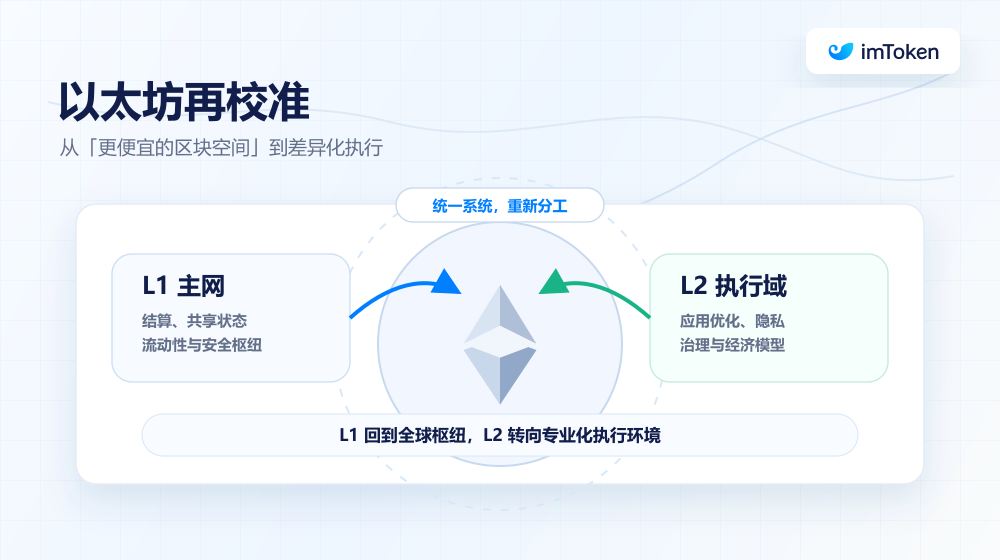
For the past two years, the Ethereum community has been crowded with concerns such as whether L2s are eating into L1’s value and whether Ethereum is losing the global composability that once defined it. Under the earlier scaling framework, L1 served as a stable but expensive settlement layer, while L2s handled cheaper and more efficient execution. That setup gave Ethereum more room to process activity, but it also chipped away at the experience of using Ethereum as one chain.
The report argues that these tensions have pushed Ethereum to revisit the long-term relationship between the base layer and rollups. On one side, Ethereum L1 has been moving to raise gas limits and advance statelessness and zkEVM-based verification instead of staying confined to the role of a low-throughput settlement base. On the other, community debate has become more direct. Earlier this year, Vitalik said that as Ethereum mainnet improves its own scaling capacity, some of the assumptions behind the roadmap set roughly five years ago, which treated L2 as the primary scaling path, have changed. More recently, Ethereum researcher Barnabé Monnot said the ecosystem needs to reexamine the long-term L1-L2 relationship, including how L2s should create value, why finality should be cut dramatically, and whether L1 itself could, in some sense, become its own rollup as proof systems enter mainnet validation.
L2 is not being discarded, but its role is changing
The piece says that when Ethereum’s rollup-centric roadmap first took shape, the job of L2 was straightforward: provide more transaction capacity at a lower cost.
That division made sense under the technical constraints of the time. Ethereum validators had to re-execute L1 transactions, which meant mainnet throughput could not be increased aggressively in the short term. Rollups, by contrast, could execute transactions off-chain in batches and submit compressed data or state commitments back to mainnet, preserving part of Ethereum’s security model while sharply reducing per-transaction costs.
Over time, that produced a parallel strategy. L1 stayed conservative and focused on decentralization and security. L2 absorbed additional transaction load and kept pushing costs down with blobs, data compression, and proving systems.
The analysis says the assumptions behind that split have now changed. In 2026, the Ethereum Foundation reorganized protocol work and merged what had previously been treated as separate tracks, “Scale L1” and “Scale Blob,” into a single scale roadmap. Raising the gas limit, expanding data availability, optimizing execution clients, advancing statelessness, and pushing forward zkEVM attester client work are now part of one scaling framework.
That change does not mean Ethereum plans to pull all activity back to mainnet, and it does not mean L2 is being abandoned. It means L2s may have a much harder time proving durable value simply by offering faster transactions and lower gas fees.
If L1 can increase execution capacity by orders of magnitude while preserving security and decentralization, then ordinary EVM execution and cheaper blockspace will no longer be capabilities unique to L2. The piece argues that L2 value will increasingly need to come from differentiated offerings that L1 cannot satisfy in one uniform design, such as application-specific optimization, privacy, and more flexible governance or economic structures.
That shift also appears in the Ethereum Foundation’s latest framing of the relationship between L1 and L2. In the earlier view, the top priority for L2 was to scale Ethereum, while customization and differentiation were secondary. In the updated view, the primary role is to offer differentiated features while still contributing extra scaling capacity. L1, in turn, is expected to serve as a strong, permissionless, highly resilient global hub for settlement, shared state, liquidity, and DeFi.
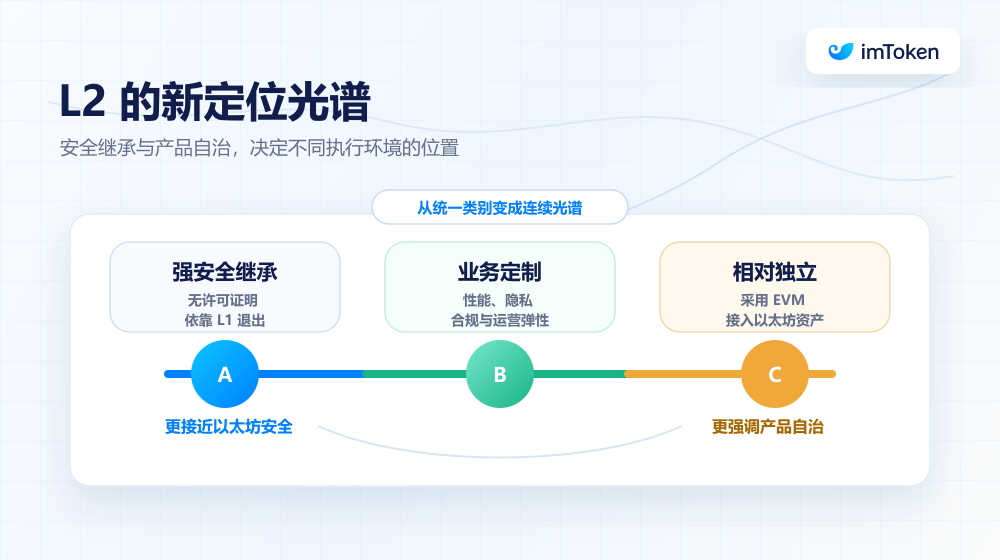
Under that lens, L2 stops looking like one unified technical category and starts to look more like a spectrum.
- At one end are rollups that aim to inherit as much of Ethereum’s security as possible. They seek to reduce reliance on multisig security councils, open up permissionless proving, and make sure users can still exit through L1 even if the operator stops running.
- In the middle are execution environments that inherit only part of Ethereum’s properties based on business needs. They may use stronger admin controls, independent sequencers, or compliance-specific designs in exchange for performance, privacy, and operating flexibility.
- At the far end are chains that may use the EVM, Ethereum-native assets, or some shared cross-chain infrastructure, yet remain relatively independent in security and settlement.
The conclusion is not that Ethereum is moving away from L2. It is trying to define the split more clearly. Over the past three to five years, L2 mostly meant a scaling technique. Going forward, it may increasingly refer to a set of execution environments with different relationships to Ethereum in security, settlement, and liquidity.
Interoperability is about trusted state, not only cross-chain transfers
Once Ethereum expands into a system made up of many L2s, another familiar problem becomes harder to ignore: liquidity, account state, and the application experience all get fragmented as activity spreads out.
The article points to the user experience of the past few years. A user may hold assets on one chain, use an application on another, and complete a trade on a third. A single stablecoin can exist in different versions on different networks, while the same account has to deal with different gas tokens, bridges, and asset entry points.
That is why interoperability is taking a larger place in Ethereum’s roadmap. According to the piece, the protocol team has centered the 2026 Improve UX roadmap on two areas: native account abstraction and interoperability. The stated goal is to make Ethereum “feel like one chain” again, and that depends on intent-based architecture becoming mature.
In the Open Intents Framework, users only specify the result they want, such as converting an asset on chain A into USDC on chain B. Solvers behind the scenes then handle route calculation, pre-funding, execution, and liquidity rebalancing. A further step, the Ethereum Interoperability Layer, or EIL, aims to build a trustless transport layer so that transactions across L2s can feel much closer to transactions on a single chain.
Account design is changing at the same time. The report notes that EIP-7702 in the Pectra upgrade already allows traditional externally owned accounts to temporarily execute smart contract code, enabling batched transactions, gas sponsorship, and recovery mechanisms. Later native account abstraction proposals, represented in the article by EIP-8141, aim to move smart account logic into the protocol itself so that smart contract wallets gradually become the default account form and reliance on extra bundlers, relayers, and intermediary services can be reduced.
Shorter finality is another key part of the discussion. The article says an L1 fast confirmation rule would try to provide a stronger confirmation signal within tens of seconds, before full finality arrives. That would shorten waiting times in normal application flows and directly matter for cross-chain systems that rely on L1 finality, including bridges, stablecoin settlement, and trading in tokenized real-world assets.
The report makes a narrower point here: the true bottleneck in many cross-chain interactions is not whether a message can be sent, but when the destination chain can be sufficiently sure that the source-chain state will not be reversed.
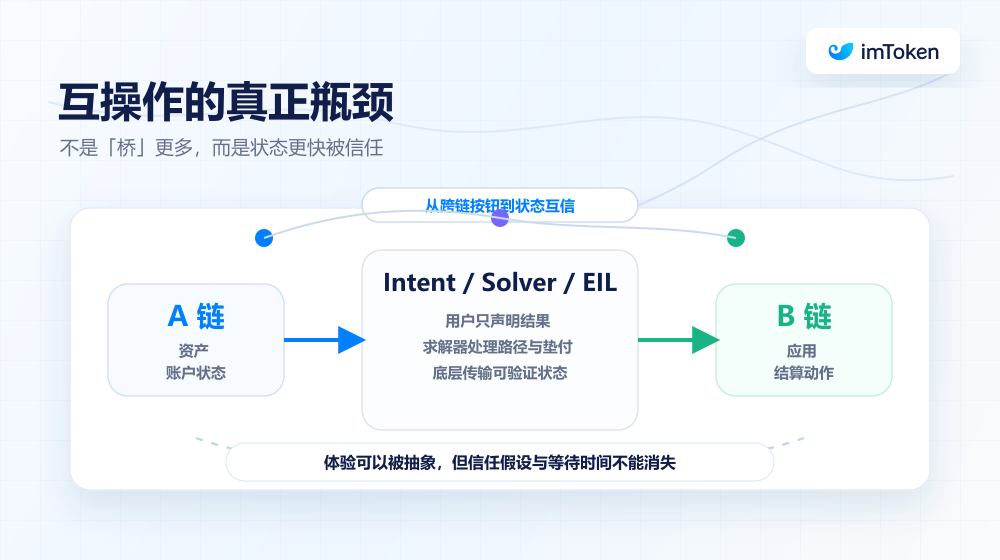
A transaction being included in a block is not the same as finality. From the user’s side, it may appear successful within seconds. For bridges, exchanges, lending protocols, and cross-chain solvers, that is not enough. They still need to assess the chance of a reorg and decide whether assets can safely be released on another chain or whether a next step can be executed.
That is why many services that seem close to instant settlement are not actually waiting for final settlement on the source chain. In many cases, solvers or liquidity providers front the funds first. The mechanism improves the user experience, but it does not remove the underlying waiting period.
Ethereum’s longer-term goal, as presented in the piece, is to reduce finality itself from minutes to seconds. This is not described as one scheduled upgrade. It is a bundle of research efforts to be advanced in stages, including separating finality voting from fork choice, optimizing validator sets, vote aggregation, and network propagation, and only then changing the consensus protocol step by step.
Viewed this way, good interoperability is not about giving dozens of chains the same bridge button. It is about making different execution environments able to trust one another’s state faster and at lower cost.
If L1 starts to look like its own rollup
The third section turns to Barnabé Monnot’s argument that as proving systems enter Ethereum mainnet, L1 itself could eventually become, in some sense, its own rollup.
That sounds counterintuitive at first. Rollups are normally understood as scaling networks built on top of L1. They execute transactions elsewhere, and L1 verifies the resulting state. Ethereum mainnet, as the base consensus and settlement network, does not look like something that could become its own L2. The article says the phrase only makes sense once “rollup” is separated from a strict layer label and understood as a broader execution-verification pattern.
In Ethereum today, once a node receives a block, it must re-execute all transactions inside it, compute the state transition independently, and check whether the block follows protocol rules. That model preserves independent verification, but it also ties network-wide execution capacity to the hardware limits of ordinary nodes. The more computation a block contains, the more hardware and time validators need to process it.
If real-time proving and L1 zkEVM become mature, that relationship may change. High-performance execution nodes could still do the heavy computation, but ordinary validators would no longer need to re-execute every transaction themselves. Instead, execution nodes would generate validity proofs, and other validators would verify those smaller, cheaper proofs to confirm that the state transition is correct.
In execution-verification terms, that starts to resemble a rollup model. One set of participants handles high-performance execution. The output is compressed into cryptographic proofs. A broader set of consensus participants does not repeat the full computation but verifies the proof and accepts the final state.
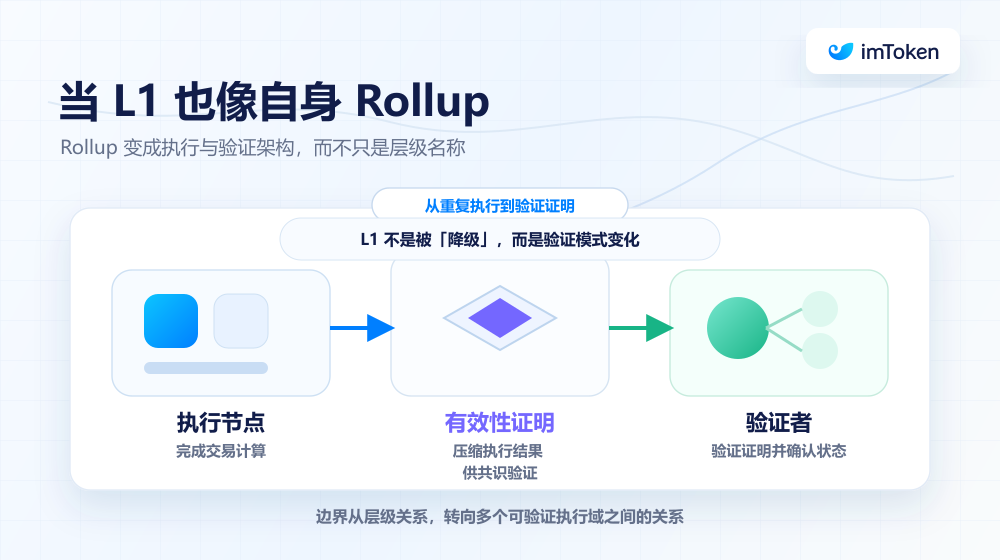
So when Monnot says L1 could become its own rollup, the point is not that Ethereum mainnet will sit on top of another base chain or be downgraded into its own L2. The point is that once proofs begin to replace repeated execution by every node, “rollup” may stop being only a name for a layer above L1 and become a more general architecture for execution and verification.
That would blur the traditional line between L1 and L2 even further. L1 could expand its own execution capacity with zkEVM-based proofs, while native rollups would try to tap Ethereum’s in-protocol verification capabilities more directly so that L1 can validate L2 state transitions in a more native and unified way.
Today, different rollups usually need to build their own proving systems, verification contracts, upgrade mechanisms, and security councils. If a proving system fails, an emergency upgrade is needed, or an operator stops functioning, users often still depend on extra governance and trust layers. The long-term direction of native rollups, according to the article, is to turn part of rollup verification into an Ethereum-native capability so that L2s can reduce self-built security structures, inherit L1 state transition rules more completely, and potentially move away from security councils.
The piece then pushes the idea one step further. If multiple L2s can rely on faster L1 confirmation, a shared proving mechanism, and synchronously composable access to each other’s state, their relationship with mainnet may no longer be defined mainly by a web of bridges.
Instead, they may look more like multiple execution domains under a single Ethereum consensus umbrella. Some would focus on general-purpose finance. Some would target gaming, social applications, or payments. Others would offer privacy or specialized compliance features. Their execution logic and product form would differ, but they would still depend on a common system for verifiable state, security foundations, and asset settlement.
The article is careful to call this a long-term direction rather than a settled protocol path. Even so, it says these lines of research are already changing how the boundary between L1 and L2 is understood. What used to look like a clean architectural divide is gradually becoming a spectrum of security inheritance.
Ethereum’s next task is to reconnect what scaling split apart
The closing argument is that Ethereum first gained global composability through shared state, then gained more capacity by splitting execution out through rollups. Its next task is to reconnect assets, accounts, and applications without undoing the scaling gains that came from that split.
For ordinary users, the ideal Ethereum should not look like a network map made up of dozens of chains, different gas tokens, and bridges. Where a trade is executed, where liquidity comes from, and who finally settles it can gradually be handled by wallets, applications, and the underlying protocol. But the trust assumptions, security boundaries, and exit paths embedded in that experience cannot disappear just because the interface becomes smoother.
The article’s conclusion is that the endgame for L2 may be neither replacing L1 nor being pushed aside by an expanding L1. It may be a set of execution environments with different functions and performance profiles that still share security, liquidity, and state relationships. Ethereum once increased capacity by splitting execution. The next phase will test whether it can put the system back together again.