


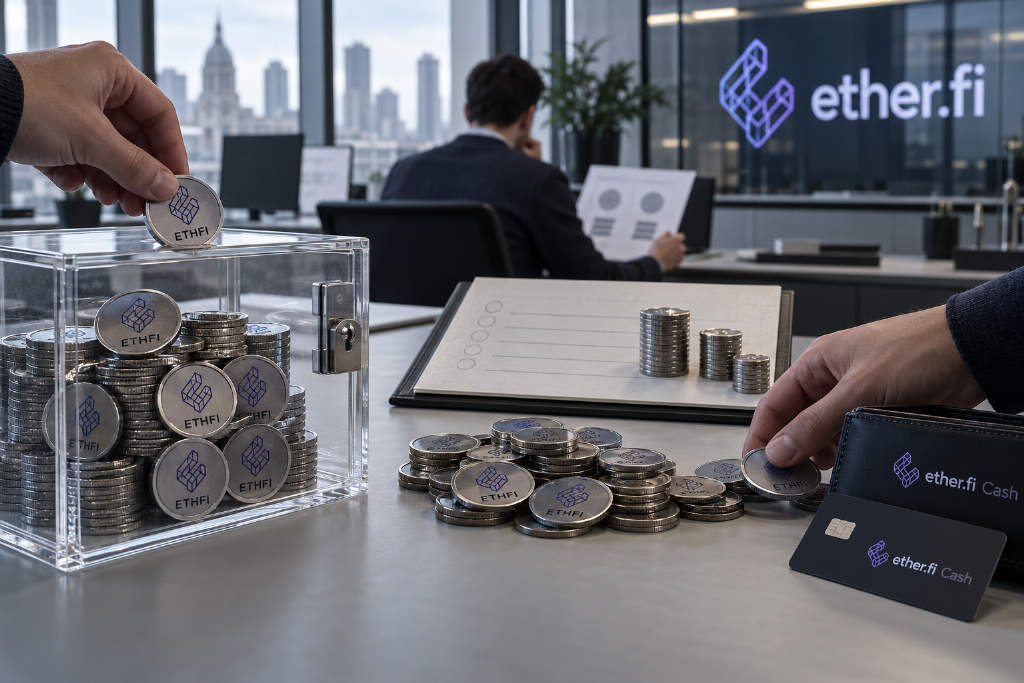
A PANews market analysis says EtherFi’s ETHFI buyback program is running below its original guidance and has yet to show the kind of supply reduction usually associated with a traditional token buyback. The article, written by Carlos and translated by AididiaoJP for Foresight News, argues that most of the repurchased tokens are effectively cycling back into the market rather than being removed from circulation.
The original bullish case centered on EtherFi Cash
The author says he explained on an Aug. 13 Analyst Hours call why he remained bullish on ETHFI. At the time, the token had just sold off following an Ethereum staking proposal, and the market was valuing EtherFi mainly as a staking company while overlooking EtherFi Cash, its crypto payment card business.
According to the article, EtherFi Cash was already contributing 65% of EtherFi revenue, with card spending reaching $100 million in July. The buyback program was presented as a way to connect that growth to the token. The author also says the market was underestimating Cash’s broader progress, with payment cards serving as the acquisition channel and borrowing and trading features deepening monetization.
What was missing at the time, the article says, was a clear mechanism for token holders to share in that growth. Later that same day, on an investor call, the company outlined a plan: a programmatic buyback starting in September, with initial guidance of about $1.33 million per month.
Six weeks into the program, the author says it is worth measuring how far execution has diverged from that guidance and why EtherFi’s structure should not be compared directly with standard buybacks that actually remove tokens from circulation.
Buyback spending is below guidance and has not risen with Cash spending
Since the week of Sept. 7, EtherFi Labs has sent $1.48 million to the Foundation for buybacks, including a $225,000 transfer made most recently, the article says. That marks the third straight week at the same amount.
As of Oct. 18, the Foundation had bought 1.81 million ETHFI at an average price of $0.692. At a weekly pace of $225,000, monthly buyback spending works out to about $975,000, around 27% below the earlier guidance of roughly $1.33 million.
The author says the fixed weekly amount raises questions because the proposal had indicated buybacks would scale with EtherFi Cash spending. Over the past eight weeks, weekly Cash spending rose from $27.6 million to $31 million, but buyback spending did not move.
If the two are meant to be linked, the article argues, buybacks should have increased as spending climbed, or at least not stayed flat.
The article says this is not a standard buyback because most purchased tokens flow back out
The piece lays out two common buyback models. One is buy-and-burn, cited with PUMP and UNI, where tokens are permanently removed from supply. The other is buy-and-retain, cited with Hyperliquid’s Assistance Fund, where tokens are not burned but are still taken out of circulation. In both cases, circulating supply falls.
EtherFi’s setup is described as different. The proposal said half of the purchased ETHFI would remain in the Foundation treasury and half would be distributed as cash back. But based on the team dashboard, the author says nearly all purchased tokens ended up going toward cash back.
Over the past six weeks, EtherFi’s distribution contract paid out 1.83 million ETHFI, almost the same as the amount bought over the same period. Recipients later moved 1.28 million of those tokens out of Cash accounts, or about 70%, leaving only 548,000 in the accounts.
That, the article says, means users converted ETHFI back into dollars, offsetting much of the buy pressure created by repurchases. On a cumulative basis, buybacks still exceed outflows by 42%. On a weekly basis, though, that edge has disappeared. In the week of Oct. 12, outflows were 7% higher than buybacks, marking the first negative net flow, according to the author.
From that, the article concludes that EtherFi’s buyback functions more like a customer acquisition cost paid in ETHFI than a supply-reduction mechanism. The author adds that this does not automatically make the model bad, but it does mean it should not be compared directly with the buybacks of PUMP, UNI, or HYPE, where tokens are taken out of circulation.
Revenue-funded rewards, but no direct re-rating through lower circulation
The article also points to what it sees as the positive side of the design. Rewards are funded by revenue rather than token issuance, the author says, and the number of receiving accounts rose from about 3,800 at the end of September to 6,820.
Still, the author says the program is unlikely to drive a token re-rating through lower circulating supply in the way a burn mechanism might.
Two things the author is watching next
The article highlights two follow-up questions.
First, whether buyback spending can catch up with the original guidance, or whether the team will clarify how much of spending is actually allocated to ETHFI repurchases. With weekly buybacks stuck at $225,000 while spending rises, the author says it is not yet clear how the current execution lines up with the proposal.
Second, whether borrowing revenue can be folded into the buyback program. The trigger is for Cash loans on EtherFi’s Aave V4 instance to reach $50 million. Loans currently stand at $42.1 million, up 78% since mid-August, while borrowing revenue remains small at about $31,000 per week.
The article ends by saying EtherFi’s new banking business is still growing. The author remains positive on ETHFI and says it still offers exposure to the on-chain banking theme. At the same time, he argues that while the buyback design is interesting because it rewards users and funds growth with revenue rather than issuance, it does not directly support a token re-rating by shrinking circulating supply.
The article notes that it reflects the columnist’s personal view and does not represent PANews’ position or constitute investment advice.