
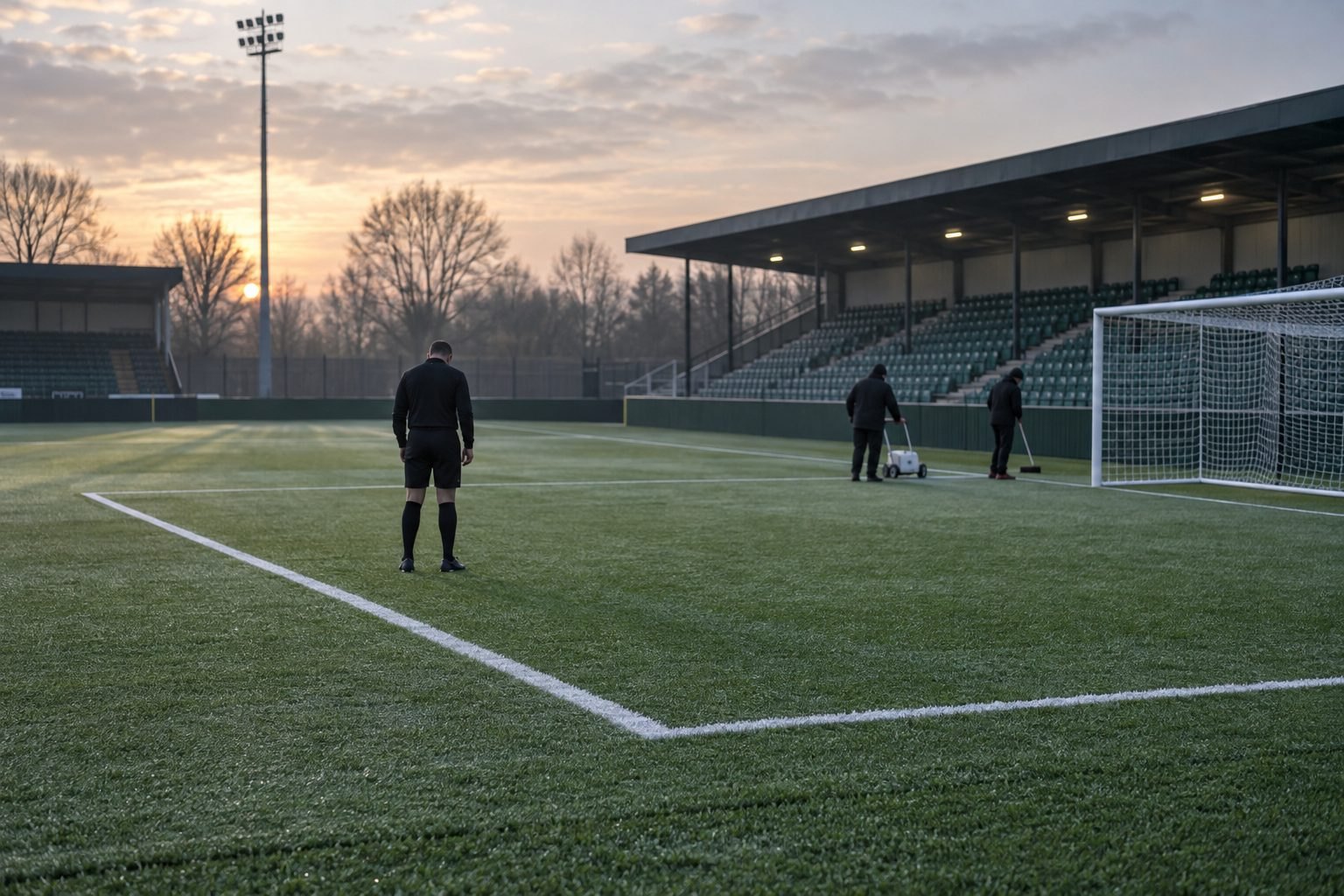
Yes. An FA Cup tie may be played on either a grass pitch or an artificial football turf pitch. In both cases the surface must meet the Laws of the Game and the competition rules, and an artificial pitch must meet extra certification conditions. The referee decides whether the pitch is fit for play.
Which surfaces are allowed in the FA Cup
An FA Cup tie must be played on a grass pitch or on an artificial football turf pitch. The surface type is permitted either way, but compliance is not optional: the pitch has to satisfy both the Laws of the Game and the competition rules.
The home club also has an active duty to protect the condition of its ground. It must take every precaution to keep the pitch fit for play, and if there is any doubt about the condition, it must notify the governing body immediately so that a match official can inspect it.
Who decides whether the pitch is playable
Unless a particular rule places the decision elsewhere, the referee determines whether the pitch is fit for play. The referee must report to the ground 90 minutes before kick-off, or earlier if the home club or the governing body requires it.
If an inspection is needed, it must be carried out either by the referee appointed to the tie or by another referee appointed by the governing body. Where it is that second referee, they must immediately give the governing body and the referee appointed to the tie the outcome and the details of the inspection.
What certification an artificial pitch needs
Here are the certification routes for an artificial football turf pitch.
| The tie involves | The pitch must hold |
|---|---|
| A Premier League or EFL club | A FIFA Quality Pro Certificate |
| No Premier League or EFL club | A FIFA Quality Certificate or IMS accreditation |
The certificate requirement changes with the clubs involved in the tie. The predecessor awards still count: a FIFA Recommended Two-Star Certificate satisfies the first route, and a FIFA Recommended One-Star Certificate or an equivalent IATS accreditation satisfies the second. In both cases, the same added conditions still apply: the pitch must conform to Law 1 of the Laws of the Game, and it must have satisfied the performance and construction requirements at its most recent annual assessment.
There is also a registration rule. An artificial football turf pitch must be on the governing body's register of such pitches by 31 July before the competition starts. If a pitch is not yet on that register, including a newly installed one, it can be used only if the club obtains the required award or accreditation and submits it at least seven days before the default date of the round.
Testing, failure, and the home club's duties to the away club
The governing body may instruct a club to undergo a pitch test at the club's own expense. It may also instruct the club to procure that whoever conducts the test gives the governing body a copy of their official report to FIFA as soon as the test is finished, and to provide any information needed to measure the pitch's performance.
If an artificial football turf pitch fails a pitch test, the governing body may order the tie to be played at an alternative venue. That is a discretionary step, not an automatic one.
When an artificial pitch is used, the home club owes the away club a set of practical protections. The away club must be allowed to train on that surface at no extra cost at least 60 minutes before kick-off. No other match or event may take place on the pitch between that training session and the tie. If the home club intends to water the pitch before the tie, that must be done before the training period begins.
A separate notice rule applies to footwear. At least five days before the tie, the home club must tell the away club about any limits or recommendations on the types of footwear that may be used on the artificial pitch.
FAQ
Are artificial pitches allowed in the FA Cup?
Yes. The competition permits a tie to be played on an artificial football turf pitch as well as on grass, provided the surface meets the required rules and conditions.
For an artificial pitch, that includes the right certification route, compliance with Law 1, and a satisfactory most recent annual assessment.
Can a tie be moved if the pitch fails a test?
Yes. If an artificial football turf pitch fails a pitch test, the governing body may order the tie to be played at an alternative venue.
The decision is the governing body's to take. A failed test does not move the tie by itself.
Do away teams get to train on an artificial pitch before the match?
Yes. If the tie is on an artificial pitch, the home club must let the away club train on it at no extra cost at least 60 minutes before kick-off.
That protection comes with related matchday conditions as well: no other match or event may be held on the pitch between the training session and the tie, and if the home club intends to water the pitch, that must be done before training starts.
What if the pitch is new and not yet on the register?
A new pitch is not barred just because it is new. It can be used if the club obtains the required award or accreditation and submits it at least seven days before the default date of the round.
That sits alongside the wider register rule, which requires an artificial football turf pitch to be on the governing body's register by 31 July before the competition starts.