
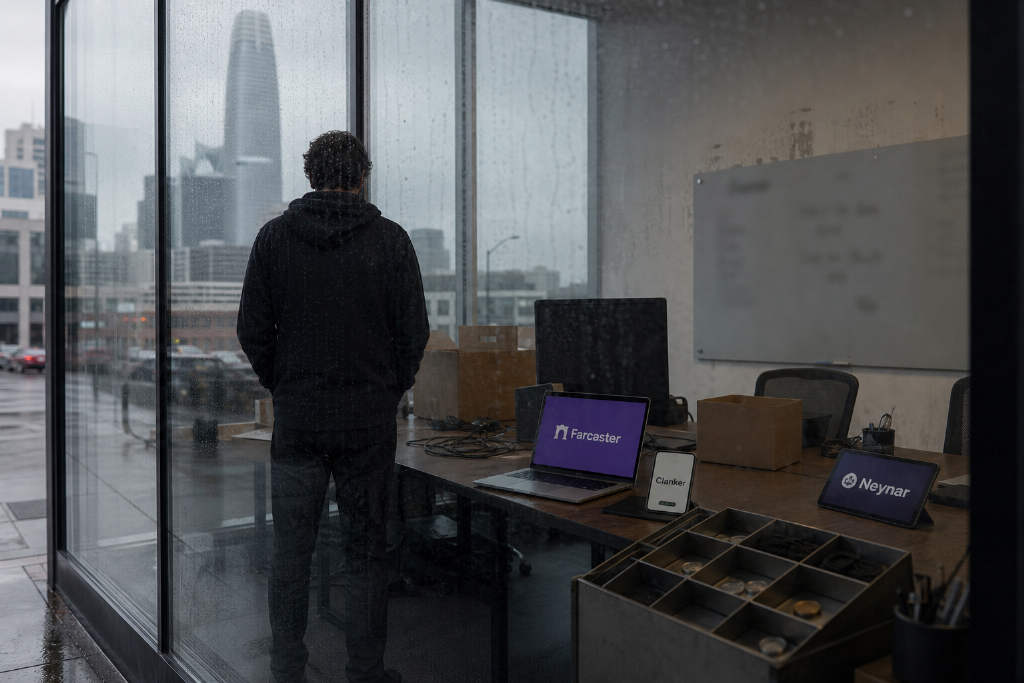
Farcaster is up for transfer again.

On Aug. 17, rish, co-founder of Farcaster operator Neynar, said the company is looking for a new team to take over the Farcaster protocol, its official app, and token-launch platform Clanker. He said Neynar will return its remaining funds, after which the team will be dissolved.
That announcement came just seven months after Neynar took control of the project from the founding team. That earlier handoff was already the first time Farcaster had effectively been sold.
The result is that the Web3 social project, once backed by Paradigm and Andreessen Horowitz, or a16z, and at one point valued at $1 billion, has entered a second search for a new home within a year.
The founders left first and returned $180 million to investors
On Jan. 21, Merkle Manufactory, Farcaster’s original builder, transferred the protocol contracts, codebase, official app, and Clanker to Neynar. At the same time, it returned the full $180 million it had raised to investors.
Founders Dan Romero and Varun Srinivasan then joined Tempo, a payments chain described in the source article as a project incubated by Stripe and Paradigm.
What Neynar took over was a broad operating stack. The company itself is a middleware provider focused on Farcaster developer tools and had raised $11 million in a Series A round in 2024. The article says Neynar saw two things when it stepped in: a developer-first social network and a token issuance machine still producing cash flow.
Seven months later, Neynar is now looking for an exit as well.
In his statement, rish wrote that the acquisition looked like a good decision at the start of the year, but conditions changed too much afterward, and Neynar was "no longer the right fit for the next phase." He also said he posted the notice early on Farcaster because, in his words, this time it should not feel so sudden.

Clanker cooled off and protocol fees fell with it
Among the assets Neynar inherited, the most valuable was Clanker, an AI bot that lets users launch tokens with one click. During the peak of the AI token issuance frenzy earlier this year, Clanker became the main revenue engine inside the Farcaster ecosystem. The article said it generated $35 million in on-chain token issuance service fees in a single quarter.
DefiLlama data cited in the report shows how fast activity later fell away. Farcaster ecosystem protocol fees came in at $35.43 million in the first quarter of 2026. In the second quarter, that dropped to $4.67 million. From July 1 to Aug. 17, the figure was $377,000. Over the past 24 hours, protocol fees were only $4,001.
From $35.43 million in a single quarter to about $4,000 in a day, the article described the decline as 99%. Since launch, Farcaster has generated a cumulative $94.10 million in fees.
At the same time, CLANKER token buybacks funded by those fees have stopped.
rish said cost was not the main factor
On the expense side, rish said it costs about $100,000 a month to keep the full-stack social network running, with the monthly burn having peaked at $500,000. Over the last 30 days, the ecosystem generated $120,000 in revenue, which he said was roughly enough to cover current monthly spending.
He also wrote on Farcaster that while operating costs are indeed high, they were not the reason behind Neynar’s decision. He said the numbers were shared because they could matter to any future team evaluating a takeover. According to him, Neynar’s balance sheet can absorb the current cost structure indefinitely.
He put the point more directly in another line: 「It's much harder to raise energy than capital.」
The harder question is product demand
The source article argues that Farcaster’s real problem may not be cost at all.

Once the market turned weaker, how much the project burned in a given month became less central because existing funds could still cover that expense. The more difficult question was why users would leave X and come to Farcaster in the first place.
Imran, co-founder of Alliance, gave a blunt assessment in the article. He said Farcaster was a useful infrastructure experiment, but a decentralized social graph alone was not enough to pull users away from X and Instagram.
He argued that the direction that makes more sense is social trading: a native product loop that combines new token discovery, speculative trading, and profit-and-loss reputation. In his view, that is the part platforms like X and Instagram cannot easily copy.
Seen from that angle, Farcaster’s strongest period was also the point when it looked least like a traditional social product. When Clanker was at its hottest, users came to launch tokens and trade them, not to socialize. Once the speculation faded, revenue dropped back, the social narrative resurfaced, and the project arrived at another transfer of control.
Megapot has publicly shown interest
Farcaster may still find a path forward.
The article notes that Megapot, an on-chain lottery project on Base, has already publicly expressed interest in taking over Farcaster under rish’s announcement. That suggests the former high-profile project is unlikely to disappear outright. If control and economic interests are reassigned, it may still try to pivot by using the products and brand assets it has already built.
The article closes by saying that as liquidity remains scarce, more small projects without clear demand may also be pushed into market clearing.
