
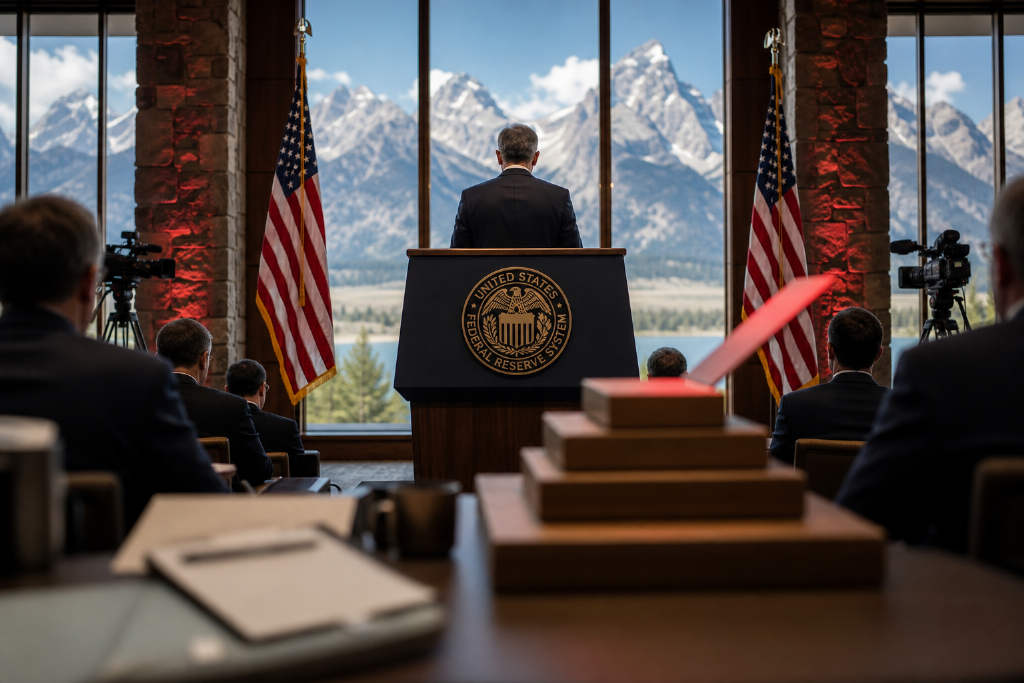
Federal Reserve Chair Christopher Waller’s debut at the Jackson Hole symposium on Friday was widely interpreted on Wall Street as a hawkish correction to the Fed’s communication after the July Federal Open Market Committee meeting.
In the speech, Waller made clear that the Fed’s 2% inflation target is not up for debate. He said overall financial conditions are difficult to describe as restrictive, and argued that recent improvements in Personal Consumption Expenditures and Consumer Price Index data are not enough to show a meaningful improvement in the underlying inflation trend. Waller also said the Fed still has work to do if policymakers cannot be confident that inflation is falling at a “clear and sufficiently fast” pace. Reuters said the remarks came as close as he has so far come to acknowledging that another rate hike may be needed.
The speech quickly changed the market’s focus for the September FOMC meeting. Priya Misra of JPMorgan Asset Management called it “a hawkish speech” and said Waller was forcefully restating the Fed’s commitment to price stability. She also described it as a clean-up act for what she viewed as a communication mistake during the July press conference. Aberdeen investment director Matthew Amis went a step farther, warning that if the Fed does not raise rates in September, its credibility could be hit again.
Barclays and Societe Generale both revised their Fed calls after Waller’s Jackson Hole remarks. Each now expects 25 basis-point rate increases in September and December. SocGen also expects another hike in March.
Wells Fargo, Fidelis Capital and others said the speech left enough room for near-term tightening, though some firms argued that Waller still did not lay out a clear policy path for September.
A hawkish reset of July communication
On Wall Street, one of the first conclusions was that Waller used Jackson Hole to repair the Fed’s message.
Misra’s assessment was blunt: “This is a hawkish speech.” She said Waller was making a strong statement that policymakers remain committed to price stability. More than that, she linked the speech directly to the Fed’s communication after the July FOMC meeting and called it a strong answer to what she saw as poor messaging at the July press conference.
She even framed it as a “clean-up act,” a phrase that captured the idea of a closing-stage correction to July’s communication.
Others echoed the same point. Natixis chief U.S. economist Christopher Hodge said the speech was a “clear improvement” over the July press conference. In his view, markets had previously underpriced the chance of another hike, and pricing now looked more reasonable. Hodge said Waller strengthened his anti-inflation credibility by directly acknowledging the inflation problem, restating the 2% target, and taking institutional responsibility for the Fed’s inflation stance.
Nationwide chief market strategist Mark Hackett said Waller achieved his objective by getting his message across without causing an obvious market disruption. Hackett said investors had been flirting with the idea that the 2% inflation target might be softening, and Waller made clear that was not the case.
Hackett summed it up this way: do not expect rate cuts soon, and prepare for more hikes.
Nick Timiraos highlighted two central points
Nick Timiraos, the reporter often nicknamed the “Fed whisperer,” zeroed in on the substance of Waller’s policy diagnosis.
He said Waller does not see overall financial conditions as restrictive, with credit and lending markets showing little sign of meaningful restraint. At the same time, recent good inflation data have not convinced him that the underlying trend has improved.
Waller put it plainly: “I find it hard to describe overall financial conditions as restrictive.”
On recent inflation prints, he said: “While this summer’s PCE and CPI data have come in better than expected, that does not lead me to conclude that the underlying trend has shown meaningful improvement.”
Timiraos highlighted that line in both his reporting and on social media. The implication, in his reading, was straightforward: markets cannot assume that a few better-than-expected inflation reports mean Waller has turned dovish. What matters to him is whether underlying inflation is moving toward 2% in a sustained way and at a fast enough pace.
A compass, not a GPS
Another defining feature of the speech was that Waller laid out policy principles but refused to give a precise reaction function.
SEI Investments chief investment officer Nathan Shetty said Waller’s clear restatement of the 2% PCE target made the speech unambiguously more hawkish.
Ellen Hazen, chief market strategist at F.L. Putnam Investment Management, took a different angle. She said Waller did not reveal the Fed’s reaction function, leaving markets in a black box.
Waller’s own explanation was that too much disclosure around the reaction function could end up constraining the Fed, much as heavy reliance on forward guidance did in 2021. Hazen said that suggests Waller wants to preserve flexibility as the economy changes, though investors may not welcome that approach.
Peter Andersen, founder of Andersen Capital, used a sharper metaphor: investors want a GPS, but the Fed is giving them a compass.
In his view, investors wanted Waller to explain the economic outlook and policy path in detail. Instead, Waller was telling markets that this Fed will not provide the same level of forward guidance seen under previous chairs, and markets will need to adapt to that new regime.
September is back at the center of the rate debate
For markets, the biggest shift was that a September rate increase moved from the edge of the discussion back into the center.
Amis said Waller’s speech created a crucial setup for the September meeting: “If they don’t hike, credibility takes another punch.”
That line tied Waller’s anti-inflation rhetoric directly to policy action. If he has already said that the Fed still has work to do unless underlying inflation falls quickly enough, then a decision to stay on hold in September, absent clear data improvement, could lead markets to question how much policy weight those hawkish remarks really carry.
Gary Schlossberg, global strategist at Wells Fargo Investment Institute, said Waller did not say it outright, but that if “you connect the dots,” the speech pointed to at least one more rate hike and possibly more than one. Schlossberg said that unless inflation falls clearly, which he does not expect, inflation pressure could even rise over the next six to eight months. Even if the Fed does not move in September, he still expects action relatively early before year-end.
Chris Gunster, head of fixed income at Fidelis Capital, said markets now see the odds of a September hike at above 50%. In his view, the factors Waller mentioned — inflation still above target, a solid labor market, and a resilient economy — together leave room for near-term tightening.
CME data showed the implied probability of a September hike rose from about 35% before the speech to about 50% afterward. Other market gauges at one point put the probability closer to 60%.
Barclays and SocGen revise their Fed forecasts
Barclays and Societe Generale now both expect the Fed to raise rates by 25 basis points in September and again in December.
That marks a clear change for Barclays. In mid-June, the bank’s forecast had been for rates to remain unchanged indefinitely.
After Waller spoke on Friday, Barclays chief U.S. economist Marc Giannoni and senior economist Jonathan Millar wrote in a note: “We expect the majority of FOMC members to align with Waller’s stance and raise rates by 25 basis points in September, because progress on inflation has not been sufficient.”
They also forecast “another 25 basis-point hike in December, bringing the federal funds target range to 4.00%-4.25%, because there is likely to be almost no year-over-year progress in inflation over the rest of this year.”
Societe Generale chief U.S. economist Jan Groen wrote that “persistent core inflation and increasingly explicit Fed concern over elevated inflation suggest the bar for staying on hold is rising.”
SocGen also expects another hike in March next year, though Groen added that a March move faces “considerable uncertainty” and may not happen.
Markets translated the diagnosis into trades
U.S. Treasury markets reacted quickly after the speech, with the front end moving the most.
Reuters reported that the 2-year Treasury yield rose as much as 11 basis points to 4.34%, the highest level in a month. The 10-year yield rose 5 basis points to 4.72%, while the 30-year yield increased by much less.
The move itself was a market interpretation of Waller’s message: traders were lifting their pricing for higher policy rates in the near term.
Michael Rosen said a fall in short-dated Treasuries and a rise in long-dated Treasuries reflected a market reassessment of the Fed’s direction. A Fed that sees inflation as the main problem, he argued, still leaves room for short-term rates to move higher.
Gunster also said the rise in short-end yields and the decline in long-end yields pointed to a flatter yield curve, in line with a market that is beginning to price in further Fed hikes.
Still, that response does not mean Wall Street has reached a consensus that a September hike is certain.
Not everyone thinks September action is settled
Peter Cardillo, chief market economist at Spartan Capital, said the Fed may choose not to act in September.
His argument was that Waller acknowledged some improvement in summer inflation data, even if it was still “not convincing enough,” and that the Fed may prefer to wait for September and October inflation reports before deciding.
Put differently, markets are repricing for a possible hike, but the data remain the final hurdle for whether the Fed actually moves in September.
Not every firm believes Waller’s speech fully repaired the Fed’s communication problem.
Eugene Epstein, head of trading and structured products at Moneycorp, said the initial reaction was hawkish, but the speech still lacked substance. His verdict was sharp: “Waller said a lot, but it didn’t seem to have much substance.”
Epstein said Waller had already delivered similar hawkish signals ahead of previous FOMC meetings, only for policy action not to follow. That leaves him concerned that markets could once again be pulled higher by hawkish rhetoric before discovering that no actual policy change is coming.
Jamie Cox, managing partner at Harris Financial Group, framed it this way: “Waller said a lot, but he also said nothing.”
In Cox’s view, Waller is trying to split the difference — rebuilding anti-inflation credibility without tying the Fed’s hands through forward guidance. That is where the compass-versus-GPS metaphor fits best. Waller is willing to tell markets what kind of data would make the Fed act, but not which meeting will deliver that action.
The real risk of no September hike is credibility
Taken together, Wall Street’s response suggests the most important part of Waller’s speech was not a promise of a September move. It was the rebuilding of a more hawkish policy logic.
That logic runs as follows: if the labor market remains solid, the economy remains resilient, and underlying inflation does not fall toward 2% fast enough, then financial conditions may not be restrictive, and the Fed cannot rule out further rate increases.
That is why Amis argued that skipping a September hike could hurt the Fed’s credibility again.
At the same time, Cardillo, Epstein and others offered a caution. Hawkish communication is not the same thing as a policy decision. Waller has stuck to a no-forward-guidance approach, has not explicitly endorsed a September hike, and has not supplied a mechanical reaction function.
The closest thing to a Wall Street consensus now appears to be this: Waller used Jackson Hole to deliver a hawkish correction to the Fed’s July messaging; the probability of a September hike has risen materially, but the final decision still depends on the next round of jobs and inflation data.
For Waller, the test has now become more direct. If the data fail to improve meaningfully, will he turn that hawkish diagnosis into an actual rate hike in September?