
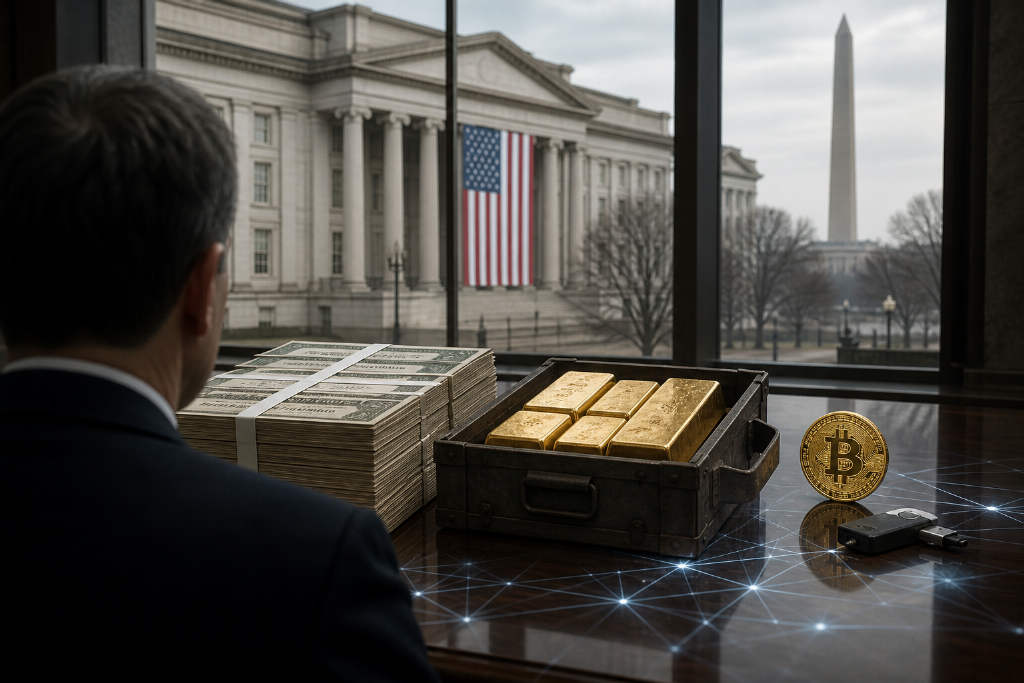
BlockBeats reported on Aug. 20 that Forbes published an article arguing Bitcoin could eventually take on a larger role as a neutral reserve asset within the global monetary system.
The article said earlier remarks by U.S. Vice President JD Vance on the dollar’s position as the world’s reserve currency had revived discussion around the long-running contradictions inside the dollar-based system. Forbes said the dollar’s reserve status gives the United States financing advantages, but also creates the Triffin dilemma, a problem in which one country’s currency struggles to meet both domestic economic needs and global reserve demand at the same time.
The strain inside the dollar reserve system
According to Forbes, the dollar’s reserve role drives global capital into the United States and lifts the value of the currency. That dynamic allows U.S. consumers to buy cheaper imported goods, but it also weakens the competitiveness of American manufacturing and worsens trade deficits.
The article also said that after the Bretton Woods system ended gold convertibility in 1971, the dollar-based order did not disappear. It continued to function through U.S. government debt and the global dollar market, while the central contradiction remained unresolved.
Stablecoins and gold each have limits
Forbes said stablecoins may expand the use of the dollar, but the structure behind them still depends on U.S. government debt. For that reason, they do not fully solve the problem of reserve assets being tied to the liabilities of a single country.
The article added that gold has non-sovereign qualities, yet still faces practical limits in transport, verification, and settlement efficiency.
Why Bitcoin is being discussed as a neutral reserve asset
Forbes argued that Bitcoin has a fixed supply, does not require backing from any state’s credit, can be verified globally, and supports digital, fast settlement. On that basis, it may emerge as a new form of neutral reserve asset.
The author wrote that the dollar could continue serving as the world’s transaction and commercial currency, while Bitcoin could gradually assume more of the reserve-asset role and reduce the global monetary system’s dependence on the debt of a single country.
Open questions remain
At the same time, Forbes said Bitcoin still faces several obstacles, including price volatility, limited institutional adoption, and an insufficiently mature custody system.
The article noted that gold has centuries of financial history, while Bitcoin is only 17 years old. Whether Bitcoin can ultimately become a global reserve asset will need more time to prove out.